New digital replica of the Titanic delves into the sinking’s secrets and corrects facts
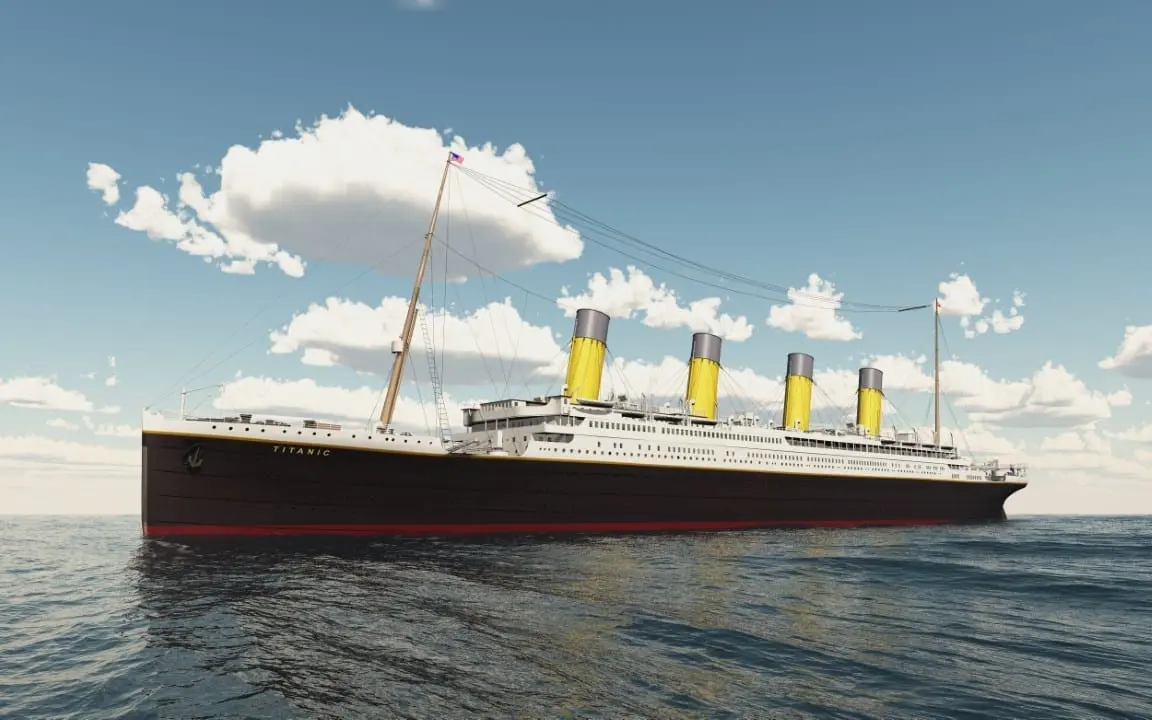
Detailed analyzes of the famous Titanic sinking have revealed unprecedented data and offered a new interpretation of the vessel’s final moments. The findings of these extensive studies were showcased in a recent National Geographic documentary, presented on April 11, 2025.
The discoveries are the central theme of “Titanic: The Digital Resurrection”, a production that offers a new vision of the catastrophe that occurred more than a century ago, placing the ship itself as the ultimate witness to the events.
On the same topic: 162-year-old beer bottles discovered in shipwreck and may be fit for consumption
Team makes detailed record of Titanic wreckage using advanced technology
With the aim of unlocking the secrets that lie in the marine abyss, two remote-controlled robots, named Romeo and Juliet, dedicated three weeks in 2022 to a depth of 3,810 meters. The task consisted of recording images and collecting data from the Titanic on the bed of the North Atlantic Ocean, representing the largest underwater scanning initiative ever carried out.
Learn more: American ghost ship found intact at record depth in California
The effort resulted in a massive 715,000 still images and many hours of 4K video, totaling terabytes of information. This data collection made it possible to create a full-scale, three-dimensional replica of the Titanic, with a degree of detail that gives researchers access to unprecedented details about the ship’s final moments.
The idea for the project came from Anthony Geffen, a filmmaker who has great admiration for the Titanic. His motivation came after frustration with the difficulty of clearly visualizing the ship during a submersible visit in 2019. The undertaking, developed in partnership with Magellan, a specialist in deep water mapping, required two years of investigation with the help of historians, engineers and experienced sailors. The documentary “Titanic: The Digital Resurrection” premiered on April 11, 2025.
Geffen stated that the fascination that the Titanic still arouses lies, in part, in the fact that the sinking occurred at a time of great luxurious travel, mixing opulence with tragic irony. He said that by developing an accurate digital replica of the wreckage, it is finally possible to understand a series of events from that pivotal night.
See Also

Chinese Horoscope 2026: Fire Horse influences and what to expect in each sign

Mercury retrograde cycles in 2026: understand the phases and prepare

Phases of the moon: complete guide to the lunar calendar from August to December 2026
More on this story: After 350 years submerged, 17th century ship with gold treasures is found by diver
Three-dimensional model explores the vessel at its rest on the ocean floor
The digital representation offers a perspective previously restricted to fiction or the mind, displaying the Titanic in its underwater resting place. The grand bow remains upright, almost intact by time, while the stern rests 792 meters away, forming a tangle of metal distorted by the violent collision with the ocean floor, which divided the ship in half. The scanning accuracy is so high that it allows detailed observation of personal items, including pocket watches, wallets, coins and combs, spread over a vast area of 39 square kilometers.
Digital record elucidates acts of heroism and innocence of crew members
One of the narratives clarified by the production is revealed by a steam valve. Testimony from survivors indicated that the lights remained on during the sinking, a point often doubted. This finding indicated that the operators continued to fill the boilers, even with the ship’s tragic outcome already visible. The discovery of an open steam valve located in the stern section after the collision reinforces the authenticity of this story of bravery. Opened, the valve allowed the generation of electricity from steam, which would have maintained lighting and facilitated the descent of lifeboats. It was proven that the chief engineer, Joseph Bell, and 35 other engineers, kept boiler room number two in operation until the last moment.
Another issue that the scans help shed light on involves First Officer William McMaster Murdoch, who was facing accusations that he deserted his post as the ship sank. The digital model, however, points to the opposite conclusion. The arrangement of the davit, a mechanism used to lower lifeboats, indicates that Murdoch remained on board, committed to preparing the launch of the lifeboat with his team before being swept away by a wave.
New simulation recreates the impact to decipher the cause of the sinking
An unprecedented simulation, developed as part of the study, investigates the most fundamental question regarding the Titanic: how could a ship considered sink-proof succumb? The digital recreation, which used the original blueprints of the vessel, its speed, direction and positioning, demonstrates that the Titanic only slid against the iceberg for an interval of just over six seconds. The damage generated, despite being small for the size of the ship, spread across a small portion of the hull and affected six compartments. If the collision had been faster and hit only four compartments, the vessel would have had a chance of surviving.
National Geographic declared that the digitization process “preserves the site of the Titanic’s sinking for future generations,” establishing a new chapter in underwater archaeology. Although it is an ambitious statement, the relevance of the project is undeniable, especially considering that the digital model will be used in future research and experiments with mixed reality glasses.