T. rex skeleton fetches record price of US$50.1 million at auction in New York
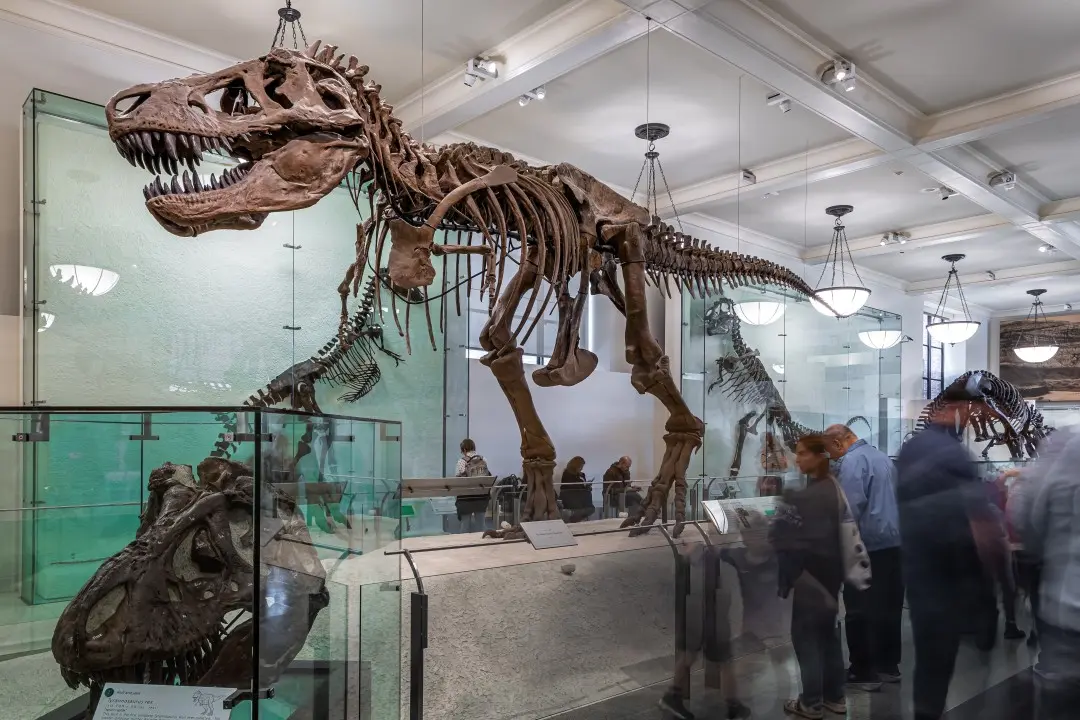
A Tyrannosaurus rex fossil, originally from South Dakota, was sold for historic value, becoming the most expensive dinosaur skeleton ever sold at auction. The specimen sold for US$50,130,000 at Sotheby’s in New York.
Estimated to be 67 million years old, the skeleton was named “Gus”, a tribute to Gary “Gus” Licking. Licking was a cattle rancher from Harding County, South Dakota, and owner of the land where the fossil was discovered. He passed away in 2022, a year after the excavation began.
T. rex Gus measures 11.6 meters long and 3.8 meters high, with a 1.37 meter skull. These proportions qualify it as one of the largest T. rex found to date, according to information from Sotheby’s. It contains 183 fossilized bone elements, which represents a completeness of approximately 61% in terms of bone quantity, or between 75% and 80% in terms of total mass.
On the same topic: Historic auction: T. rex fossil Gus sells for US$50.1 million by anonymous buyer
Gus’ excavation took place in three stages, from 2021 to 2023, followed by a three-year laboratory process to clean, treat and assemble the bones.
Like many other T. rex skeletons, Gus was discovered in the Hell Creek Formation, a geological region notorious for housing diverse fossils that stretches across Montana, Wyoming and the Dakotas. It was in this same area that one of the first T. rex skeletons was found in 1902, leading to the official naming of the species.
The previous record for a fossil at auction was Apex, a Stegosaurus, which was purchased in 2024 by billionaire Ken Griffin for $44.6 million. Apex is currently on loan at the New York Museum of Natural History, where it will remain for four years.
Before the auction, Sotheby’s estimated that Gus would sell for between 20 and 30 million dollars. The winning bid was placed by telephone, and the buyer’s identity remains anonymous.
More on this story: T. Rex Gus fossil auction reaches record price and raises alarm among scientists
See Also

Giants of the seas: the 11 biggest cruise ships of 2026 and the future of floating luxury

New Pop Mart collections stand out in 2026 and expand the universe of collectible toys

Zahi Hawass promises archaeological announcement in Egypt that will rewrite history
Consequences of private purchasing for scientific research
Paleontological scientists express concern about fossils that are acquired by private collectors, as this often makes them inaccessible for scientific study. Academic publications generally only accept research based on specimens that are in public collections. If a fossil is in private hands, replication of studies cannot be guaranteed, a crucial factor in validating scientific discoveries.
Gus presents notable characteristics that made him attractive both to the scientific community and to potential buyers. Its skull contains about 82% of its original bones, and the skeleton includes rarely found parts such as the wishbone, a complete pelvis, and both feet. Sotheby’s reported that only one other known specimen has two feet so well preserved. Additionally, Gus displays bite marks and evidence of fractures that the dinosaur managed to overcome during its lifetime.
Despite being considered one of the most complete T. rex skeletons by the auction house, Gus is less complete than other famous ones, such as Stan and Sue. Stan, a T. rex sold in 2020 for $31.8 million, has about 70% bone completeness. Sue, the first dinosaur to be auctioned in 1997, set a standard with its impressive 90% completeness.
An important feature of Gus is that he has “full rights”. This means that the fossil does not incorporate any parts of other dinosaurs that may be copyrighted. In many situations, when a bone is missing from a skeleton, it is common to acquire a mold of another specimen to fill the gap.
Learn more: T. rex auction at Sotheby’s raises debate about the future of science and valuable fossils
Historically, Stan serves as a reference for this process, coming from the same South Dakota county as Gus. With the acquisition of Gus and his full rights, the new owner may have the ability to compete with Stan in producing or licensing casts for museums and private collectors.
At this time, attention turns to the buyer, whose identity remains unknown, and what the next steps will be for the conservation and exhibition of the fossil.