

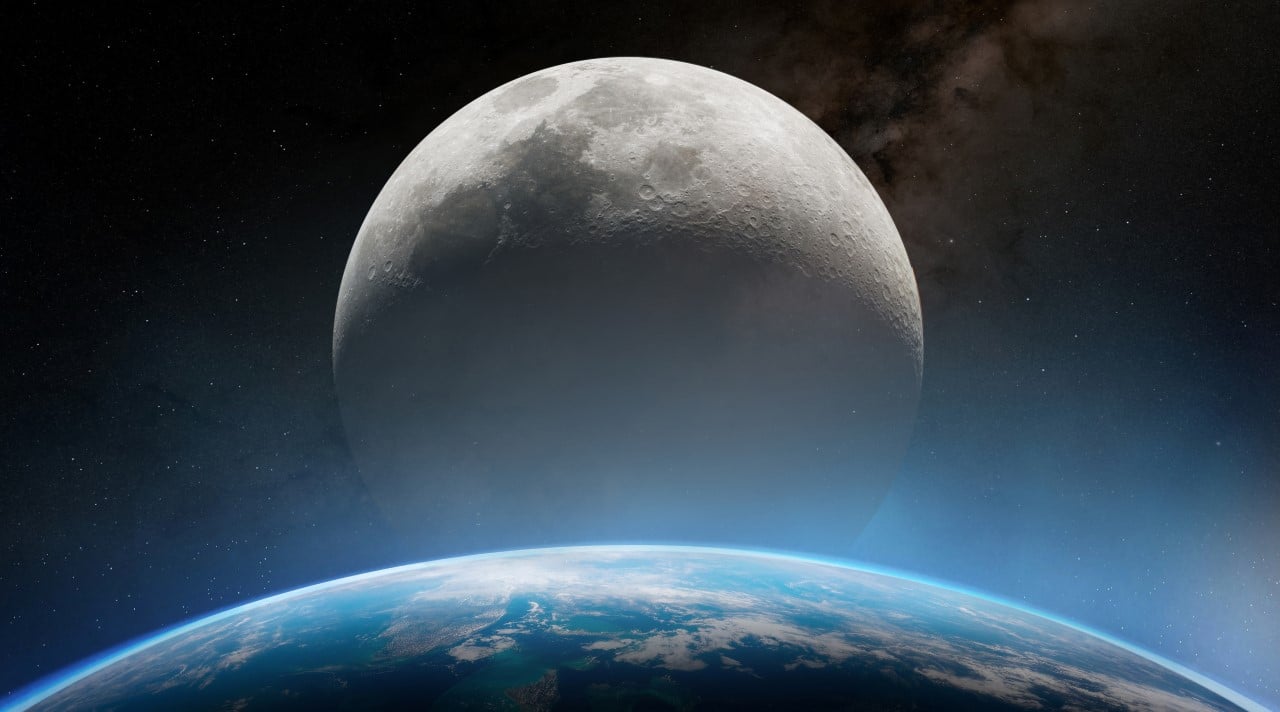
The Chinese space agency is preparing to launch the Change-7 mission, an ambitious project focused on the detailed exploration of the Moon’s south pole. The initiative, which is being planned to be sent into space, represents a crucial step in the country’s goals of establishing a long-term lunar presence and intensifies the race for resources on Earth’s natural satellite.
The Moon’s south pole has become a region of intense scientific and strategic interest. Several nations, including the United States, are directing their efforts to this area, driven by the expectation of finding significant deposits of water ice. The search for this vital resource is considered fundamental to sustaining future manned missions and possible lunar colonization.
What Change-7 is looking for in the South Pole region
The Change-7 mission’s main objective is to investigate the geology, topography and soil composition in the lunar south pole region. To achieve this, the spacecraft will carry a series of high-tech instruments, including an orbiter, a lander, a rover and a small relay satellite for communication. The rover will have the ability to explore permanently shadowed craters, where water ice is more likely to be preserved.
Onboard experiments will look for direct evidence of frozen water, as well as mapping its distribution and depth. The intention is not only to confirm the presence, but also to understand the quantity and accessibility of this resource. The information collected by Change-7 will be essential for planning future missions to extract and utilize resources in situ, a concept known as ISRU (In-Situ Resource Utilization).
The importance of water ice goes beyond simple hydration for astronauts. Water can be broken down into hydrogen and oxygen, crucial components for producing rocket propellant and generating breathable air. The ability to produce these elements directly on the Moon would drastically reduce the costs and complexity of space missions, making deep space exploration more viable. Without local resources, every gram of material would have to be brought from Earth, which is extremely expensive and logistically challenging.
The moon race and competition with the US Artemis program
The Change-7 mission is a vital component of China’s long-term space strategy, which envisions building an International Lunar Research Station (ILRS) in collaboration with Russia and other nations. This venture aims to establish a robotic and eventually manned base on the Moon. This plan aligns with the country’s growing ambition to become a leading space power, directly rivaling the efforts of the United States.
On the other side, the Artemis program, led by NASA, aims to return astronauts to the Moon, including the first woman and the first person of color, establishing a sustainable presence on the lunar surface and using the satellite as a springboard for future missions to Mars. Artemis also targets the Moon’s south pole, with missions planned to explore and search for water ice. The competition between the two programs is clear and creates a new phase in the space race.
The dynamics of rivalry between China and the United States in space have significant geopolitical implications. Mastery of space, especially the Moon, is seen as an indicator of technological and strategic superiority. The ability to control or access lunar resources could confer a substantial advantage in the future of space exploration and the space-based economy.
The two countries’ approaches, although similar in their focus on the South Pole, differ in their mission architecture and partnerships. While China seeks to consolidate a multi-nation international station, the US is leading the Artemis program with bilateral agreements, such as the Artemis Accords, which seek to establish principles for peaceful and collaborative space exploration, but with American leadership.
Technical, financial and political challenges continue to be obstacles for both powers. However, the determination to explore the Moon’s south pole and its valuable energy and water resources shows that humanity is entering a new chapter in space exploration. Missions like Change-7 and the Artemis program will shape the future of our presence beyond Earth, defining the direction of science, technology and geopolitics for decades to come.




