
End of the magnetic shield turned Mars into an arid and lifeless desert

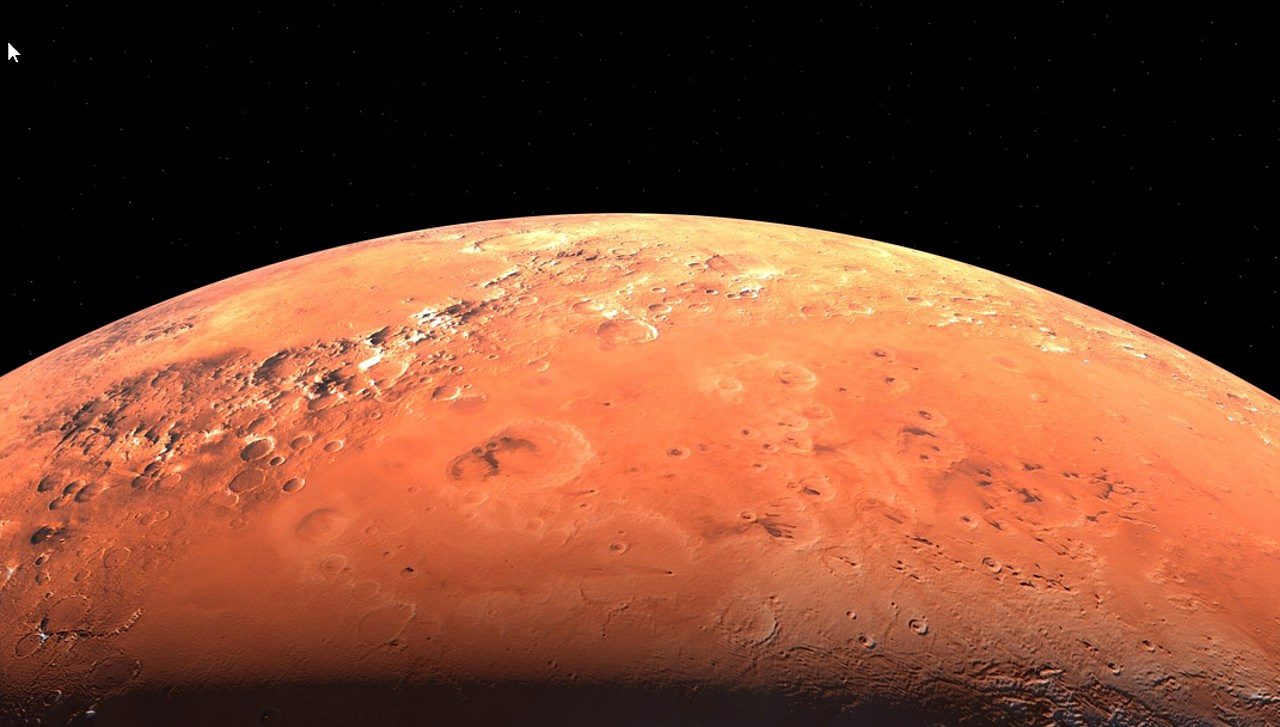
The bleak and icy landscape that defines the Red Planet today contrasts drastically with its promising past. The explanation for this radical change is linked to the existence of an ancient magnetic shield, similar to the one that protects the Earth from severe solar storms. When this invisible barrier lost strength and collapsed, the celestial body became vulnerable, resulting in the dissipation of its thick atmospheric layer and the evaporation of vast oceans, shaping the dry surface that telescopes capture today.
Geological marks reveal the magnetic past of the neighboring planet
The oldest rock formations in Martian territory hold indisputable evidence that the place already had a magnetic defense during its first million years. At elevations in the southern hemisphere, the crust presents a strong magnetization, functioning as a fossil archive generated when the magma cooled under the influence of a global field. This geological record proves that the interior of the planet was home to an active dynamo, characterized by a moving metallic core capable of generating this protective bubble.
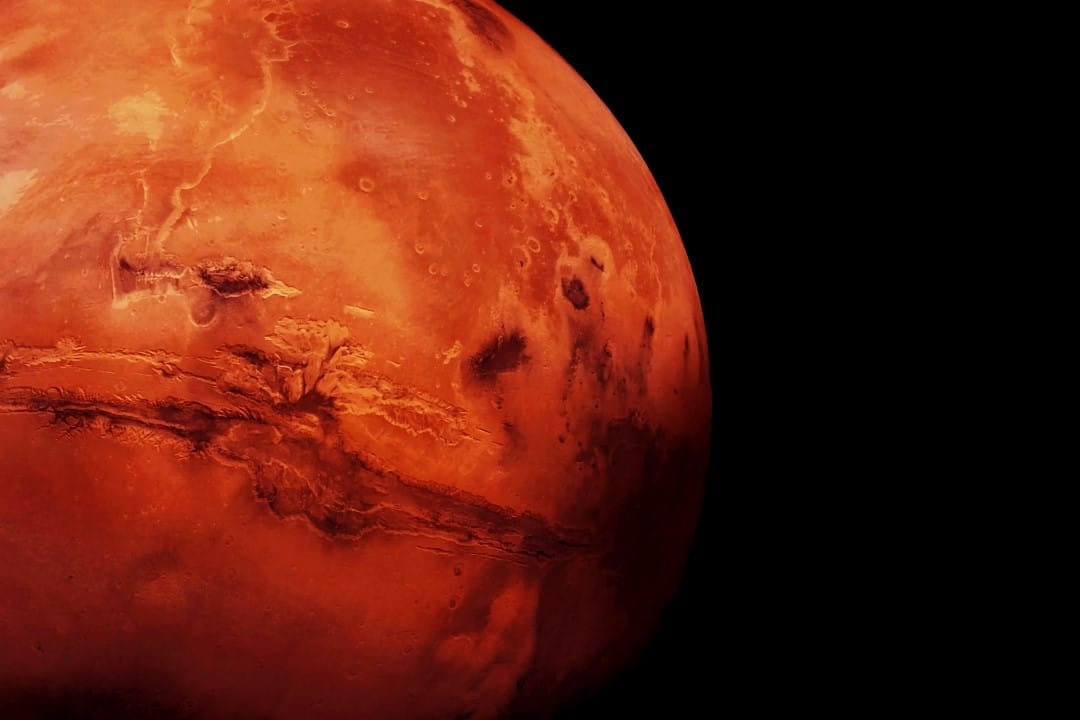
The process that turned off the natural defense against solar radiation
This early magnetosphere acted as a crucial shield, bouncing off harmful solar wind particles long before they reached the atmosphere. By investigating ancient impact craters to map areas that still retain magnetism, researchers concluded that the planet’s internal engine stopped working about four billion years ago. From that critical moment onwards, the barrier that surrounded the globe completely disappeared.
The shutdown of this internal mechanism occurred due to the progressive cooling of the planet’s core. Without the heat needed to keep liquid metals constantly moving, the generation of magnetic energy ceased. Consequently, the invisible boundary that separated atmospheric gases from the lethal flow of radiation emitted by the Sun ceased to exist.
Totally exposed, the upper Martian atmosphere began to be bombarded by solar particles, composed of protons and electrons at high speed, which swept their molecules into the vacuum of space in a continuous manner. While the Earth maintains its boiling core and its magnetosphere intact — ensuring the maintenance of the air we breathe — the neighboring world suffered an early structural failure that sealed its geological fate.
Data from the American space agency confirm the escape of gases
The theory of atmospheric degradation caused by our system’s star has gained proven status thanks to direct observations. Launched by NASA with the aim of measuring this gas leak, the MAVEN probe detected that the planet is still losing around one hundred grams of atmospheric material per second. The equipment’s records also indicate that this leak was hundreds of times more intense in the youth of the Solar System, a time when stellar activity was much more aggressive, validating the continuous erosion model.
A climate transition that lasted billions of years
Despite the devastating impact, the drying of the planet did not happen overnight. The evaporation of the seas and the loss of air formed an extremely slow process of wear, lasting hundreds of millions, or even billions, of years. When experts classify this transition as rapid, they are referring strictly to the geological time scale, since, for human perception, the change would be imperceptible over countless generations.
The end of the magnetosphere, however, is just one piece of this complex astronomical puzzle. Because it has a smaller mass than Earth, Mars’ reduced gravity considerably facilitated the dispersion of gases into the cosmos. The fate of the elements that formed the primordial environment was divided into different geological processes:
- Some of the water froze in the deep layers of the Martian subsurface.
- Another water fraction was absorbed by minerals present in the crust.
- Huge amounts of carbon dioxide ended up petrified and trapped in rock formations.
Core collapse acted as the main catalyst, but it operated in conjunction with these other physical dynamics to completely drain the planet of moisture.
The contrast between the habitable past and current reality
The duality between today’s scenario and past simulations arouses great interest in the scientific community. During its first millennia, the Martian environment was hot, humid and covered by a dense layer of clouds, boasting river basins, rushing rivers and long-lasting oceans. Conditions like these, observed in places like the ancient Jezero Crater, form the perfect setting for the emergence of living organisms.
Confirmation of the existence of extraterrestrial biology during this period still remains a mystery. Robotic vehicles have already identified complex organic compounds and mapped dry lake beds, but no definitive proof of microbial life has been demonstrated to date. With the thinning of the atmosphere and the sudden drop in temperatures, maintaining liquid water became impossible, freezing the globe in the arid configuration we study today.
Martian lessons applied in the search for exoplanets
The degradation trajectory of our cosmic neighbor functions as a natural laboratory for understanding the mechanics of the universe. The case highlights that the ability to harbor life directly depends on the health of the planetary core, proving that the death of an internal dynamo can transform an aquatic paradise into an inhospitable terrain. This parameter has become essential for astronomers searching for habitable worlds orbiting other stars, where the presence of a magnetic shield dictates the rules of atmospheric survival.
The future of space exploration now focuses on deciphering the details of this water-rich era. The Mars Sample Return mission, which plans to bring the samples currently collected by the Perseverance rover to Earth, promises to revolutionize our understanding of the mineral composition and exact fate of the planet’s water resources. Although the protective shield dissipated eons ago, the scars left by its absence remain preserved in the ground, ready to reveal the deepest secrets of the Solar System’s evolution.





