
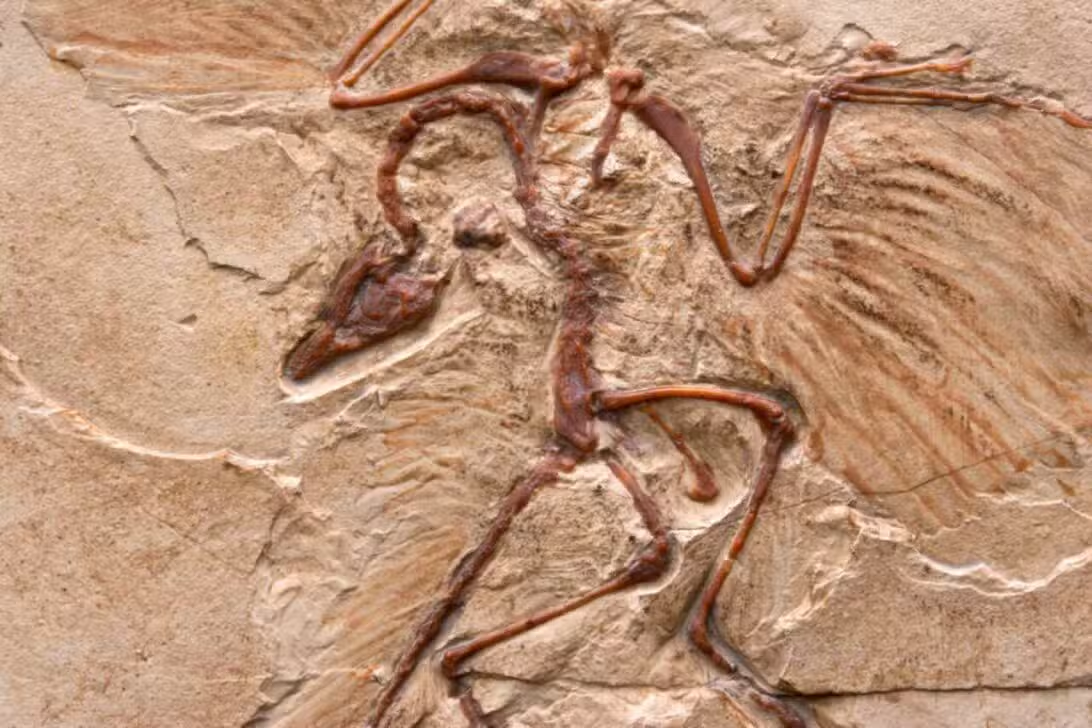
Understanding the origins of flight has just gained a new chapter with unprecedented discoveries about Archeopteryx, one of the most emblematic fossils in paleontology. Researchers identified that this ancestor of birds did not take to the skies with a single strong impulse, but depended on a sequence of small jumps coordinated with the legs to gain support. These complex takeoff dynamics profoundly alter previous perceptions about the aerodynamic capability of this transitional species.
Biomechanical simulations reveal the animal’s true flight mechanics
Inhabitant of the Jurassic period, around 150 million years ago, the animal had a peculiar anatomy that mixed feathered wings with a bone structure typical of terrestrial theropods. For decades, the scientific community debated the efficiency of its aerial locomotion, questioning whether it really flew or just glided. The finding that takeoff required multiple land jumps points to a gradual physical effort, ruling out the idea of an explosive launch into the air.
Advances in research were only possible thanks to the use of cutting-edge technologies that combined the morphological analysis of fossils with advanced computer modeling. The experts mapped the density of the bones of the legs and wings, crossing this data with estimates of body mass and air resistance. All this multidisciplinary effort generated a virtual model capable of reproducing the exact movements that the creature needed to perform to overcome gravity.
The role of the German fossil in understanding the bird family tree
Originally found in the famous limestone quarries of Solnhofen in Germany, this feathered dinosaur remains the main key to unlocking the transformation of reptiles into birds. The exceptional preservation of these skeletons allowed us to observe a unique combination of anatomical features that divide the two worlds. This biological duality transforms the specimen into a true fossilized evolutionary laboratory, presenting very specific traits.
- Presence of pointed teeth adapted for capturing small prey.
- A long bony tail that served as a counterweight during terrestrial locomotion.
- Sharp claws on the ends of the wings, a direct inheritance from their predatory ancestors.
- Highly developed asymmetrical feathers, essential for aerodynamic support.
The way flight emerged on Earth divides paleontologists between the cursorial model, where terrestrial animals ran and jumped to hunt, and the arboreal model, which advocates jumping from high branches. The new survey on the behavior of Archeopteryx considerably strengthens the terrestrial hypothesis. By demonstrating that the species needed to run with sequential jumps on the ground, scientists find robust evidence that the heavens were conquered from the ground.
Breaking paradigms regarding energy expenditure in the first takeoffs
Past theoretical models imagined that the Jurassic creature acted like modern birds, using a unique muscular contraction in its legs synchronized with the flapping of its wings. Another view believed that the animal depended exclusively on elevated places to play and glide passively. The introduction of the multiple jump theory shifts the focus to a much more continuous lifting process, requiring different motor coordination and energy expenditure distributed throughout the race.
Understanding this takeoff mechanic opens the door to reassessing the behavior of several other lineages of extinct animals. Early flight strategies may have followed similar patterns in giant winged reptiles, such as pterosaurs, or even in the first insects that developed wings. The study shows that nature tested multiple biomechanical approaches before reaching the flight efficiency that we observe in current fauna.
Next steps involve studying the Jurassic climate and atmosphere
The researchers’ work does not end with the discovery of takeoff, as the next challenge is to determine how long the species was able to remain in the air after leaving the ground. Future computer simulations will incorporate complex environmental variables, including atmospheric density 150 million years ago and wind patterns at the time. This ongoing investigation promises to further detail the survival routine of feathered dinosaurs and the beginnings of aerial locomotion.