

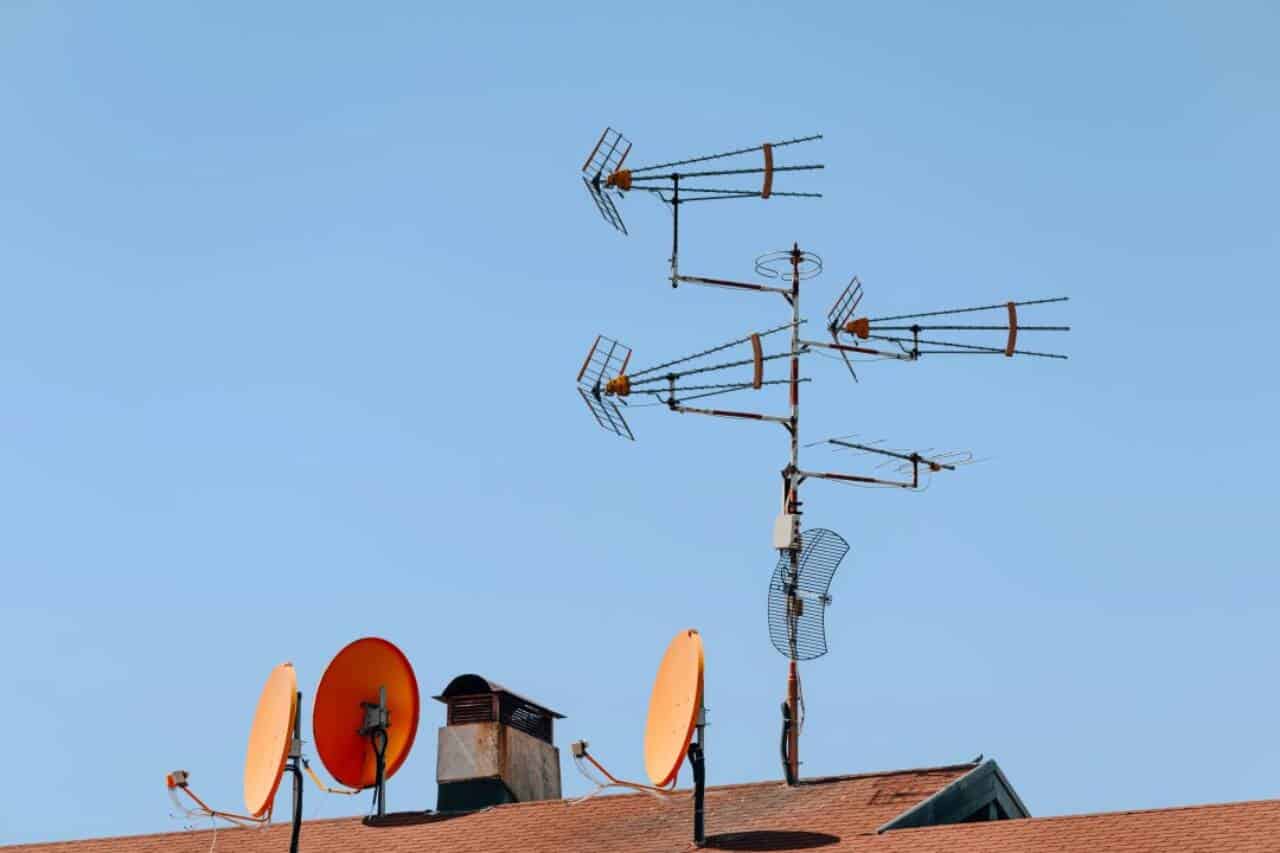
Many imagine that an old DirecTV or Dish satellite dish, installed on the roof, could pick up free-to-air television channels for free. However, connecting the coaxial cable from one of these antennas to your TV set will not result in tuning to local stations, such as ABC, CBS or NBC in the United States.
The reality is that for most people, especially in the United States, this compatibility does not exist. A satellite dish is designed to receive satellite transmissions, which come from space, while an open TV antenna (OTA) captures signals from terrestrial towers located much closer. Although both may be on the roof and use coaxial cables, the similarities end there, given the fundamental difference in their functionality.
Outside the United States, the scenario is a little different. In nations like the United Kingdom, free satellite television is a long-established concept, indicating that an old satellite dish fixed to a home may indeed have some use for this purpose.
The reason why your satellite dish does not receive terrestrial TV channels
A dish is equipped with a curved reflector that directs signals to the low-noise converter (LNB), located at the tip of the arm. In contrast, terrestrial antennas are designed to receive much lower frequencies, such as VHF and UHF, used by local TV stations. Simply attaching a conventional antenna to the satellite dish does not work as an intelligent solution, as the reflector concentrates the signals in a way that does not benefit the reception of an antenna made for terrestrial transmissions. The clear recommendation is to always use the appropriate equipment for the desired function.
However, the structure of the old installation does not need to be completely discarded or simply used as decoration. The satellite dish’s mast or attachment point can be adapted to receive an external TV antenna, as long as the position is favorable in relation to local broadcast towers. Furthermore, the existing coaxial cable can be reused, avoiding the need to run new wiring throughout the house. It is crucial, however, to remove any splitters, diplexers, or other satellite-specific components that may be connected to the cable.
Reception quality continues to be highly influenced by geographic location. Factors such as terrain, nearby buildings, trees and the height of the antenna have a direct impact on the digital TV signal. External antennas tend to offer superior reception, and some viewers may require a model capable of receiving both VHF and UHF channels.
Even a Smart TV cannot solve this issue by itself. Although many models have an integrated tuner to decode open TV, it is essential that an antenna provides the signal for this decoding to happen.
Free satellite TV: a more common reality outside the US
When crossing the Atlantic Ocean, the image of a satellite dish, which seemed obsolete, gains a new perspective of usefulness.
In the United Kingdom, for example, Freesat offers a satellite television and radio service with no monthly fees, offering more than one hundred channels. These programs can be accessed directly on Freesat compatible televisions, eliminating the need for an external decoder, but require a working satellite dish connected. Many existing installations, such as Sky Q and Sky+, can be reused, although the LNB (signal receiver) coupled to the dish can influence features such as simultaneous recording. It is important to note that Freesat does not guarantee the compatibility of all legacy satellite installations.
The United States isn’t entirely devoid of free satellite TV options, either. Lyngsat’s Galaxy 19 satellite, positioned at 97.0°W, broadcasts free-to-air programming primarily aimed at multicultural and religious audiences across North America. Current listings still indicate the availability of clear satellite channels. However, these channels do not represent an easy solution to cutting pay TV, as they require the appropriate satellite dish, LNB and receiver to capture them.
For the vast majority of Americans just looking to watch free broadcast TV programming, an OTA antenna still represents the simplest way to access local channels. Additionally, some content gaps can be filled by internet services, with free streaming platforms offering several options.




