
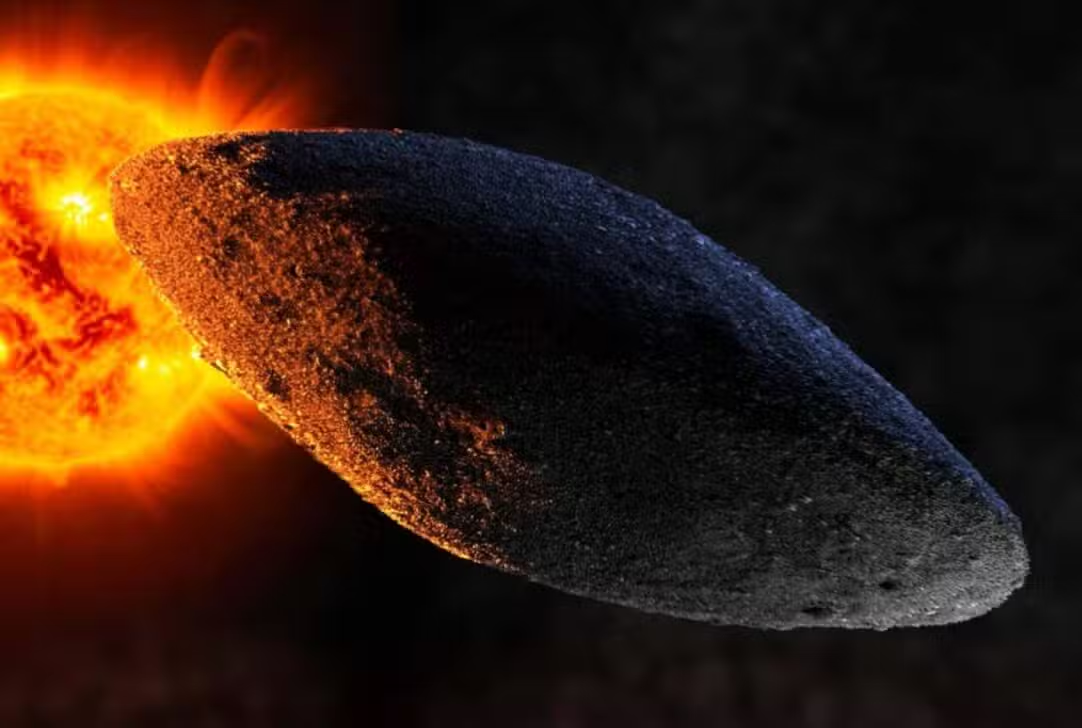
A new visitor from outside our cosmic neighborhood is tearing through space at an impressive 57 kilometers per second, equivalent to more than 205,000 km/h. The celestial body named 3I/Atlas describes a hyperbolic route, a type of geometric path that guarantees its direct passage without the gravitational force of our star being able to imprison it. Advanced observation equipment has already confirmed that the piece of rock and ice was born far beyond known borders, in a star system completely different from ours.
The identification of this galactic traveler happened recently, placing it in the select group of proven interstellar bodies, just behind the famous Oumuamua and Borisov. As its approaching speed is much higher than the limit necessary to escape solar attraction, the path will only suffer an abrupt deviation, functioning as a gravitational slingshot. Although the Sun’s field of influence can disturb objects in the Oort Cloud up to 3.8 light-years away, this magnetic and gravitational force is insufficient to slow down and capture 3I/Atlas.
- 3I/Atlas travel rate: 57 kilometers per second;
- Mark registered by the pioneer Oumuamua: 26 kilometers per second;
- Speed reached by comet Borisov: 33 kilometers per second.
Violent cosmic events expel rocks into deep space
Before wandering through the darkness of the universe, space fragments with the characteristics of 3I/Atlas peacefully orbited other stars billions of kilometers away. Eviction from their original homes often occurs due to chaotic gravitational interactions with gas giant planets or as a direct result of the explosion of massive stars at the end of their lives.
Once launched into the vacuum, these celestial bodies face lonely journeys that can last millions or even billions of years before they cross paths with planetary systems like ours. To attest to this alien nature, research centers use high-precision telescopes that map routes incompatible with any object born under the influence of the Sun.
Understand how the hyperbolic route works that prevents the capture of the comet
In celestial mechanics, a hyperbolic trajectory basically means that the object has such high kinetic energy that it exceeds the escape velocity of the environment at any point along the path. In practice, this means that 3I/Atlas will dive into our neighborhood, undergo a slight bend in its original direction and leave forever, without the slightest chance of establishing itself in a fixed orbit around the star.
The attraction exerted by the star king even manages to bend the visitor’s flight line, but fails miserably in the attempt to reduce its frantic pace to a capture level. Currently, several astronomy teams keep their instruments focused on the comet to record each stage of this dive before it returns to the immensity of outer space.
Mathematical calculations already indicate the exact date and the minimum distance that the rock will reach in relation to the Earth and the Sun, in a dynamic encounter that should only last a few weeks. To predict the exact behavior of the rock, scientists run simulations on supercomputers that show exactly how the gravitational slingshot effect will hurl the celestial body outward.
Crucial differences between distant visitor and local celestial bodies
When we analyze comets that were born in our own cosmic backyard, we notice that they reach a few tens of kilometers per second only at perihelion, the point of greatest proximity to the central star. Interstellar travelers, on the other hand, bring with them an absurd cruising speed, directly inherited from the violent dynamics of the galactic environment from which they came.
This abyss in dynamic behavior is the main signature that denounces the foreign origin of 3I/Atlas before the scientific community. In addition to speed, researchers apply spectroscopy techniques to break down the light reflected by the comet and discover exactly which chemical elements form its ice and dust core.
Anomalous behaviors recorded in passages of other alien bodies
The history of interstellar visits brings surprises, such as the case of Oumuamua in 2017, which showed a mysterious, non-gravitational acceleration as it went around the Sun. After years of debate, the most accepted explanation today is that the heating released pockets of hydrogen gas trapped inside the rock, functioning as a small natural propulsion engine.
This release of volatile material occurs because extreme thermal radiation boils the inside of the object, forcing the gas to escape through cracks in the surface. Although some conspiracy theories have suggested that the pioneer was an alien spacecraft, these alternative ideas lack any physical substantiation or concrete observational evidence.
Impact of solar gravity on the space traveler’s change of direction
The pass by our star will bend the trajectory of 3I/Atlas at an angle that has already been rigorously calculated by astrophysicists. To ensure that theory matches reality, large ground and space observatories are updating the comet’s orbital parameters in real time, refining predictions with each new image captured.
As the energy of movement of the rock is overwhelmingly greater than the force of attraction of our system, the clash ends with the victory of speed. Once it crosses the planetary boundary towards the outside, the ice fragment will resume its perpetual and silent movement through the interstellar void.
Chemical signature confirms that the object was born in another region of the galaxy
Preliminary investigations of the gas cloud surrounding the comet revealed known chemical ingredients, but mixed in proportions that do not exist in our neighborhood. This exotic chemical recipe works like an unquestionable fingerprint, definitively stamping the object’s passport as an authentic traveler from another star system.
Capturing these light spectra allows astronomy laboratories to place the composition of the intruder and that of local asteroids side by side. The data processed so far leaves no room for doubt and confirms that the celestial body has absolutely no relationship with the cloud of material that formed the Sun and the Earth.