
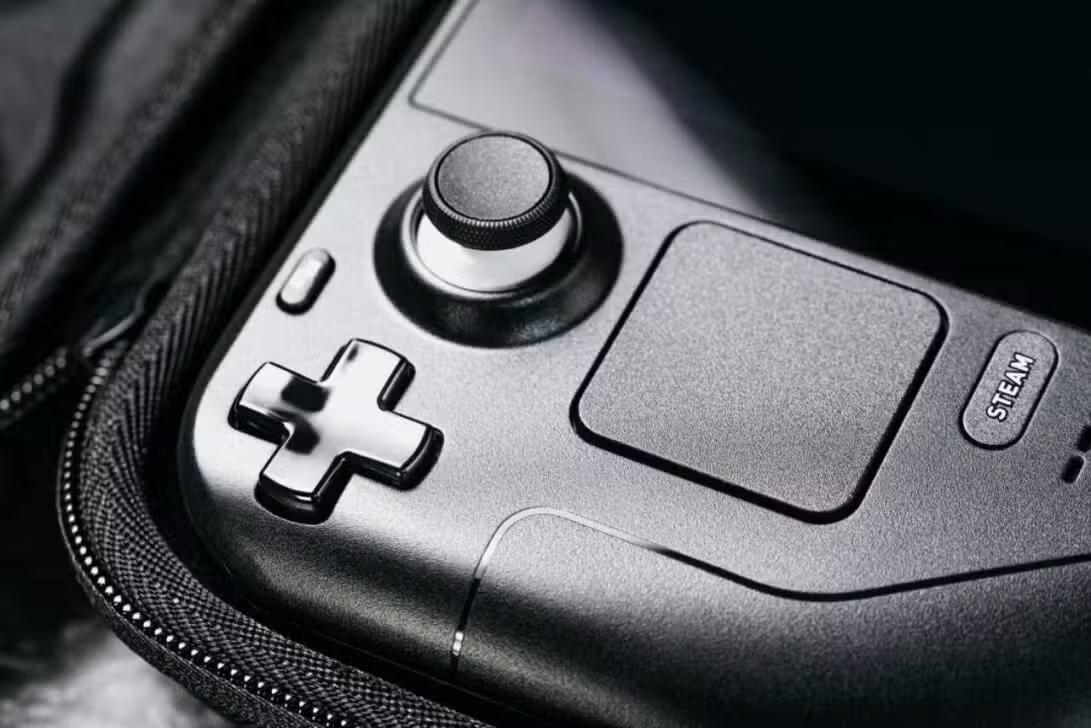
Digital gaming giant Valve has launched its latest hardware bet for 2026 on the market, updating the line of peripherals with a gamepad focused on extreme immersion. The equipment hits virtual shelves promising to revolutionize the way users interact with the platform’s vast library, bringing cutting-edge tactile response technologies. However, the accessory hides a technical peculiarity that directly affects those who prefer to play outside the brand’s ecosystem, generating heated debates in technology forums. To extract the full potential of the device and access its most advanced commands, the consumer is hostage to the installation and continuous execution of the company’s proprietary software.
Steam Deck design heritage shapes Valve’s new peripheral
The current project acts as a significant generational leap in relation to the company’s first attempt, originally launched more than a decade ago, in 2015. The manufacturer’s engineers took advantage of the enormous commercial success of the Steam Deck portable computer to refine the ergonomics, weight and arrangement of the buttons in this new desktop controller. This strategy of unifying the visual and functional identity of the hardware pleased both the brand’s veterans and gamers who are assembling their first computers aimed at high-performance entertainment. Initial analyzes from the gaming community highlight the ease of adaptation in complex genres, allowing you to command entire empires in deep strategy titles, such as Civilization V, or play intense matches in first-person shooters with surprising agility.

This move by the North American developer comes at a crucial time for the computer industry, where the search for comfort on the living room sofa strongly rivals the traditional keyboard and mouse combination. By investing millions in the development of its own peripheral, the corporation is trying to consolidate its absolute dominance in the distribution of digital games, creating an invisible barrier that encourages consumers to remain logged into its store. The accessory is not just a piece of plastic with integrated circuits, but rather a strategic tool for customer retention in a market that is increasingly contested by competing stores trying to grab shares of this lucrative sector.
Touch-sensitive surfaces and universal remapping transform gameplay
The product’s greatest technological difference lies in the maintenance and improvement of the haptic contact areas, an engineering signature from the manufacturer that few rival companies have managed to successfully replicate over the years. Strategically positioned under the user’s thumbs, these circular panels read pressure and movement with impressive fidelity, translating subtle gestures into fast, precise actions on the monitor screen. This surgical precision manages to simulate the behavior of a conventional mouse with extreme dexterity, breaking the historical barrier that prevented the full enjoyment of complex simulators and management games through traditional video game controls.
To make all this hardware engineering work perfectly, the company relies on the invisible power of its command translation tool, which works silently behind the scenes of the operating system. This remapping program, known as Steam Input, was born out of an urgent need to support the original peripheral, but has quickly evolved to become a compatibility bridge for virtually any joystick on the market today. Thanks to this technology distributed completely free of charge, computer owners can connect equipment from rival consoles, such as the coveted DualSense or the versatile Switch Pro Controller, and play without facing headaches with complex manual configurations.
Lack of industry standards creates barriers in alternative operating systems
The technological complexity of the accessory takes its toll immediately when the user tries to use it away from the protective umbrella of the official application. Unlike conventional joysticks that use universal communication protocols established decades ago, the 2026 launch adopts a human interface language completely customized by the manufacturer’s engineers. In daily practice, this means that smart televisions, living room multimedia centers and Apple computers cannot identify the product as a standard game controller when connected via USB cable or wireless connection.
When plugged into a Mac computer, for example, the Apple operating system sees the device only as a generic set of mouse and keyboard, completely ignoring the existence of sensitive triggers and analog levers. The frustrating scenario is repeated on machines equipped with Windows, requiring the player to use applications developed by third parties to mask the peripheral and make it pass as a virtual Xbox 360 controller. Without the presence of official software to translate proprietary signals in real time, advanced features like gyroscopic motion sensors and high-definition vibration are completely dormant and useless to the consumer.
Native integration with Linux and how hardware safe mode works
There is only one virtual environment where the equipment shines in a completely independent way, eliminating the need to previously open any game store or auxiliary program: the vast Linux ecosystem. The global open source community, working in direct partnership with the manufacturer’s own developers, embedded a specific driver directly into the central core of the operating system, ensuring immediate recognition of all control functions. This notable technical exception reinforces the company’s long-standing commitment to open platforms free from corporate constraints, something that had already been evident during the development of its own Linux-based operating system for portable devices.
In other commercial operating systems, the store application acts as an essential simultaneous translator to guarantee uninterrupted user fun. When launched, the program intercepts the raw signals sent by the hardware and creates complex virtual devices that games can understand perfectly, masterfully bypassing the chronic communication limitations of Windows and macOS. If the program is closed abruptly due to a failure, the accessory immediately enters a basic survival state, called lizard mode, allowing only the movement of the cursor and simple clicks, definitively proving that the real intelligence of the operation resides in the software, and not just in the control’s printed circuit boards.
Main technical differences between the new control and traditional models on the market
To understand the true impact of this launch on the current scenario of computer peripherals, it is strictly necessary to observe the engineering choices that move the product away from the standards established by major console manufacturers. The closed architecture adopted by the North American developer creates a unique and interconnected ecosystem, which presents undeniable advantages for users loyal to the platform, but imposes severe restrictions for those looking for cross-platform versatility in their entertainment routine.
- Unique communication: The device uses a custom human interface protocol, rejecting the XInput standard adopted by the overwhelming majority of the PC gaming industry.
- Software dependency: Tilt sensors, haptic vibration motors, and panel sensitivity zones require real-time processing by the store app.
- Fragmented recognition: Operating systems without proper drivers interpret hardware as conventional office peripherals, severely limiting gameplay.
- Open source advantage: Only Linux-based distributions have the native read key in the kernel, allowing full use without the need for intermediate programs running in the background.
The corporate decision to maintain an architecture so closely linked to the ecosystem itself clearly reflects the company’s business strategy for the current generation of hardware aimed at the gaming public. The equipment delivers unparalleled precision to the digital store’s vast library, definitively transforming the navigation and control experience in historically complex titles. Restricted operation outside of this strictly controlled environment highlights the hidden price of proprietary innovation, requiring the consumer to understand exactly the technical limitations before integrating the coveted device into their daily entertainment suite.