

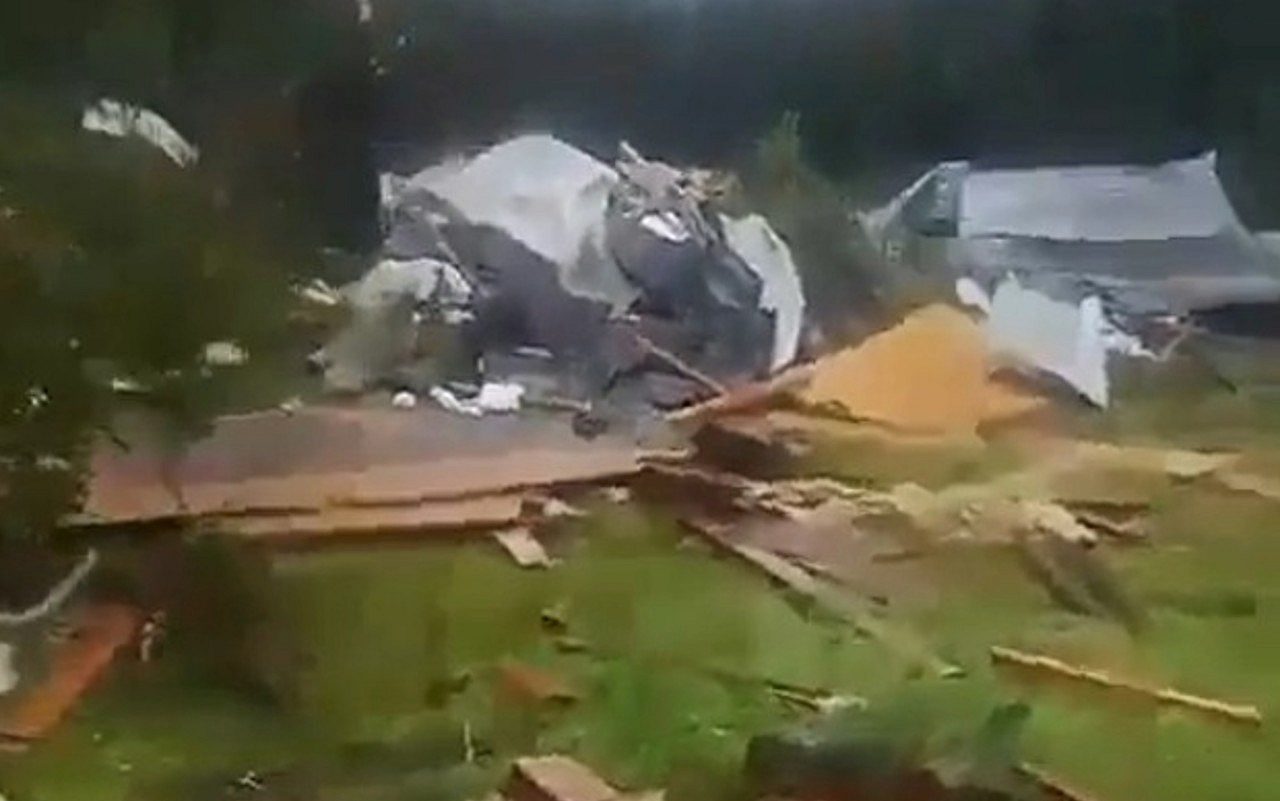
A tornado caused devastation in rural areas of Yungay, in the Ñuble region, south-central Chile, on July 28, leaving at least 30 homes damaged. The weather phenomenon was so intense that some homes were ripped from their foundations and moved several meters, making them irrecoverable.
Number of affected homes increases and families seek support
Chilean authorities confirmed the number of 30 impacted homes, with many of them seriously compromised. Initially, reports pointed to around eight houses, a number that quickly rose to 20 and ten destroyed, according to the regional governor of Ñuble, Óscar Crisóstomo, until it was finalized at 30 by the Undersecretary of the Interior, Máximo Pavez. This variation is common in rural events, where access is difficult and the full extent of the damage is only revealed in daylight.
Despite the magnitude of the material destruction, no injuries were reported. Families who lost their homes were relocated to relatives’ homes, as the National Disaster Prevention and Response Service (Senapred) did not activate official shelters.
Damage concentrated in rural regions and critical infrastructure
The strength of the tornado was mainly concentrated in the towns of Cholguán, Campanario and San Miguel de Itata, with additional reports in Ranchillo Bajo and Saltillo de Itata. The trajectory of the phenomenon was estimated from northwest to southeast, impacting several points.
In Cholguán, violent winds tore off the roof of the laboratory room at the Paneles Arauco Trupán plant. Poles and trees fell onto the roads, causing interruptions to the Frontel company’s electricity network. One resident, Alexis González, described finding only the raft, the concrete base, of his parents’ house, with furniture and walls scattered across the land.
Thousands of customers were left without electricity after the tornado hit
The interruption in electricity supply affected a total of 15,860 customers in three municipalities in the region, according to the released balance.
- Yungay: 11,212 customers
- El Carmen: 2,686 customers
- Pemuco: 1,962 customers
Teams from the Chilean Army and Senapred were mobilized after a communal Regional Emergency Operational Committee (Cogrid). Ñuble’s presidential delegate, Diego Sepúlveda, reported that teams are distributing essential materials to affected families. The region remains in Early Preventive Alert due to meteorological instability, and the Chilean Meteorological Directorate maintained a warning of adverse weather conditions for the following day.
F0/EF0 classification does not reflect the intensity of destruction in Yungay
The phenomenon was initially classified as F0 by the Chilean Meteorological Directorate, through meteorologist Claudia González. The General Directorate of Civil Aeronautics and Sepúlveda used the Enhanced Fujita (EF) scale, assigning a preliminary classification of EF0, which corresponds to winds between 105 and 137 km/h. Traditionally, the EF0 label suggests light damage, such as torn off shingles and fallen branches.
However, the reality in Yungay was much more severe, with entire homes lost and structures displaced. This discrepancy occurs because Chile does not have specific radars to monitor tornadoes, and the classification is based on the analysis of post-event damage, and not on real-time measurements. For this reason, the tornado category may be re-evaluated after further analysis in the field.
Ñuble region had already recorded another tornado recently
This is the second tornado to hit Ñuble in just over a month. On July 27, 2026, the commune of El Carmen was the scene of a tornado classified as EF1, which resulted in the destruction of warehouses, the death of livestock and one injury.
Óscar Crisóstomo, regional governor, compared the Yungay event to a frontal system that had occurred a month earlier. He explained that, this time, the impact was more geographically concentrated, but the destructive force in specific points was significantly greater, moving houses from their original locations. For residents of affected rural areas, the main change in practice is the challenge of reconstruction. Without the provision of official shelters, the responsibility falls on family members, while the wait for the recovery of electricity in the three communes and the final accounting of losses by the Ministry of Housing continues.




