

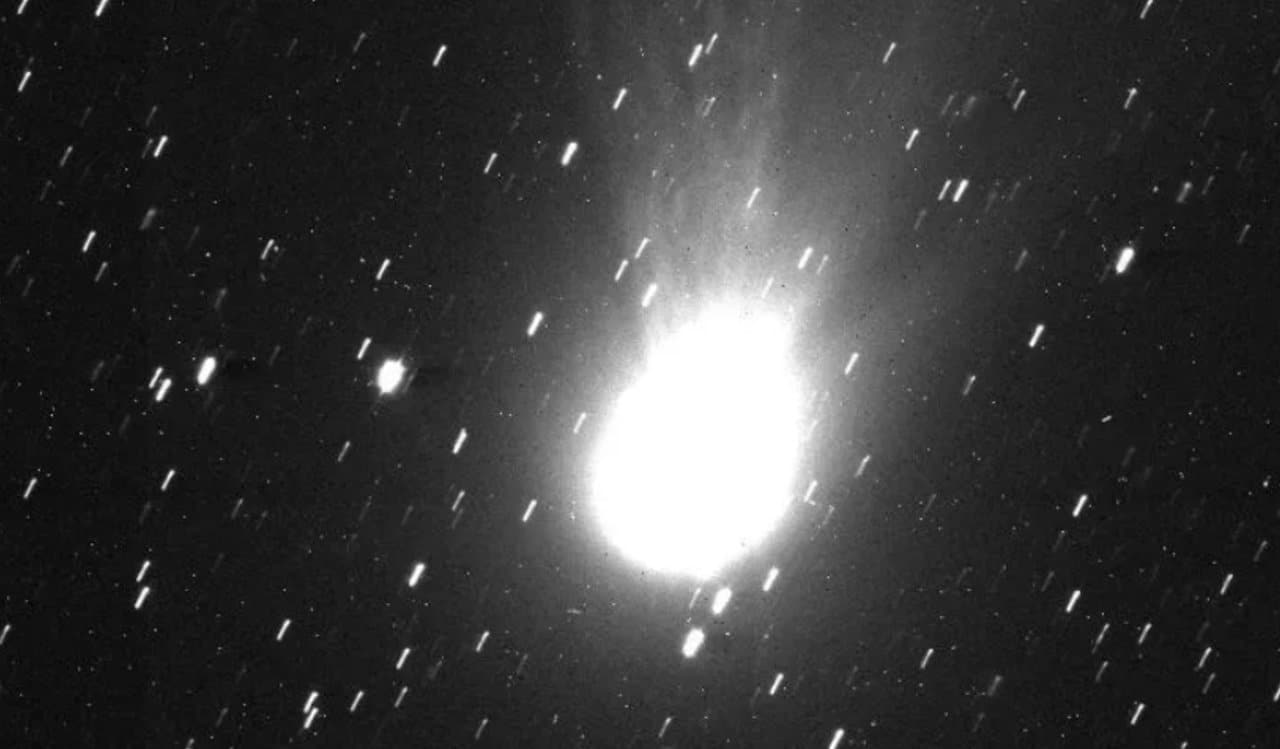
A recent cosmic passage through our planetary system has left the astronomical community in a state of alert and deep fascination. The celestial body officially named 3I/ATLAS crossed Earth’s neighborhood on October 29, 2025, revealing chemical characteristics that defy traditional models of star formation. Unlike the icy stars we usually observe in our neighborhood, this distant visitor presented an extraordinary concentration of heavy elements. The discovery raises new and complex questions about the diversity of planetary systems spread across the arms of the Milky Way.
Researchers identify unprecedented chemical anomaly in the composition of the cosmic visitor
Experts from Kyoto Sangyo University, located in Japan, joined forces with scientists from the University of Padua, in Italy, to decipher the light signature left by the star during its rapid passage. Using advanced equipment at the Asiago Observatory, the team meticulously mapped the visible and ultraviolet wavelengths emitted by the celestial body’s tail. Data processed by computers confirmed an extreme abundance of iron and nickel atoms floating in the tenuous atmosphere surrounding the rocky core.
In traditional astronomy, comets are often described as large “dirty snowballs”, composed mostly of ice, dust and gases frozen over billions of years. Finding vaporized heavy metals in this proportion is a phenomenon considered extremely rare, as it requires very high temperatures for these solid materials to transform into a gaseous state and be detected by telescopes. This peculiar detail suggests that the birthplace of 3I/ATLAS had completely different thermal and dynamic conditions than those that formed our well-known Oort cloud.
Japanese academics reported in their official documents that the detection of these levels of metallicity is something that no researcher in the field had ever imagined finding in a body of this category. The spectrometric reading works like nature’s barcode, and the lines indicating the presence of iron glowed with an intensity that forced scientists to revise their calculations several times before final publication.
History of detections shows how rare bodies from outside the solar system are
Space rocks classified as interstellar roam the galaxy without being bound by the gravitational pull of any specific star, traveling in darkness for untold millennia. To date, human science has managed to confirm the existence of only three specimens with this nomadic nature crossing our territory. Continuous monitoring of the night sky has proven key to identifying these speedy travelers before they disappear again into the deep darkness of outer space.
- The first historical record occurred in 2017 with the passage of 1I/Oumuamua, which intrigued the world with its elongated shape and anomalous acceleration that could not be explained solely by the natural release of gases.
- The second cataloged body was 2I/Borisov, found in 2019 by an amateur astronomer in the Crimea region, presenting chemical behavior much more similar to traditional comets that orbit our Sun.
- The third and most recent member of this select group is 3I/ATLAS, which is now gaining the spotlight of the global scientific community due to its extreme metallicity and completely unpredictable physical behavior.
The letter “I” present in the official nomenclature of all these objects serves precisely to attest to the interstellar origin confirmed by the International Astronomical Union. Each new detection helps to piece together a gigantic puzzle about the amount of matter ejected by other solar systems during their formation or destruction phases.
Hypotheses about alien technology gain traction among Harvard academics
The chemical uniqueness of the new comet was not the only factor that attracted the attention of major international observatories spread across the globe. During its closest approach, ground-based equipment detected radio emissions at very specific frequencies, as well as a brightness that oscillated in an unexpected way for a common rocky body. These physical anomalies were enough to reignite heated debates about the true nature of the flying object and its possible artificial origin.
Astrophysicist Avi Loeb, a renowned researcher at Harvard University, was one of the main names to publicly question the natural origin of the newly discovered phenomenon. Just as he did during the controversial passage of Oumuamua years ago, the scientist calculated that there was about a 40% probability that the star was, in fact, a technological artifact built by an advanced extraterrestrial civilization. This bold statement quickly made global headlines, dividing opinion in the halls of leading astrophysics universities.
Loeb’s theory is based on the premise that excess metals and radio signals could be indicative of an engineering structure, such as a malfunctioning exploration probe or a heat shield worn down by eons of space travel. Although the majority of the scientific community demands much more compelling evidence to support this idea, the debate serves to boost funding for new telescopes capable of tracking anomalies with greater precision.
Extreme speed and lack of communication reinforce the thesis of natural formation
Regardless of the exotic theories raised by academia, the space rock continues its solitary journey towards the ends of the universe at a pace considered mind-boggling by navigation standards. Driven by the gravitational slingshot effect generated by the Sun’s mass in a perfect parabolic trajectory, the celestial body reached a cruising speed of 68 kilometers per second. Even at the exact moment of its closest approach to Earth, the safety margin was immense, remaining at a distance equivalent to almost twice the space between our planet and the system’s central star.
The authors of the study conducted in Japan and Italy make a point of clarifying in the reports that the high concentration of iron and nickel does not mean, in any way, that the object is a massive metallic spacecraft. The immensity of the cosmos is home to violent processes of star formation, planetary collisions and supernova explosions that we still don’t know in detail, perfectly capable of forging rocky fragments with exotic chemical signatures.
As no pattern of intelligent communication or mathematical repetition has been detected in the radio waves captured by terrestrial antennas, the current scientific consensus establishes that we are facing a fascinating quirk of universal chemistry. 3I/ATLAS says goodbye to our field of vision, leaving behind a legacy of valuable data, proving that nature still has creation mechanisms that are much more complex than current theories could predict.




