Curiosity rover maps polygons on Mars while dealing with damaged wheel

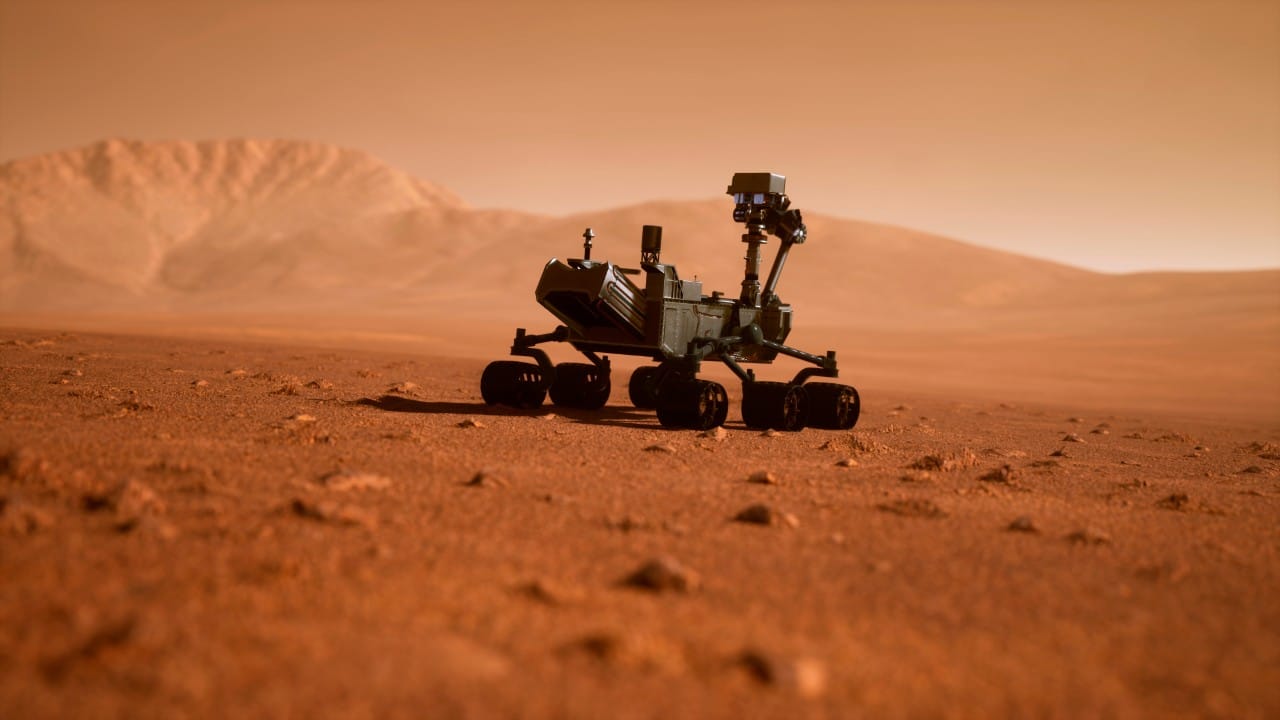
The Curiosity space exploration equipment, operated by the North American agency NASA, identified a wide expanse of geological formations that resemble beehives in the area known as Valle Grande, on the Red Planet. Despite the scientific enthusiasm generated by the find, photographic records captured by the robot on July 23, 2026 show significant damage to one of its traction components.
The journey to this discovery began when mission controllers directed the vehicle to a specific sector of the terrain. Orbital observations and previous images captured by the machinery itself suggested that this area had a lighter color and a relief apparently free of major obstacles.
As soon as the equipment reached the stipulated coordinates, the researchers responsible for navigation came across an atypical geological scenario. The soil displayed a complex geometric pattern, full of polygonal figures distributed across the crust that visually resemble the internal structure of bee nests.
Next to these natural drawings, the ground revealed a layer of small, dark-colored stones. As the atmosphere of the neighboring planet has an extremely low density and offers little resistance against the entry of space bolides, experts suspect that these fragments are debris ejected by ancient collisions and accumulated on the local dust.
Mission scientists published a report detailing that the exact origin of this rocky material remains under investigation. Current hypotheses suggest that the rocks may have slid from higher elevations, the result of impacts occurring far beyond the borders of Gale Crater, or even celestial bodies originating from other parts of the solar system.
Chemical assessments of dark samples previously found by the robot pointed to a high concentration of nickel, a metal abundant in meteorites but rare in the planet’s native geology. Researchers are now seeking to determine whether all the dark pebbles scattered throughout the region share this same extraterrestrial signature, requiring additional analysis of onboard instruments.
As the vehicle advanced along the slopes of the valley, geometric cracks in the ground continued to appear up to the limit of the horizon visible through the camera lenses. The technical team reported that, although the robot has already come across similar textures in the past, the colossal extension of this specific field represents an unprecedented record in the history of Martian exploration.
Ashwin Vasavada, the project’s principal investigator based at NASA’s Jet Propulsion Laboratory in California, expressed the visual impact of the discovery in an official document. The expert stated that the machinery has already transmitted images of incredible landscapes, but the vastness of this geometric pattern deeply impressed the entire team of geologists.
Telemetry data indicates that each geometric figure measures between 4 and 8 centimeters in diameter, dimensions that scientists are cross-referencing with chemical analyzes to understand the formation process. The pattern was repeated even on the slopes of a solitary 6-meter-high elevation, named “Miraflores” by the researchers.
The main line of investigation points out that these marks emerged from the drying out of ancient mud, indicating cycles of humidity and drought that reinforce the theory that the planet already had favorable conditions for microbial life in the past. Another studied possibility involves the thermal expansion and contraction of the crust, a mechanical process that expels residual moisture from sediments over millennia.
The counterpoint to this rich harvest of scientific data occurred during the hardware inspection routine. The robot uses its robotic arm to periodically photograph the chassis itself, ensuring that engineers on Earth monitor the physical wear and tear on the parts.
Photographs received on July 23, 2026 confirmed that the degradation of the aluminum in one of the wheels had reached a critical stage. The progression of holes and tears, however, remained within the projected tolerance margin when compared to records made in March of the same year.
The space agency did not issue orders for immediate repairs or halting scientific activities. Engineers have a catalog of contingency strategies ready to extend the life of the locomotion system and ensure that data collection continues without interruption.
The machinery preservation catalog has specific contingency tactics already in place during daily navigation:
- Mapping routes that avoid sharp rocks, prioritizing beds of fine sand for safe movement.
- Running an updated operating system in 2017, designed exclusively to mitigate mechanical wear and tear.
The traction control mechanism instantly processes terrain information to modulate the individual rotation of each axle. This basic artificial intelligence reduces impact force when metal comes into contact with hard surfaces, preserving cylinder integrity.
The programming code monitors variations in the suspension system to map exactly where each tire touches the ground. From this three-dimensional reading, the central computer calibrates the exact acceleration necessary to prevent skidding, maximizing grip on loose gravel.
Extreme engineering strategies to save robot mobility
If material fatigue exceeds the safety limit, flight controllers will activate a radical mechanical amputation protocol. The objective of this maneuver is to force the internal section of the torn wheel to completely detach, eliminating dead weight and the risk of axle locking.
Mission technical documents explain that the original design of the landing gear provided for the gradual destruction of aluminum during crossing hostile terrain. A single wheel has the structural capacity to withstand massive punctures before the vehicle’s ability to move suffers any real limitations.
Simulations carried out at the space agency’s test field using the Scarecrow prototype proved the project’s resilience. The tests demonstrated that the machinery can navigate perfectly supported only by the remaining rim, even after the total loss of traction locks, as long as the loose fragments are ejected from the system.
Traction cleats, technically known as grousers, are the zigzag blades that grip the soil. The imminent danger lies in the possibility of these parts breaking and bending inward, creating sharp edges that could tear the power cables that power the electric motors built into the axles.
To neutralize this electrical threat, engineers plan to use the Martian topography itself as a cutting tool. The strategy involves finding a specific rock formation that serves as a natural lever to rip out the compromised metal sheet.
The tests on Earth validated two extrication maneuvers, called twisting and directional tilt movements by the technicians. The procedure requires the robot pilot to hook the torn part to a solid rock and apply maximum torque to the intact motors, tearing the aluminum until the defective part falls to the ground.
The operations team remains optimistic that these drastic measures will remain just theory in contingency manuals. Having a tested emergency plan offers security for the mission to continue with its research schedule, expanding the scientific legacy of equipment that has been mapping the neighboring planet for 14 years.