

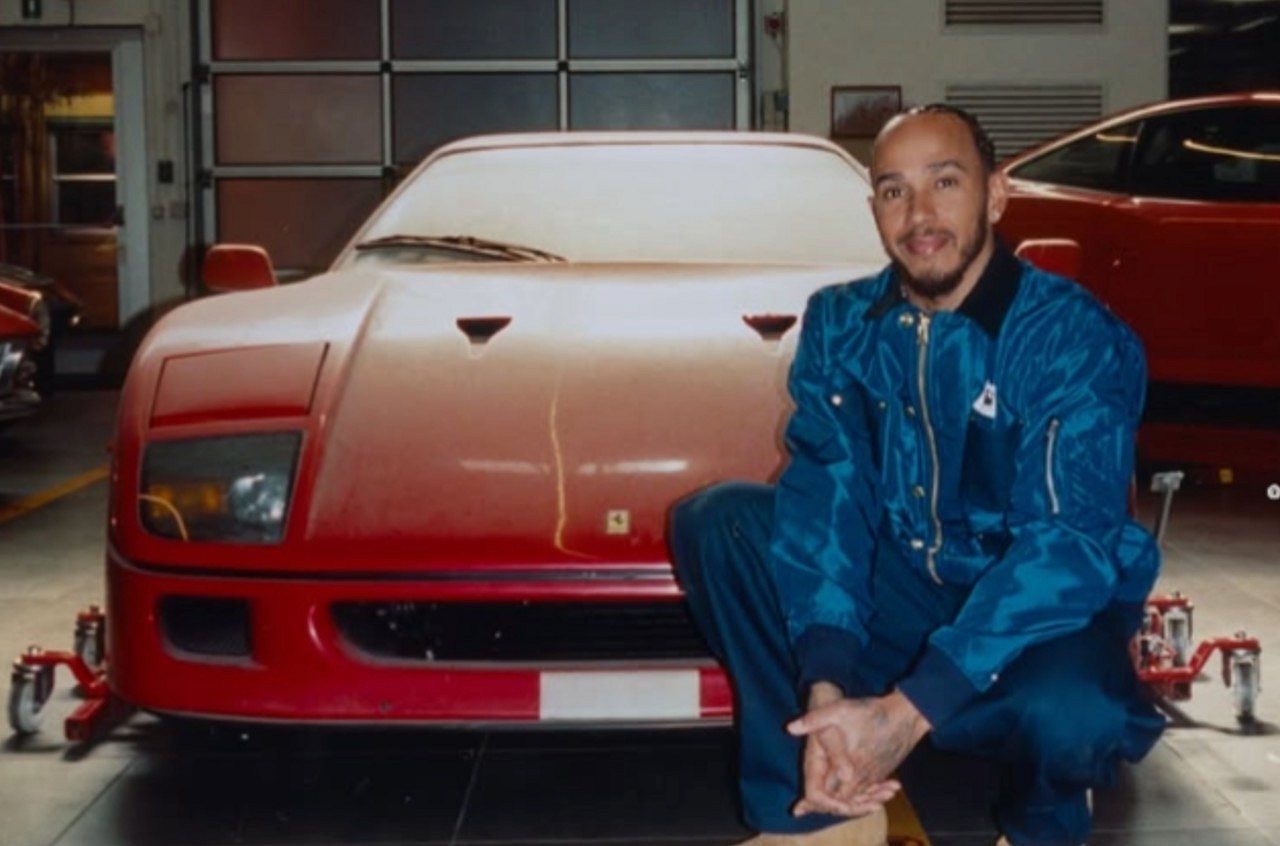
Lewis Hamilton, seven-time Formula 1 champion, surprised by announcing the acquisition and restoration of a Ferrari F40, a model that was found in a state of abandonment. The British driver sent the vehicle to Maranello, Italy, to complete the recovery process, demonstrating a personal interest in one of the greatest icons in automotive history, in contrast to his renowned career at Mercedes.
The racer himself described the car as “my dream vehicle for as long as I can remember.” The Ferrari F40 is widely recognized as one of the most revered and iconic automobiles in the history of the global automotive industry, captivating enthusiasts with its performance and striking design.
Discovering the iconic Ferrari F40 and its creation in 1987
Launched in 1987 to celebrate the Italian automaker’s 40th anniversary, the two-seater sedan was developed based on the experience accumulated with the 288 GTO and, mainly, with the 288 GTO Evoluzione project, initially designed for Group B competitions.
The model is notable for being the last street car created under the direct supervision of Enzo Ferrari, who passed away the following year, in 1988. The main proposal was to offer a vehicle approved for urban use with racing car characteristics, prioritizing reduced weight, high performance and little interference from electronic systems.
The F40 is equipped with a 2,936 cm³ V8 engine, positioned in the central rear part of the chassis and complemented by two IHI turbochargers. This package delivers a power of 478 horsepower at 7,000 rpm and a maximum torque of 577 Nm at 4,000 rpm, working in conjunction with a five-speed manual transmission and rear-wheel drive.
Reducing weight was a crucial aspect in the vehicle’s design. The Ferrari F40’s structure combines steel tubes with reinforcements made from composite materials, while the body employs fiberglass, Kevlar and other substances designed to reduce overall mass. The final weight approaches 1,100 kg, depending on the reference and configuration.
Aerodynamics also received special attention. The body design was created by Pininfarina and underwent extensive wind tunnel testing. The result was a drag coefficient of around 0.34, with the large rear spoiler, air intakes and transparent bonnet contributing to stability and engine cooling.
The weight reduction philosophy extended to the interior of the vehicle. The F40 did not have a sound system, carpets or most of the coverings found in conventional cars. The first versions featured side windows with a specific solution, while later units adopted crank-operated windows. The car also dispensed with power steering and ABS brakes, establishing a direct and challenging connection between the driver, the gearbox, the accelerator and the dynamic behavior.
The expansion of production of the Ferrari F40 model
Initially, Ferrari had plans to manufacture just 400 units of the F40. However, due to high demand, the automaker expanded the production program several times. In the end, just over 1,300 units were built, varying slightly depending on the source and counting criteria.
Production of the F40 ended in the early 1990s, being succeeded by the F50. Even so, the Ferrari F40 remains an icon of a particular phase of the automotive industry, symbolizing a period when composite materials, turbo engines and track-derived innovations could be integrated into a road car without the vast array of electronic systems that would become standard in the following decades.




