
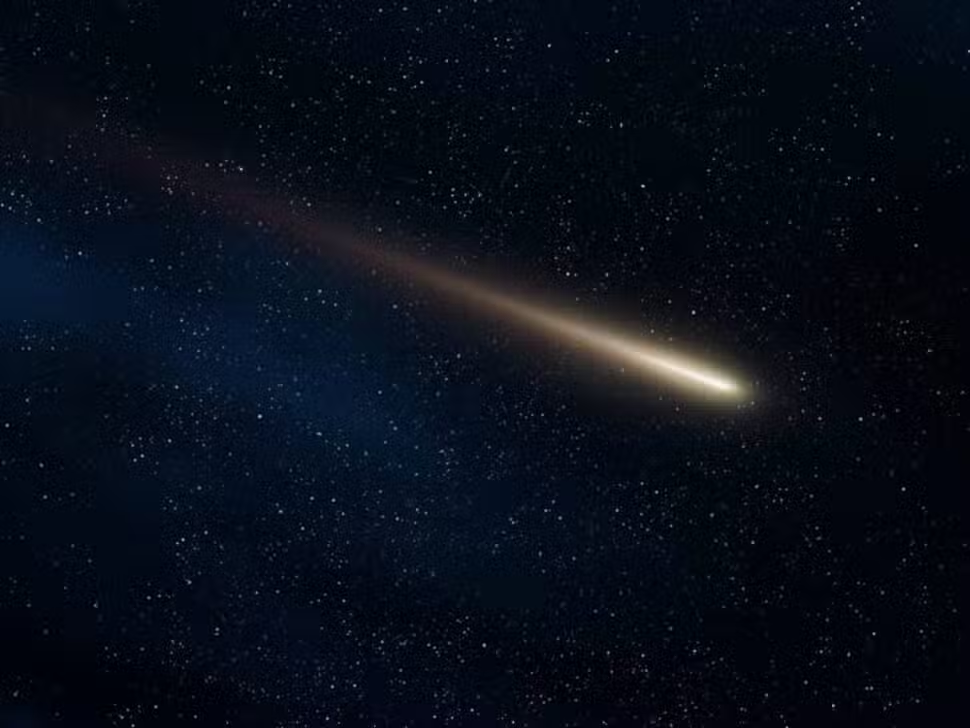
Astronomers responsible for monitoring deep space have confirmed that comet 3I/ATLAS, initially identified in July 2025 by equipment installed in Chile, travels through space at an impressive speed of 57 kilometers per second. The hyperbolic tracing of its orbit definitively proves that the celestial body was ejected from another stellar neighborhood, becoming the third interstellar visitor cataloged by science, right after the historic passages of Oumuamua and Borisov. The discovery consolidates the thesis that our system is frequently crossed by galactic travelers, transforming what was previously considered a rare anomaly into a continuous and predictable field of study. The object reached its closest point to the Sun on October 29 and, due to its accelerated pace, will not be captured by solar gravity. Cutting-edge instruments, such as the Hubble and James Webb space telescopes, recorded a very active cloud of dust and gas around the nucleus, ruling out any type of risk to our planet.
The extreme speed of the celestial body prevents it from adopting a closed elliptical orbit, presenting an eccentricity greater than 6, an index much higher than that recorded in its predecessors. Mathematical projections indicate that the closest approach to Earth will occur in December 2025, when the comet will pass at a safe distance of 1.8 astronomical units. For contextualization purposes, this measurement is equivalent to almost double the average distance between our planet and the Sun, which represents around 270 million kilometers of absolute separation, guaranteeing an astronomical spectacle without any possibility of impact.
https://twitter.com/3IAtlas_Anomaly/status/1983314548456395095?ref_src=twsrc%5Etfw
Behind the scenes of initial detection by ground equipment
The ATLAS telescope, located in Chilean territory, recorded the object for the first time on July 1, 2025, when it was still sailing 4.5 astronomical units from the central star of our system. The first analyzes of the captured images already indicated a movement too fast for a local asteroid or comet, raising immediate suspicions about the absence of a gravitational connection with the Sun.
The officialization of its extrasolar nature took place on July 2, through the Minor Planets Center. The 3I nomenclature was assigned to reflect its position as the third confirmed external visitor in the history of astronomy. Shortly afterwards, observatories located in Chile, the state of Arizona and the Hawaiian archipelago were able to detail the visitor’s structure, identifying a well-defined coma at the edges and a tail that extended for 3 seconds of arc in the instruments’ field of view.
Information retrieved from previous databases, dated June of the same year, allowed scientists to expand the trajectory tracking. This previous data was fundamental to complete the calculations and confirm, without any doubt, the hyperbolic curve that the comet describes in space.
Orbital dynamics and the deep space speed record
The mark of 57 kilometers per second sets a new standard for interstellar objects, easily surpassing the 26 kilometers per second recorded by Oumuamua and the 32 kilometers per second of comet Borisov. This metric, calculated as speed at infinity, attests that the celestial body suffered a violent ejection from its star of origin billions of years ago, wandering in the cosmic vacuum ever since.
The hyperbolic trace presents a tilt of 175 degrees in a retrograde motion, which suggests that the comet underwent complex gravitational interactions in the galactic environment before arriving here. The perihelion, the moment of greatest proximity to our star, occurred at a distance of 1.36 astronomical units, positioning the object exactly in the intermediate region between the orbits of Earth and Mars.
- Orbital eccentricity calculated at approximately 6.14, the highest rate ever documented in modern astronomy;
- Maximum approach to our planet projected to reach 1.8 astronomical units in December 2025;
- Escape route directed towards the constellation Virgo, marking its definitive return to deep interstellar space.
Advanced computer simulations demonstrate that the Sun acts only as a gravitational slingshot in this scenario. The strength of our star can slightly alter the comet’s exit route, but it is insufficient to stop the object or keep it trapped in our planetary system.
Chemical analysis reveals ancient elements of the Milky Way
Spectroscopic scrutiny showed the presence of materials common to local comets, but distributed in completely different proportions. One of the most intriguing findings was the detection of nickel gas in very cold regions far from the Sun, an unusual behavior. In August 2025, the James Webb Space Telescope deepened the investigation and found primitive isotopes, as well as a surface crust severely punished by ancient cosmic radiation.
The reddish color of the coma suggests dust rich in silicates, bearing similarities to the composition of comet Borisov, but with the addition of a high concentration of organohalogen fractions. Additional readings carried out by the Nordic Optical Telescope had already confirmed diffuse material release activity during the month of July.
The results obtained so far suggest that the space traveler is estimated to be between 7.6 and 14 billion years old. This vast temporal window connects the celestial body directly to the oldest stellar populations that form the structure of the Milky Way.
Thermal forces propel the celestial body during the journey
During the phase of greatest proximity to the central star, 3I/ATLAS recorded an additional acceleration of 0.02 millimeters per second squared. This non-gravitational gain in speed is caused by the violent expulsion of gases generated by solar heating, a phenomenon identical to that which propelled Oumuamua in 2017. Although this extra force does not change the hyperbolic nature of the orbit, it causes severe wear, with estimates pointing to the loss of half of its total mass in a matter of months.
Swift observatory sensors detected the presence of hydroxyl and water ice in the comet’s structure. This discovery perfectly explains the thermal jolt suffered by the object, ruling out alternative theories about artificial movements. The bluish hue that the comet began to exhibit in October is a direct consequence of the gas cloud formed by the ice sublimation process.
The European space agency has scheduled the use of the JUICE probe to carry out dedicated observations in November 2025, with the aim of mapping in detail the gas emission pattern from the nucleus.
Crucial differences from the first galactic visitors
The pioneer Oumuamua, identified in 2017, was characterized by its 400 meters in length and by accelerating through hydrogen degassing, without presenting any visible coma around it. Comet Borisov, which crossed our system in 2019, exhibited a highly active plume and a chemical signature rich in organic compounds, although it traveled more slowly.
The current visitor stands out for an estimated diameter that varies from one to ten kilometers, accompanied by an intense luminosity that inverts the spectral inclination towards the blue spectrum as the gases react to sunlight.
- Oumuamua: elongated cigar-shaped structure and anomalous propulsion without a dust trail;
- Borisov: reddish coma and high concentration of carbon fractions in its tenuous atmosphere;
- 3I/ATLAS: massive frozen core and surprising emission of vaporized nickel at great distances.
These fundamental discrepancies reinforce the immense chemical and structural diversity that exists in the exoplanetary systems spread across our galaxy.
Continuous monitoring ensures data collection until next year
Several terrestrial facilities have maintained uninterrupted tracking of the comet since November 2025. The object reached a visual magnitude of 14.7, allowing it to be followed by instruments with an aperture of 20 centimeters during the hours before dawn, in the direction of the constellation Virgo. In October, the Mars Express probe managed to capture exclusive images of the visitor from a distance of 19 million kilometers.
The GOES-19 meteorological satellite managed to record the solar conjunction on October 21, providing data that attest to the stability of the orbit even under intense radiation pressure. Global observation efforts, which mobilize giants such as the Very Large Telescope (VLT) and the Keck Observatory, guarantee the extension of scientific data collection until March 2026.
The object’s luminosity remains stabilized after perihelion, exhibiting a tail structure divided into four distinct components, without showing signs of fragmentation or breaks in its main core.