
The start of the work week was marked by a severe digital blackout for thousands of professionals around the world this Monday, August 31, 2026. Users of the technology giant’s email service reported a massive outage that prevented them from accessing their inboxes and sending messages. The instability reached its peak in the late morning, transforming the routine of offices and remote workers into a real communication obstacle.
Independent network monitoring platforms recorded an upward curve of complaints that lasted hours. While internet users flooded forums and social networks with screenshots showing connection errors, the company’s official communication was slow to reflect the seriousness of the situation. This mismatch between the real consumer experience and corporate status dashboards has led to additional frustration among information technology systems administrators.
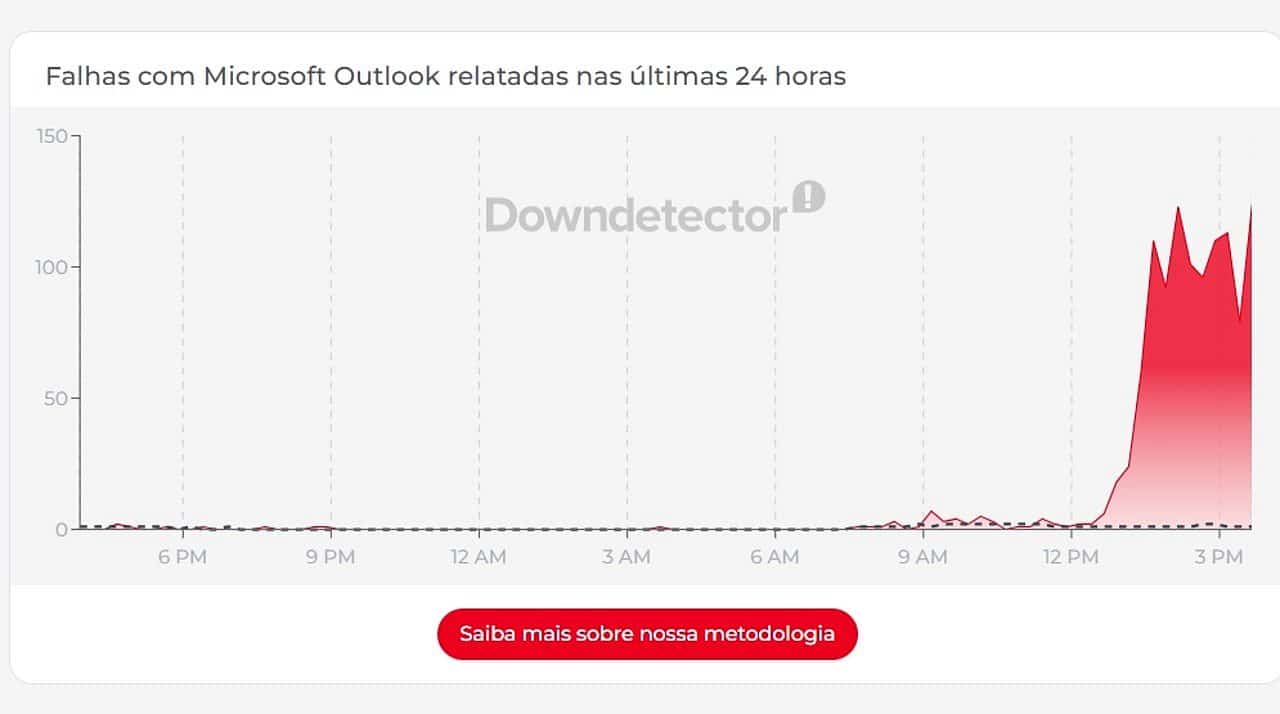
Failure evolution and real-time monitoring of collapse
The first signs that the infrastructure was giving way began to appear around 8 a.m. Pacific time, when monitoring charts made a sudden jump. The Downdetector website, specialized in compiling reports of instability in digital services, recorded more than 6,000 notifications in the first seventeen minutes of the event. From that moment on, the volume of complaints grew exponentially, following the awakening of different business time zones.
Shortly after 9 am, the records already indicated a significant worsening in the stability of the servers, surpassing the mark of 13,000 simultaneous complaints. The problem continued to deteriorate rapidly throughout the morning, affecting entire corporations. At 10:35 am, the collaborative control panel showed 35,000 users without access, culminating in an alarming spike of almost 50,000 notifications at around 11:05 am.
Interestingly, during much of this escalation of failures, Microsoft’s official health check tool was displaying a green light for all of its products. The corporate panel indicated that the services were operating normally, contrary to the tens of thousands of tickets opened by customers who were unable to load their emails. This temporary discrepancy delayed the activation of contingency protocols in many companies that depend exclusively on the supplier’s official diagnosis.
Root of technical issue on Exchange Online servers
The technical investigation revealed that the email application itself was not causing the blackout, but rather the back-end infrastructure that supports the entire operation. The collapse was directly linked to Microsoft Exchange Online, the cloud hosting service responsible for managing traffic, storage and delivery of messages. As the email client entirely depends on this backbone to function, any bottleneck on the central server results in an error screen for the end user.
Company representatives publicly confirmed the opening of a rigorous investigation to isolate the fault. Through a detailed technical statement published on official channels, the engineering team explained that the incident was caused by a defect in a specific authentication component. This module acts as the system’s digital gatekeeper, responsible for checking the credentials of each person trying to access the platform before allowing them to view their inbox.
For purposes of transparency with network administrators, the company cataloged the crisis under the identification code EX1464935 in its administration center. The authentication failure explains exactly why customers were unable to get past the initial loading screen. When the server loses the ability to validate who is requesting access, it blocks the connection as a security measure, bringing down the cascading service for all connected terminals.
Main obstacles faced by internet users during the morning
The diversity of reported errors demonstrated that the instability affected multiple layers of the company’s communication ecosystem. The statistical survey of complaints helped to map the failure behavior of the different devices used by the public. Data consolidated by monitoring platforms revealed the following distribution of technical difficulties:
- The largest portion of those affected, representing 37% of registrations, reported a complete block in receiving new messages, with inboxes frozen without synchronization.
- Around 23% of users faced direct crashes in the application for computers and cell phones, making it impossible to even initially open the program.
- Another 20% indicated that the web portal was completely inaccessible, displaying server error messages when trying to load the page via the internet browser.
The practical impact of this shutdown has been widely documented on discussion forums like Reddit. Workers expressed outrage at the inability to carry out basic tasks, such as searching for old documents, approving contracts or responding to urgent customers. One of the most commented reports highlighted the frustration of not being able to even open the website and, on the rare occasions when the interface partially loaded, the search bar remained inoperative.
Corporate dependence on cloud solutions and the productive impact
The time at which the failure reached its peak coincides with the most critical period for companies’ technology infrastructure: Monday morning. This moment is known behind the scenes in technology as the login storm, when millions of employees return from the weekend and try to access their systems simultaneously. A spike in access of this magnitude requires authentication servers to operate at maximum capacity.
When a vital component fails precisely during this high-traffic window, the impact on overall productivity is immediate and severe. Meetings are canceled due to lack of access links, financial approval flows are blocked and companies’ external communication is cut off. The episode highlights the extreme vulnerability of modern corporate operations, which have almost entirely outsourced their communications infrastructure to centralized cloud providers.
Mitigation strategy and testing on isolated infrastructure
To contain the damage without risking an even greater system outage, engineers took a cautious approach to remediation. The support team developed a remediation strategy focused solely on fixing the corrupted authentication component. Instead of applying the update across its entire global network at once, the company opted for a piecemeal rollout, a rigorous practice in managing large-scale technology crises.
The fix was initially injected into a small portion of the server infrastructure. This controlled environment allowed technicians to test the effectiveness of the solution in real time, monitoring whether the fix would resolve the bottleneck without generating new conflicts in the source code. The official promise was that, as soon as the stability of this sample was proven by the engineers on duty, the fix would be widely distributed to the rest of the global servers, normalizing access for the millions of affected users.