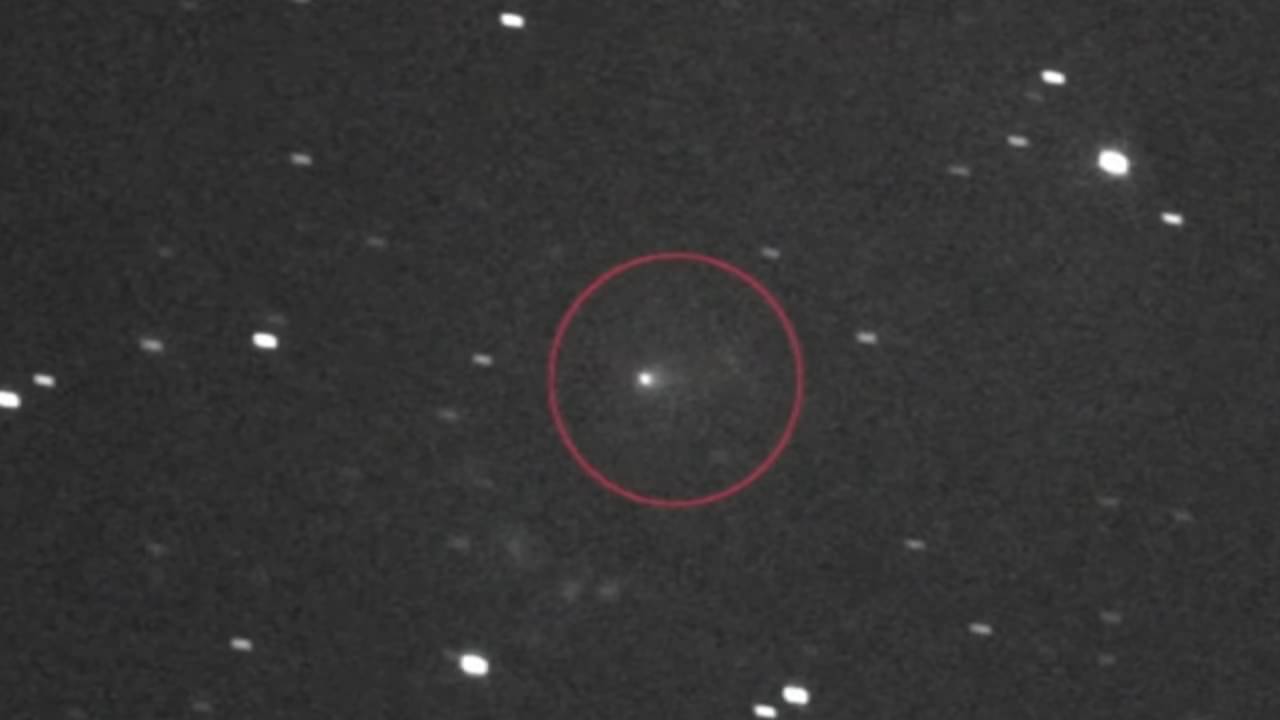
China’s Tianwen-1 probe has captured high-resolution images of the interstellar comet 3I/ATLAS from the orbit of Mars, marking the first time an object from outside the Solar System has been photographed from the Martian vicinity. Operated by the China National Space Administration (CNSA), the spacecraft recorded the target between September 30 and October 3, 2025, when the body passed approximately 30 million kilometers from the orbiter. The tracking protocols developed during this operation directly supported the navigation of the Tianwen-2 probe, which arrived within 20 kilometers of the near-Earth asteroid 469219 Kamoʻoalewa on July 6, 2026.
During the observation window near Mars, 3I/ATLAS traveled at a hyperbolic excess speed of 58 kilometers per second, reaching up to 68.3 kilometers per second at its closest approach to the Sun. The dataset collected by the Chinese orbiter offers planetary scientists a direct view of the physical structure and chemical makeup of bodies formed around distant stars.
Photographs released by the CNSA clearly distinguish the central nucleus from the surrounding gaseous coma. The maneuver pushed the operational limits of the Tianwen-1 camera systems, which engineers originally designed to map the bright, static surface of Mars rather than faint objects moving rapidly against dark deep space.
Chemical signatures from an extrasolar planetary disk
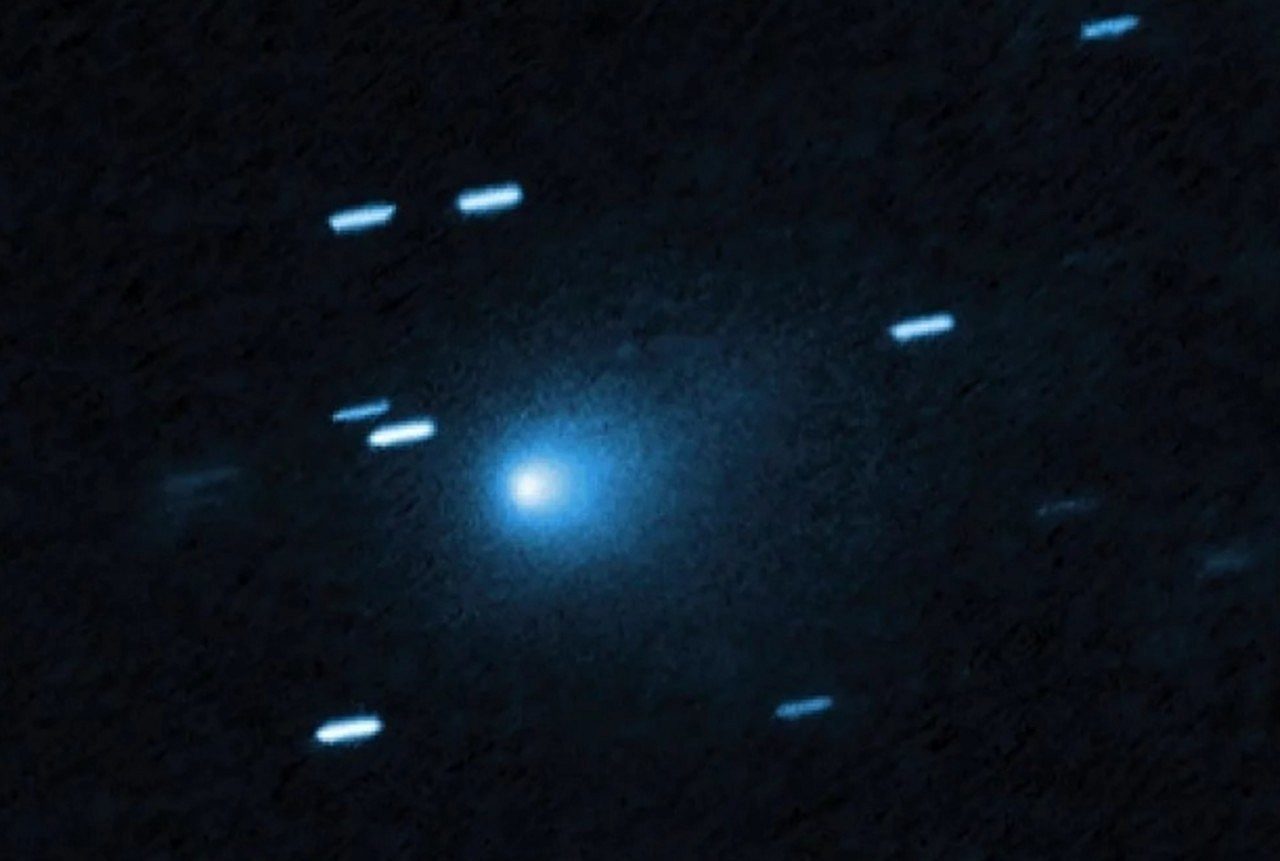
The close pass of 3I/ATLAS near the fourth planet of the Solar System gave astronomers a rare chance to examine pristine material from another star system. Because interstellar comets preserve the physical and chemical conditions of their birthplaces, researchers treat them as cosmic time capsules that test models of planetary formation beyond our neighborhood.
Every dust grain and gas molecule vented by the comet carries the signature of a distant stellar nursery. Spectral measurements indicate that 3I/ATLAS likely formed within a cold outer protoplanetary disk, where volatile substances such as water ice, carbon dioxide and carbon monoxide remain frozen for billions of years.
Detailed analysis of the Tianwen-1 observations from March 2026 revealed that the coma is dominated by relatively large dust grains measuring a few hundred micrometers across. The comet ejected this material at velocities between 3 and 10 meters per second, shedding dust mass at an estimated rate of 1,000 kilograms per second as solar radiation heated its surface.
Check out: Comet 3I/Atlas reveals frozen carbon dioxide from distant star system
Orbital path and discovery of the third interstellar visitor
Officially cataloged as C/2025 N1 (ATLAS), 3I/ATLAS is only the third confirmed interstellar object ever detected passing through the Solar System, following 1I/ʻOumuamua in 2017 and 2I/Borisov in 2019. Astronomers first spotted the body on July 1, 2025, using the Asteroid Terrestrial-impact Last Alert System (ATLAS) survey telescope in Rio Hurtado, Chile.
Calculations quickly confirmed its extrasolar origin through its hyperbolic trajectory, which shows an orbital eccentricity of 6.14. Unlike local comets that follow closed elliptical paths bound by the gravity of the Sun, a hyperbolic orbit proves the object moves fast enough to cross the Solar System once and return permanently to interstellar space.
- Discovery date and location: July 1, 2025, by the ATLAS station in Rio Hurtado, Chile.
- Closest approach to Mars: 29 million kilometers on October 3, 2025.
- Perihelion (closest point to the Sun): 1.356 astronomical units, or about 203 million kilometers, on October 29, 2025.
- Closest approach to Earth: 1.8 astronomical units, or roughly 270 million kilometers, on December 19, 2025, posing no collision risk.
- Estimated nucleus diameter: between 0.52 and 0.75 kilometers, surrounded by a carbon dioxide coma stretching nearly 700,000 kilometers.
Reprogramming the HiRIC camera in Beijing
Photographing a sub-kilometer comet from 30 million kilometers away required a complete overhaul of the Tianwen-1 observation procedures. The onboard High Resolution Imaging Camera (HiRIC) was built for close-range planetary topography, a task that involves high light levels and predictable ground speeds.
Flight controllers in Beijing wrote new targeting strategies from scratch, recalibrating the attitude control systems and executing precise orbital adjustments to align the optical lens with the predicted path of 3I/ATLAS. Engineers ran extensive simulations to balance exposure times, keeping the shutter open long enough to gather faint reflected light without blurring the frame due to the 58-kilometer-per-second relative motion.
Thermal stability also demanded strict control, as ground teams regulated the temperature of the sensors during the brief imaging window. Once the raw files reached the control center in Beijing, specialized algorithms stacked multiple exposures to isolate the dense rock-and-ice nucleus and the reddish organic dust typical of outer-disk bodies.
Joint campaign with NASA and ESA around Mars
The tracking of 3I/ATLAS mobilized an international fleet of spacecraft operating at Mars. Both the National Aeronautics and Space Administration (NASA) and the European Space Agency (ESA) pointed their Martian orbiters toward the comet to measure its gas plume and refine its spatial coordinates.
Data collected in early October 2025 by ESA’s ExoMars Trace Gas Orbiter improved the predicted trajectory of the comet by a factor of ten. On the Martian surface, mission teams also programmed the NASA rovers Perseverance and Curiosity to scan the night sky, combining ground-level views with the orbital vantage point outside the ecliptic plane.
Direct application on the Tianwen-2 asteroid mission
Launched in July 2020, Tianwen-1 entered Mars orbit in February 2021 and deployed the Zhurong rover in May of that year. Completing a deep-space astronomical observation five years into the mission confirmed that the navigation hardware and optical sensors of the orbiter remain fully operational for secondary targets of opportunity.
The optical tracking techniques validated on 3I/ATLAS are already in use on China’s follow-up interplanetary expedition, Tianwen-2. Launched from the Xichang Satellite Launch Center on May 28, 2025, aboard a Long March 3B rocket, Tianwen-2 traveled roughly 1 billion kilometers over 400 days to reach the quasi-moon asteroid 469219 Kamoʻoalewa in mid-2026.
Using optical navigation methods to cut positional uncertainty down to the kilometer scale, Tianwen-2 closed to within 20 kilometers of the asteroid on July 6, 2026, to begin its sample-collection campaign. The spacecraft is scheduled to depart Kamoʻoalewa on April 24, 2027, deliver at least 100 grams of asteroid material to Earth, and continue toward the main-belt comet 311P/PanSTARRS for an orbital arrival set for January 24, 2035.