
Astronomers catch pair of black holes devouring matter in rare galaxy

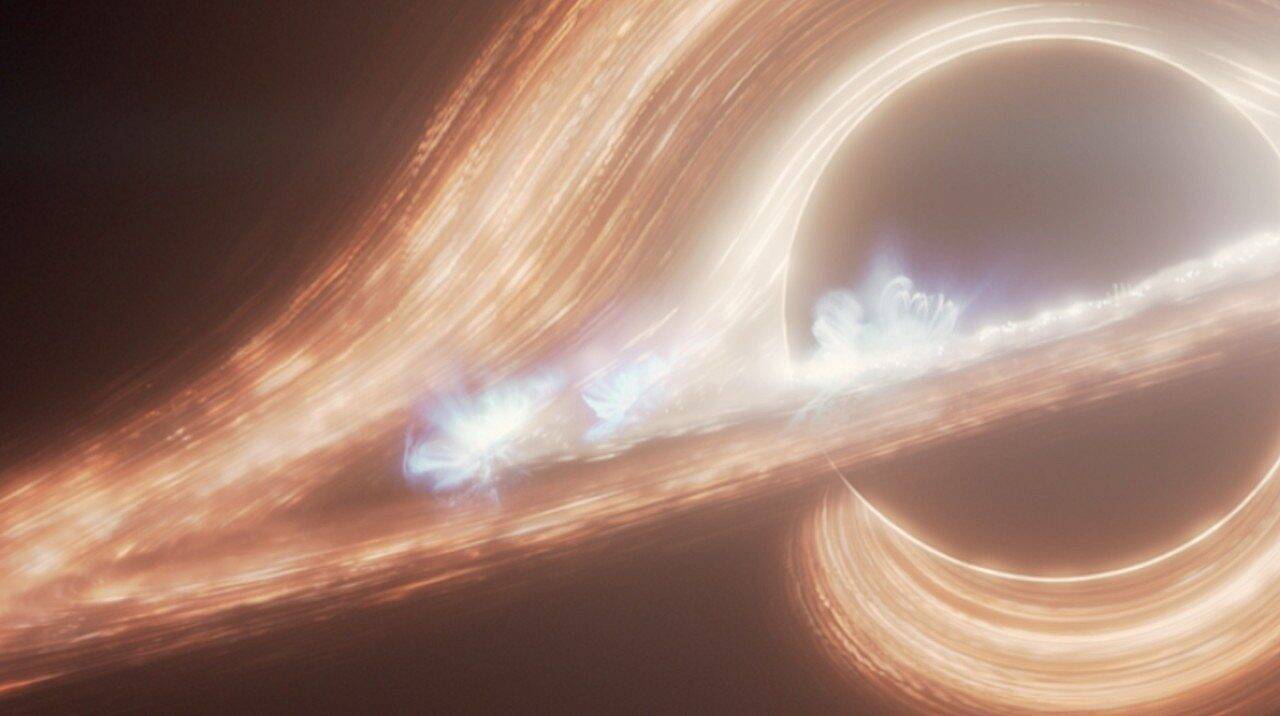
Researchers from different parts of the world recorded an unprecedented milestone in space exploration by locating a pair of supermassive black holes consuming matter simultaneously. The phenomenon occurs inside J1622+3521, a compact star formation classified as “Green Pea”. This is the first time that science has confirmed the existence of a double active galactic nucleus within a structure with this profile, operating at a distance of 27 thousand light years from each other. The survey, made available in the arXiv repository on July 20, 2026, provides fundamental pieces to unravel the mechanics of the birth and aging of galaxies.
Understand the characteristics of pea galaxies and their role in the study of the cosmos
The structures known as “Green Pea” represent fascinating anomalies in deep space. Originally discovered in 2007 by volunteers from the Galaxy Zoo project due to their peculiar greenish glow in telescope images, these formations are small in size and have a notable lack of heavy chemical elements. In contrast, they produce new stars at a frantic pace when we analyze their total size. This intense behavior makes these celestial bodies function as perfect mirrors of the galaxies that dominated the universe in its beginnings.
Thanks to this physical and chemical similarity, scientists use the “Green Pea” closest to Earth as authentic astronomical testing grounds. Analyzing these clusters allows us to investigate the rules of the primitive cosmos with a clarity that is impossible to achieve when trying to focus on objects located billions of light years away from us. The sight of two gigantic black holes operating at the same time in the center of one of these formations opens a rare window to decipher the dynamics of these gravitational monsters in scenarios identical to those at the dawn of the universe.
X-ray tracking by the American space agency proves double activity
J1622+3521 was already attracting the attention of the scientific community due to its chaotic and non-conventional format. High-depth visual captures showed two well-defined centers, accompanied by trails of dust and gravitational debris that betray a galactic collision in full swing. Faced with this turbulent scenario, experts decided to investigate whether each of these cores housed a black hole in an active feeding phase.
The definitive answer came through the equipment at the Chandra X-ray Observatory, operated by NASA. The satellite managed to map two independent radiation emissions, aligned to the millimeter with the positions of the two luminous centers seen previously. This exact cross-reference between the visible light and the x-ray signature served as irrefutable proof that the two black holes were indeed active and sucking in surrounding material.
The space that separates these two gravitational giants measures about 8.4 kiloparsecs, the equivalent of 27 thousand light years away. Preliminary assessments indicate that both have almost identical sizes, with the first body registering 19.5 million solar masses and the second reaching the mark of 20.5 million solar masses. The combination of visual evidence with the double emission of radiation eliminates any doubt, stating that J1622+3521 hosts a binary system instead of a single central engine.
Light analysis reveals the speed and strength of radiation in the binary system
To scrutinize the internal physics of J1622+3521, the group of experts used technology from the Keck Observatory. The reading of the light spectrum captured by these instruments showed extremely strong emission traces, encompassing rare signatures of high ionization. In practice, these markings function as a barcode that attests to the presence of extreme radiation, generated exclusively by active galactic nuclei, validating the theory of matter consumption.
Astronomers also calculated the redshift of each nucleus, a technique that measures the rate at which celestial bodies move away from our planet. The speed discrepancy between the two centers was around 7 kilometers per second, a margin so small that it dissolves into the equipment’s margin of error. Such numerical proximity indicates that the two black holes travel through space at the same systemic speed, reinforcing the picture of two galaxies merging just before the final collision between their supermassive hearts.
An extra battery of tests was applied with the aim of separating the energy generated by black holes from the light emitted by the birth of ordinary stars. The result of this screening placed the system in the classification of an active galactic nucleus, aligning perfectly with the x-ray readings and previously detected Balmer emission patterns.
Impact of the find on mapping the history of the early universe
Locating two supermassive black holes dining at the same time in the galaxy J1622+3521 represents a giant leap forward for modern astrophysics. The event delivers a faithful portrait of how these singularities and their stellar homes grow together, simulating the exact conditions of the ancient cosmos. For years, attempts to find double active nuclei in “Green Pea” galaxies have ended without conclusive results.
The work coordinated by Konstantinos Kouroumpatzakis, a researcher at the Czech Academy of Sciences, provides the first material proof that colossal black holes can grow fat simultaneously during a space merger. The record of this phenomenon in a low-mass, lean-dimension environment breaks old astronomy paradigms, forcing a review of theories about galactic collisions and the feeding process of these gravitational anomalies.
- J1622+3521 is a compact galaxy with accelerated production of new stars.
- The system houses two supermassive black holes in the process of feeding.
- The physical distance between the two celestial bodies reaches 27 thousand light years.
- The weight of the objects varies between 19.5 million and 20.5 million solar masses.
- It is the first double active galactic nucleus validated in a pea formation.
Kouroumpatzakis’ team also carried out a safety check, crossing the Helium II emission levels with the intensity of the x-rays captured. The proportion found between radiation and the rate of matter suction matched exactly the mathematical models predicted for true active nuclei. Scientists point out that clouds of thick gas may be blocking a fraction of the real energy emitted by black holes, a detail that will require the use of very high-energy x-ray telescopes in the future. From now on, J1622+3521 assumes the role of definitive laboratory to uncover the secrets of the evolution of our universe.





