
Giant cosmic cavity N44 shelters 30,000 developing stars
NASA released an optical survey recorded by the Hubble Space Telescope featuring superbubble N44, a vast hollow of gas located within the Large Magellanic Cloud roughly 160,000 light-years from Earth. The astronomical data documents an active stellar breeding ground containing approximately 30,000 embryonic celestial bodies that have not yet started thermonuclear hydrogen fusion within their deep central cores.
The cosmic chasm astounds.
High-resolution imagery maps a cavernous central gap where energetic ultraviolet radiation and high-velocity gales emitted by colossal stars continuously drive surrounding matter outward into an exceptionally thick wall of luminous gas that now accumulates sufficient molecular mass to trigger sequential generations of new stars through gravitational collapse accelerated by past detonations of adjacent supernovas. Astronomers track this compounding pressure across multiple surrounding sectors. Dense clusters continue to form along those compressed boundaries.
Central void expands through intense stellar winds
Inside the core of the structure documented by the Hubble Space Telescope lies a broad dark expanse enveloped by incandescent ribbons of superheated gas. Persistent forces exerted by stellar winds originating from massive local giants combined with ancient supernova blasts hollowed out this central depression over several million years, sweeping pristine hydrogen away from the interior and building corrugated walls that shine brightly across space.
Researchers charted every perimeter sector of N44.
Read also: Gravity shapes cosmic web in the Tarantula Nebula and drives birth of massive stars
Orbital surveys logged nearly 500,000 stars situated across the broader N44 complex. Observations show that extreme physical compression generated along the shell perimeter serves as the decisive trigger for cool cosmic dust to clump together into denser pockets. In this boundary ring, matter reaches critical mass thresholds, turning once-diffuse interstellar clouds into energetic focal points of stellar creation.
Dense outer rim concentrates thousands of proto-stars
Along the margins of the expanding bubble, NASA imagery highlights red and blue luminous points buried within thick ribbons of dark molecular dust. These specific coordinates mark roughly 30,000 infant protostars accumulating mass before acquiring internal pressures and core temperatures adequate to ignite their hydrogen reserves.
Ultraviolet emissions generated by established neighboring giants erode pillars of dense matter pointing straight toward the interior of the primary cosmic cavity. This persistent radiation strips away exterior layers from molecular clouds, laying bare durable embryonic cores that survive structural disruption. Data recorded by Hubble demonstrates simultaneous destruction of original gas fields alongside rapid emergence of secondary stellar generations.
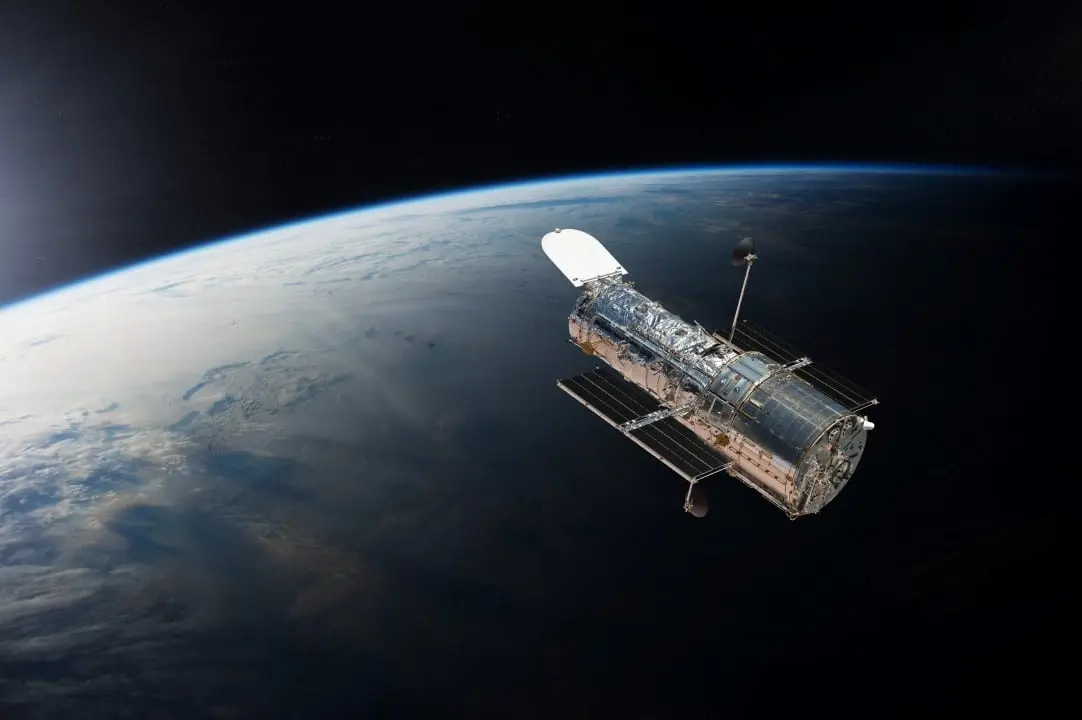
The observatory operates in low orbit.
Learn more: Hubble Telescope records nucleus of the Lagoon Nebula and reveals nursery of massive stars
Spectroscopic examination of N44 separates absorption belts intertwined with glowing filaments energized by radiation from the hottest massive stars in the cluster. While central blue giants reach surface temperatures exceeding tens of thousands of degrees, adjacent protostars remain cool as they gather remnants left behind by older explosions.
Southern Hemisphere observers view satellite galaxy from ground
The Large Magellanic Cloud, a dwarf satellite galaxy orbiting the Milky Way that hosts superbubble N44, maintains direct visibility for skywatchers across the southern half of the planet. Skygazers in Southern Brazil can view this satellite structure without optical equipment during clear moonless nights, observing it as a pale stationary cloud positioned between austral constellations.
Understand the case: Recent images of the Tarantula Nebula reveal gravitational web and formation of giant stars
Amateur astronomers track this formation across Brazil.
A separation distance of 160,000 light-years grants ground instruments an advantageous vantage point because the plane of the Large Magellanic Cloud suffers minimal obscuration from central dust disks located inside our own galaxy. Due to this clean observational window, N44 functions as an outdoor natural laboratory where researchers evaluate theoretical predictions regarding starbirth and stellar decay cycles.
Orbital sensors separate chemical wavelengths across the complex
Hubble operated its wide-field camera array to isolate distinct emission wavelengths radiated by separate chemical elements distributed throughout the N44 expanse. Ionized hydrogen illuminates the brightest belts within the composite image, while concentrated pockets of oxygen and sulfur mark outer boundaries where shock fronts slam into cooler regions.
- Ionized hydrogen gas tracing high-energy shock waves along the interior walls
- Heavy sulfur deposits concentrated along outer shock margins
- Cool molecular oxygen belts framing the most resilient star-forming pillars
Each pixel transmitted by the orbital platform spans minute fractions of a light-year inside the neighboring galaxy. Detectors converted photon intensity into calibrated digital measurements, separating the 30,000 young protostars from the remaining 470,000 cataloged objects across the surveyed region.
More on this story: NASA telescope discovers drastic drop in star creation in Andromeda
The final record maps subtle color gradients where shock fronts from ancient supernova remnants collide with untouched interstellar gas reserves. Fronts traveling at peak velocities create higher-energy signatures, whereas shaded pockets shielded behind dense gas pillars stay shielded from direct ultraviolet bombardment. NASA concluded the transmission by registering celestial coordinates for every discrete stellar cluster across the outer perimeter.
More news in Latest News (EN)
See more → Chinese leaks reveal Xiaomi 18 Fold panel reaches 4,000 nitsXiaomi 18 Fold display reaches 4,000 nits peak brightness
 Apple redesigns iOS 27 with upgraded Siri and camera search
 Final Fantasy VII trilogy bundle hits Japan for 500 dollars
 Capcom classics and Mycopunk arrive on PlayStation Plus tiersDino Crisis 2 leads fresh wave of PlayStation Plus gamesTrilogy pack for Final Fantasy VII arrives in Japan for $500
 Ten classic PlayStation 2 titles that deserve full remakesClassic PlayStation 2 games demand complete modern revivals
 Classic RPG Astonishia Story arrives on Switch platforms in 2027Astonishia Story remake will launch on two Nintendo platforms
 Larissa Morata dies from gunshot wound in Embu das Artes
More news on Mix Vale
- 1Beijing injects $53.6 billion into key financial institutions to bolster economic stability
- 2Bureau warns record El Niño will intensify drought, driving up Australian food prices
- 3UK poised to implement trade restrictions on Israeli West Bank settlements amid rising international concern
- 4Apple prepares iOS 27 with contextual Siri and visual search
- 5Woman found shot dead with officer gun in Embu das Artes
- 6Standalone edition opens the frontier of Red Dead Online
- 7Frontier journey opens via standalone Red Dead Online release
- 8Xbox gamers stack loyalty points to purchase GTA 6 for free
- 9Console demand surges in Britain after Netflix debuts GTA 6 look
- 10Xbox fans accumulate loyalty credits to secure GTA 6 launch