
Moon will block daylight for 6 minutes across Egypt in 2027

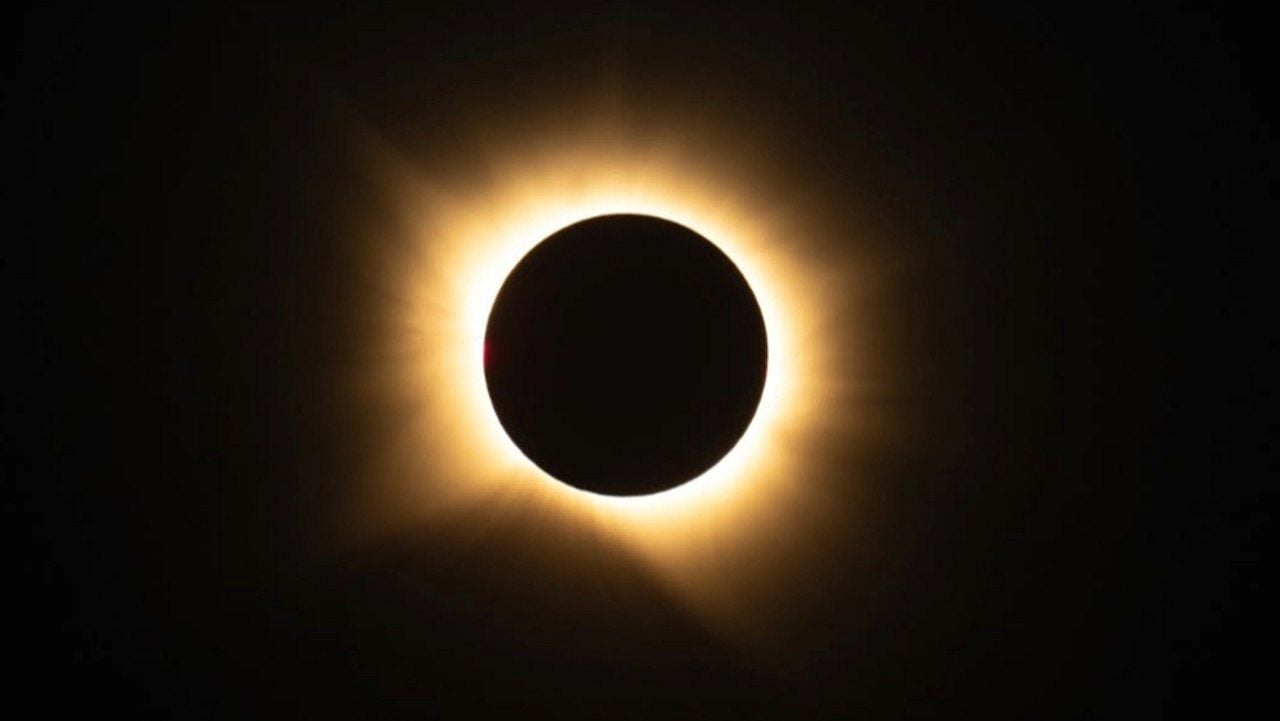
A total solar eclipse will blot out daylight across a 258-kilometer-wide corridor stretching from southern Spain to Somalia on August 2, 2027. NASA projections show the Moon will conceal the Sun for up to 6 minutes and 23 seconds, marking the longest period of totality observed on land since 1991.
Orbital distances create prolonged darkness during totality
Specific planetary alignments account for the unusual duration of the event. During the alignment, the Moon approaches perigee, its closest point to Earth, expanding its visible silhouette against the sky. Meanwhile, Earth sits near aphelion at its furthest distance from the Sun, making the solar disk appear smaller than usual.
This geometric interplay enlarges the umbral shadow and decelerates its passage across the terrestrial surface, an effect that intensifies near the equator where planetary curvature slows the transit of darkness until an equivalent phenomenon recurs in the year 2114. Such exceptional duration will not happen again until 2114.
Shadow corridor extends across North Africa and southern Europe
The lunar shadow originates over the waters of the Atlantic Ocean. From there, the path crosses the Strait of Gibraltar and cuts across southern Spain. The track then sweeps through Morocco, Algeria, Tunisia, and Libya before entering Egypt.
- Starting point: Atlantic Ocean
- Transit zone: Strait of Gibraltar and southern Spain
- North African corridor: Morocco, Algeria, Tunisia, and Libya
- Peak totality location: Luxor region, Egypt
Historic temples in Luxor offer optimal viewing conditions
The longest period of darkness settles near the Nile River around Luxor, home to renowned archaeological sites. August cloudiness stays below 10%.
Tourists have already reserved more than 90% of available accommodations in the city for the date of the event.
Oxford astrophysicist highlights rare opportunity to view celestial bodies
University of Oxford astrophysics professor Roger Davies addressed the scientific significance of the prolonged phenomenon. “Six minutes and 23 seconds is a long time, your eyes will adapt to the darkness, and I hope we can see much more stars and planets,” Davies stated.
Observers outside the trajectory must rely on remote broadcasts
No Brazilian cities fall within the trajectory of total or partial visibility. Astronomers advise interested viewers to track the spectacle through live digital transmissions. Official feeds will be streamed online by NASA and the National Observatory.
A total solar eclipse of comparable magnitude will not reach Brazil until August 12, 2045, when totality will sweep across northern and northeastern regions of the country.





