
NASA completes 25th test flight with quiet supersonic X-59

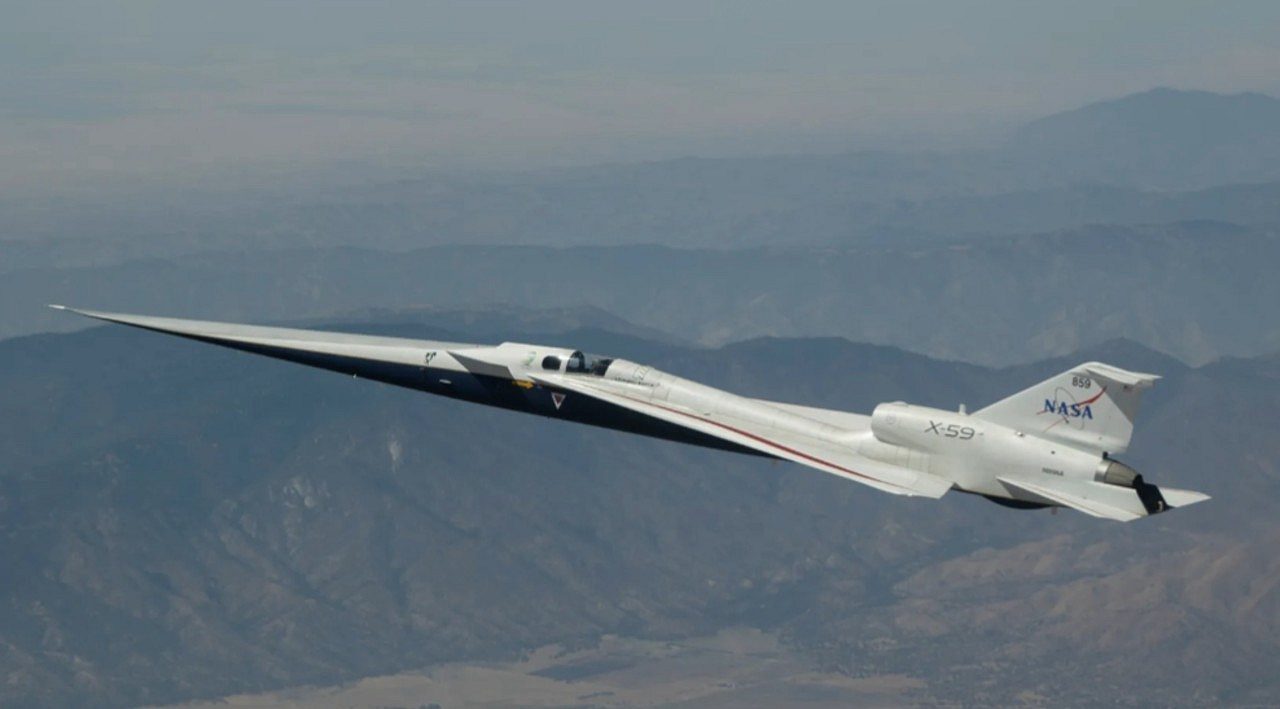
NASA advanced its experimental X-59 quiet supersonic aircraft through 25 test flights by August 21, 2026, meeting target aerodynamic metrics set by project engineers. The completed operations allow the agency to prepare for a subsequent testing stage later in 2026, when technicians will measure the sonic thumps produced as the jet flies beyond Mach 1.
The 25th flight occurred on August 21, 2026, originating from NASA Armstrong Flight Research Center in Edwards, California. During the 72-minute session, the aircraft climbed to approximately 49,000 feet and achieved a speed of Mach 1.2. A chase plane flew alongside the jet to monitor systems, and acoustic shock waves from that escort aircraft masked sound generated by the X-59.
Reaching this operational stage follows multiple years of structural planning and computer modeling before manufacturing began, allowing researchers to verify predictions made in wind tunnel tests against actual flight behavior.
“Through our ongoing flight tests with the X-59, we’ve gained invaluable insights into both the aircraft’s performance and the unique challenges of the aircraft design,” said Cathy Bahm, project manager for the Low Boom Flight Demonstrator project at NASA. “Each test point has validated our models and predictions, and it has strengthened our confidence in the aircraft’s performance. Every flight brings us closer to transitioning to the next phase where we will demonstrate the X-59’s quiet supersonic flight capabilities.”
Engineers shaped the airframe of the X-59 to generate a softened acoustic thump instead of an explosive boom when breaking sound barriers. Flight crews monitor telemetry by comparing incoming numbers against a real-time digital twin running computer simulations.

Physical performance metrics recorded in the atmosphere match previous aerodynamic models across key operational categories:
- Controllability and piloting qualities in dynamic flight
- Stability margins identifying boundary conditions where the aircraft approaches turbulence
- Structural stress loads acting on the airframe during acceleration maneuvers
The jet avoided aerodynamic instability and excessive vibration throughout the initial 25 sorties. NASA test pilot Nils Larson described the X-59 missions as “exciting but uneventful” after reviewing flight logs.
Early trials focused strictly on takeoff, stable navigation, and safe runway landing procedures. Since completing basic handling tests, the aircraft achieved its intended cruising benchmark of Mach 1.4, equivalent to 924 mph, while ascending to 55,000 feet, which allowed technicians to examine flight envelope parameters spanning both supersonic velocities and lower operational speeds. Subsequent evaluations centered on low-speed handling boundaries.
Data gathered during sequential flights confirmed that hardware components, including the top-mounted air intake serving the single GE-F414 engine, functioned as intended throughout dynamic maneuvering.
Between test runs, maintenance crews and flight engineers evaluated telemetry to implement needed technical adjustments on the X-59. Technicians modified flight-control software packages to refine maneuvering responses. They also resolved a sensor glitch that previously caused systems to display nuisance alerts as caution warnings.
Personnel working on the Quesst mission continue expanding operational altitude and velocity ranges that computer simulations cannot fully forecast. NASA pilot Larson noted that the experimental vehicle naturally handles better at higher speeds during high-altitude runs.
X-59 acoustic signatures remain the priority.
“This is the phase we’ve been working toward,” said Larry Cliatt, acoustic validation technical lead for the Quesst mission at NASA. “Building and flying a brand-new aircraft is an extraordinary accomplishment, but the next phase is where the real research begins.”
Technicians will deploy ground sensors and airborne observation instruments to capture the precise acoustic signature of the X-59 during its supersonic test runs.
“Acoustic validation will put the tools and methods used to design the X-59 to the test, tools that could ultimately become part of the DNA of every future commercial supersonic aircraft,” Cliatt stated regarding the upcoming phase. “It will be a complex and demanding flight campaign focused on demonstrating that the X-59 can produce the quiet sonic thump it was designed to achieve.”
The experimental jet serves as the primary testing platform for the Quesst mission run by NASA to support commercial supersonic flights across populated land.





