
Japan fossil reveals 3-meter dinosaur beside 8-meter giant


Researchers in Tsukuba identified a 3-meter dinosaur bone on September 9, 2026, at 09:45 after the fossil remained unstudied in storage at the Iwaki City Ammonite Center in Fukushima Prefecture. The anatomical analysis shows the chest plate belonged to a small styracosternan that lived alongside an 8-meter giant previously recorded in the same geological layer.
These herbivorous iguanodontians dominated terrestrial ecosystems from the Late Jurassic to the Late Cretaceous across the supercontinent of Laurasia. Their migration between Asia, North America, and Europe drove substantial biological diversification across distinct landmasses. The eastern margin of Asia still retains very few fossil records from this group.
Paleontologists working in Japan have traditionally retrieved only isolated teeth and scattered bone fragments rather than articulated skeletons, which creates major knowledge gaps regarding coastal dinosaur diversity.
Fossil remained untouched inside museum facility for decades
Staff members found the bone in 1999 directly on the grounds of the Iwaki City Ammonite Center rather than through an official field expedition. The discovery occurred within the Obisagawa Member of the Ashizawa Formation, a section belonging to the lower Upper Cretaceous Futaba Group. Geological dating places these specific strata between 90 and 88 million years ago.
The Ashizawa Formation represents a shallow-marine depositional zone where coastal waters regularly received organic debris from land. Sediments preserved terrestrial carcasses that drifted into seawater before settling alongside marine organisms.
Initial assessments in 1999 categorized the specimen merely as a hadrosauroid sternal plate, leaving it unexamined in museum storage for more than twenty years.
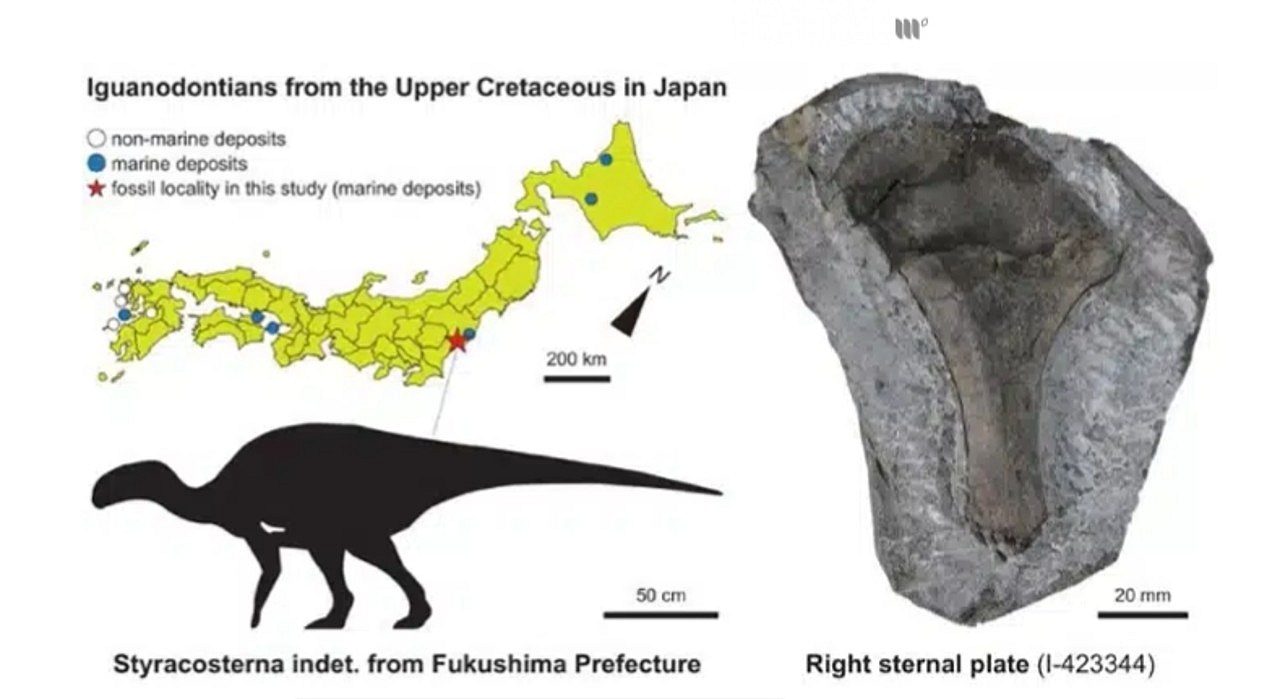
Anatomical analysis confirms chest bone from small styracosternan
Morphological examinations confirmed that the specimen represents the right sternal plate of a styracosternan, an advanced branch within the broader Iguanodontia group. While researchers could not assign the isolated bone to an exact genus or species, anatomical comparisons confirmed its taxonomic placement within Styracosterna. It shares several diagnostic features.
Comparative measurements established that the animal measured approximately 3 meters in total length. Scientists noted that this modest stature contrasts sharply with an 8-meter iguanodontian previously documented in the same geological horizon.
Different dinosaur sizes shared ancient Japanese coastline
By confirming that this 3-meter creature roamed the ancient coast alongside an 8-meter relative roughly 90 million years ago, the discovery demonstrates that distinct iguanodontian species occupied Japanese shoreline habitats simultaneously rather than segregating into separate ecological zones.
These findings confirm greater morphological variation within regional dinosaur populations than previously recognized in fragmented Asian fossil collections. The small sternal bone provides direct physical evidence of complex coastal ecosystems in Cretaceous Japan.





