
Physicists explain how record BOAT photon defied Einstein laws

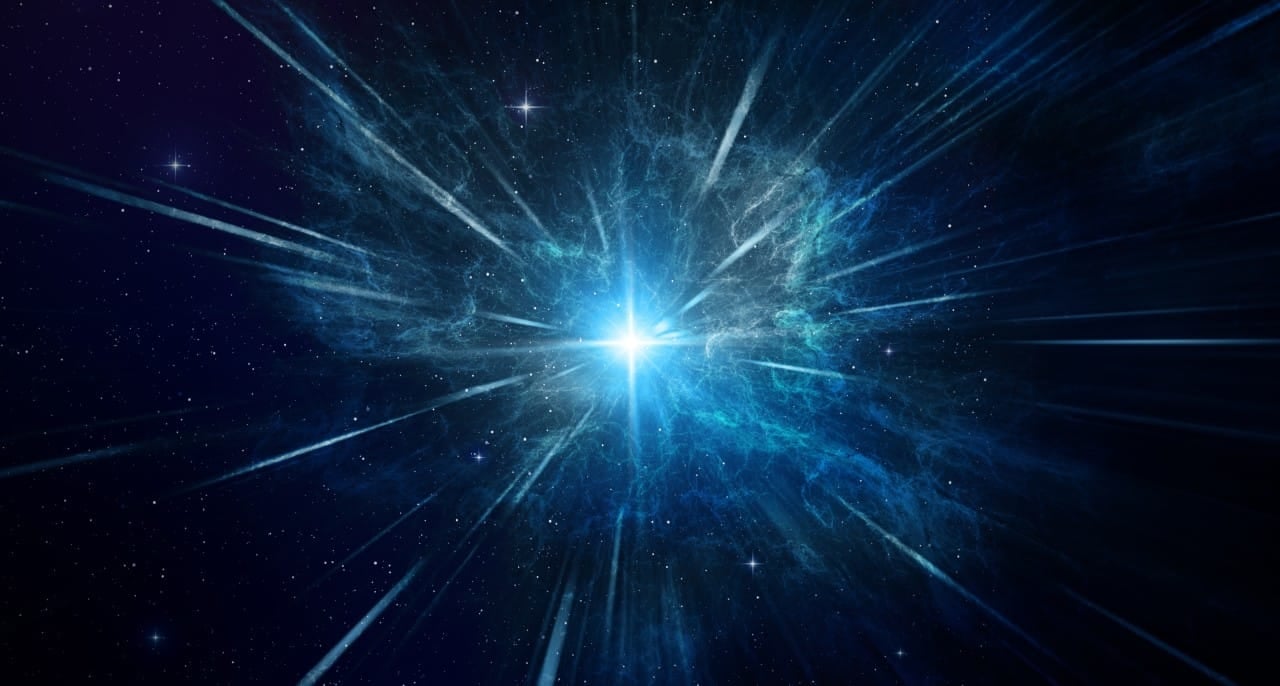
Scientists uncovered evidence indicating how an energetic photon from the brightest cosmic eruption recorded since the Big Bang reached Earth across 2 billion light-years without disintegrating along the way. The particle originated from the blast known as the BOAT, which breached classical physics models established by Albert Einstein.
Astronomers recorded this gamma-ray burst, officially designated GRB 221009A, on 9 October 2022. The event discharged an unprecedented deluge of light particles toward the planet, including the most energetic photon ever tracked from such an explosion. The Carpet cosmic-ray detector located at the Baksan Observatory in the Russian Caucasus logged the arrival of the signal.
Under prevailing physical laws, a particle carrying that volume of energy cannot survive across billions of light-years because space remains saturated with the cosmic microwave background, a relic radiation field left by the Big Bang whose photons destroy high-energy intruders.
“We started from a very simple question: how did this photon survive a journey that, according to known physics, should have destroyed it?” team leader Giorgio Galanti from the Italian National Institute for Astrophysics stated. “The new data from the Carpet experiment showed us that the explanations proposed so far were no longer sufficient. We therefore looked for a theoretical scenario capable of consistently describing what we observe, without resorting to arbitrary corrections to the equations.”
Theoretical particle shifts and relativity limits explain the signal
Researchers investigated hypothetical ultralight particles termed axion-like particles to decipher the anomaly.
These units could permit photons to oscillate into axion-like forms across intergalactic space before reverting to light upon entering the Milky Way. Yet that process alone failed to account for the extreme energetic levels recorded in the Russian Caucasus.
The research team addressed the gap by pairing axion transitions with a calculated breakdown of Lorentz invariance, the core tenet of the 1905 special relativity framework asserting that observers moving at varying speeds encounter identical physical behaviors. By testing whether Lorentz invariance fails under immense energy thresholds, the physicists altered mathematical models showing how radiation moves across deep space.
This combined mechanic prevented the traveling particle from striking the fossil radiation background.
The resulting physics model shows that photons at extreme energies bypass surrounding matter through an unobstructed cosmic corridor. Destruction ceased.
Observational timelines gathered from the 9 October 2022 event match the proposed mathematical framework, because the ultra-energetic photon struck terrestrial sensors roughly sixty minutes after the initial wave of lower-energy light arrived from GRB 221009A. “The most interesting aspect of our work is that, for the first time, it brings together two ideas that until now had been developed separately,” team member Marco Roncadelli from the National Institute for Nuclear Physics stated. “If future observations confirmed this scenario, the universe would become a natural laboratory for studying quantum gravity at energies enormously higher than those achievable by any accelerator built on Earth.” The study secured acceptance for formal publication in the scientific journal Physical Review Letters after appearing on the arXiv repository.





