
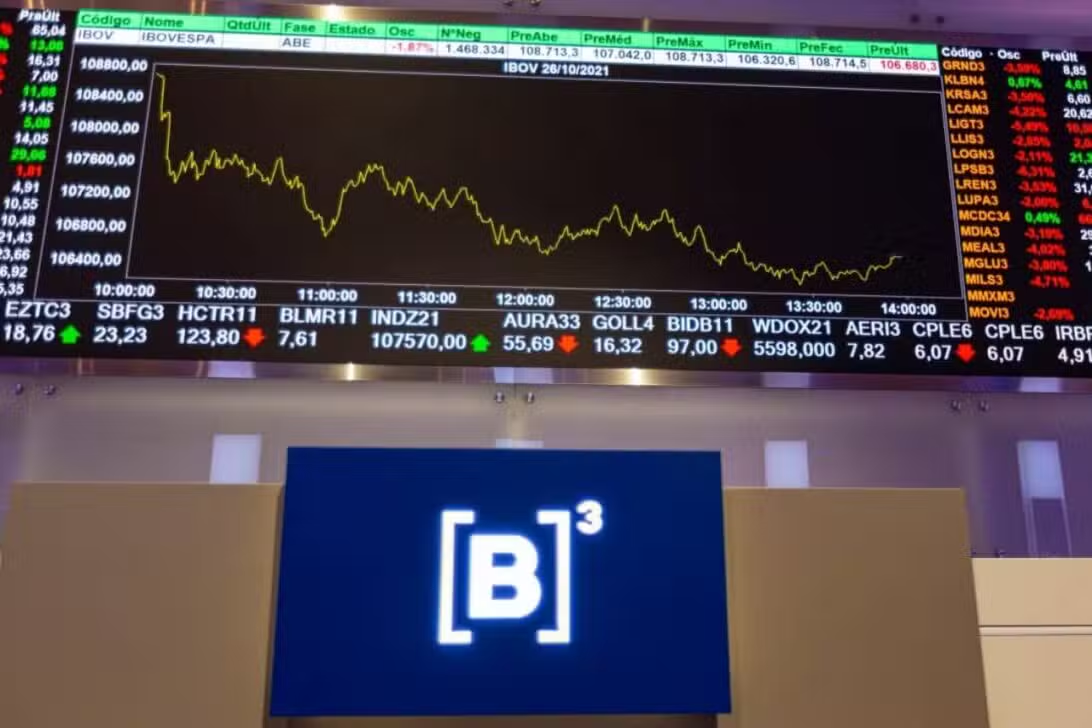
The Ibovespa equity index opened in negative territory on the 9th in São Paulo as traders reacted to surging international crude prices and broad risk aversion across global financial exchanges. Investors also parsed fresh survey figures regarding the Brazilian presidential race while tracking labor market statistics arriving from the United States.
At approximately 10:10 a.m. Brasília time, the benchmark Brazilian index retreated 0.45% to stand at 186,636.96 points.
In foreign exchange trading, the commercial dollar gained 0.12% to trade at R$ 5.0924 at the same hour, diverging from the broader weakness displayed by the United States currency worldwide. Meanwhile, the DXY index, which measures the greenback against a basket of six major currencies, dropped 0.14% to 98.645 points.
Supreme Federal Court reinstates leadership at Federal Police
Supreme Federal Court Justice Flávio Dino ordered Andrei Rodrigues to resume his role as director-general of the Federal Police and mandated that Leandro Almada da Costa return as head of the Directorate of Police Intelligence.
Secrecy rules govern the court proceedings. Justice André Mendonça had previously ordered the removal of both police officials through a preliminary injunction on the 8th.
“I warn that any resistance to compliance with this order may constitute, depending on the case, an unlawful act subject to the consequences provided in the legal system, without prejudice to other measures necessary to preserve the authority of the rulings of this Court,” Flávio Dino stated, emphasizing that such authority belongs solely to the full bench of the tribunal.
Polling firm records dead heat in presidential runoff simulation
President Luiz Inácio Lula da Silva and Senator Flávio Bolsonaro tied in a simulated runoff matchup conducted by polling institute Meio/Ideia in research published on the 9th. The resulting figures indicate that the battle for the Palácio do Planalto remains entirely unsettled.
This latest snapshot marks a reversal from the August round, when the incumbent president held a lead of 5.5 percentage points over his opponent.
Both contenders captured 46% of voter intentions in the direct comparison. Relative to August data, Luiz Inácio Lula da Silva dropped 2.5 percentage points, while Flávio Bolsonaro advanced by 3 percentage points.
The margin of error for the study stands at 2.5 percentage points in either direction. Blank or spoiled ballots accounted for 3.5% of total responses collected during the sampling. Participants who expressed no answer represented 4.5% of those polled.
Presidential decree unlocks billions for domestic fuel support
The federal administration enacted Provisional Measure 1,389 to release R$ 6.605 billion in extraordinary credit for the Ministry of Mines and Energy to finance fuel refining and import subsidies, allocating R$ 5.607 billion exclusively to diesel supplies.
A separate executive measure released R$ 375 million to the National Treasury to sustain operations under the National Program for Strengthening Family Agriculture. Both official decrees appeared in the Diário Oficial da União.
Iranian military targets merchant tankers across Gulf shipping corridors
Iran’s Revolutionary Guard declared strikes against 10 oil tankers following an announcement by the United States detailing the destruction of five Iranian vessels. The altercation represents the sharpest exchange of assaults across local navigable waterways. Hostilities throughout the corridor reached six months in duration.
Iranian military commanders designated an exclusive maritime restriction zone spanning from the port of Chabahar through sections of the Gulf of Oman and the Arabian Sea, with detailed geographic boundaries scheduled for official release at a later stage.
Global energy markets see crude contracts cross key milestone
Escalating confrontations between the United States and Iran in the Middle East intensified investor anxieties regarding sudden disruptions to crude supplies. Energy traders fear immediate delivery bottlenecks across worldwide export channels.
On London’s Intercontinental Exchange, Brent crude futures for November delivery rose 2.88% around 10:00 a.m. Brasília time to trade at US$ 100.74.
West Texas Intermediate crude for October delivery gained 2.99% on the New York Mercantile Exchange, settling near US$ 95.81 per barrel. This price swing reflected growing apprehension over international marine transport security.
Bank of America projects Brent crude will average US$ 82 during the second half of this year and forecast US$ 75 for 2027, incorporating persistent passage barriers along the Strait of Hormuz.
Goldman Sachs calculated that spot prices could touch US$ 120 per barrel in the near term, though the financial institution maintains a baseline projection of US$ 85 for the current period. For the following year, the bank projected an average benchmark price of US$ 80 per barrel.