
Webb telescope captures 70 infant stars in Carina Nebula
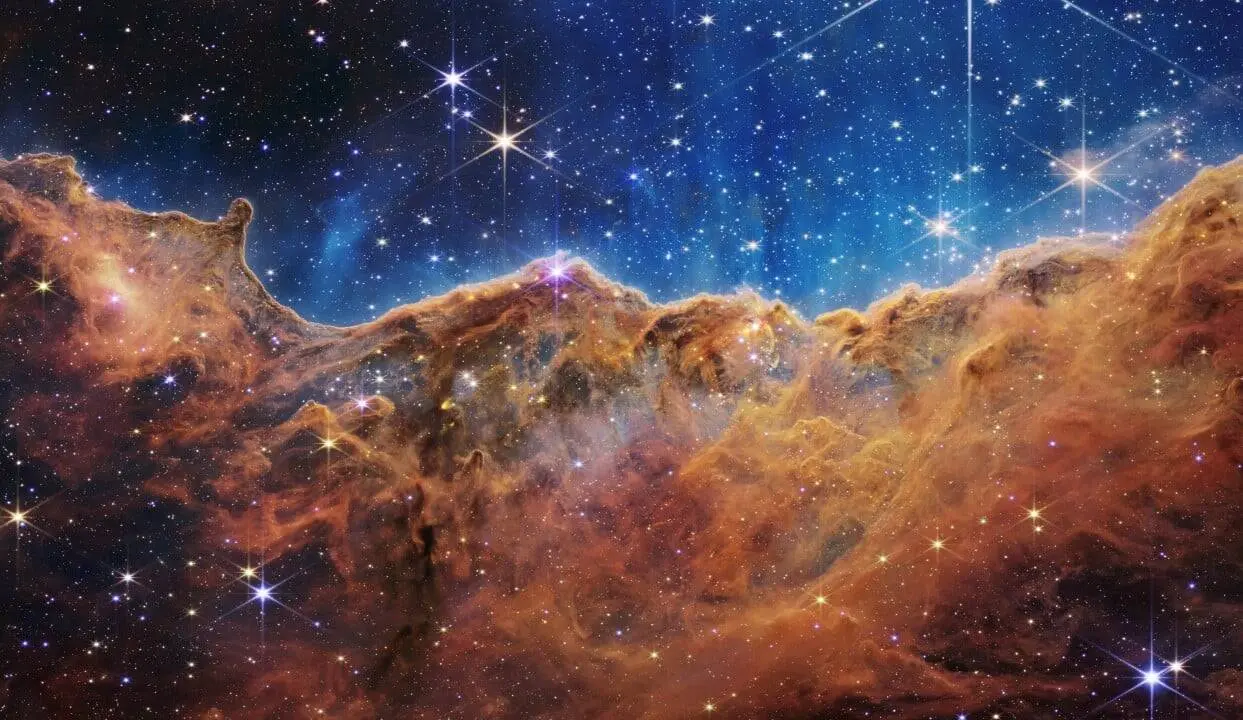
The NASA/ESA/CSA James Webb Space Telescope captured approximately 70 young stars gathered inside a dense gas and dust formation called the Treasure Chest within the Carina Nebula on 6 August 2026. This celestial cloud sits roughly 7,500 light-years away from Earth and conceals a rare O-type star weighing approximately 19 times the mass of the Sun.
The Treasure Chest designation applies strictly to the gas globule rather than the central massive star that illuminates its interior.
Learn more: Young universe: unprecedented system discovered with three active supermassive black holes
A cometary globule consists of an isolated cloud containing a dense, opaque head and an extended tail sweeping in the opposite direction of external radiation. The dense head resists incoming pressure while thinner matter stretches outward along the directional path of incoming stellar forces. In broad views of the 260-light-year Carina Nebula, these formations appear as compact dark commas set against a wide luminous background.
Infrared instruments unveil hidden stellar nursery
Infrared detectors pierce dense dust. Near-Infrared Camera data collected through specialized narrowband filters allowed researchers to look past the optical blockage and map the stars embedded in the hollow cavity of the globule.
Understand the case: Webb telescope reveals hidden black hole glowing like star
- Filters at 1.62 micrometers and 1.64 micrometers isolate emission lines from shocked iron.
- Filters at 4.44 micrometers and 4.7 micrometers detect warm molecular hydrogen displaced by energetic gas flows.
- Broadband infrared coverage captures point sources located inside the curved walls of the gas cloud.
The combination of iron and molecular hydrogen tracers reveals regions where moving matter collides directly with stationary gas envelopes instead of resting quietly in space. Because near-infrared light passes directly through dense concentrations of interstellar dust that completely obstruct visible optical wavelengths, the space observatory revealed the young star cluster as distinct points of light situated within a hollow cavity surrounded by curving walls of gas. Astronomers target the Carina region in the southern constellation Carina because its relatively close proximity allows research equipment to distinguish individual stellar bodies rather than recording a single blurred smear.
Radiation from massive star threatens planetary discs
According to the ESA/Webb release, the star cluster carries an estimated age of 1.3 million years, whereas previous scientific assessments placed the age closer to 100,000 years.
Multiple young stars within the pocket display circumstellar discs of dust and gas that serve as raw building blocks for future planetary development. Intense radiation emitted by the 19-solar-mass O-type star erodes those discs at short distances while internal energy actively scoops out the surrounding gas envelope.
More on this story: James Webb Observatory identifies unprecedented population of brown dwarfs in Westerlund 2 cluster
External stellar winds carve the cometary boundary
External pressure from the massive binary system Eta Carinae, positioned about 39 light-years northwest on the sky, works alongside cluster Trumpler 16 to blow away lighter outer material. Those external stellar winds sweep the trailing gas tail across the interstellar medium while internal cluster activity carves out the dense head. The interaction balances forces originating from outside the cloud against energy released from within.
ESA/Webb records indicate the cluster likely condensed inside a larger molecular cloud before external winds stripped away less dense outer layers. An alternative scientific model suggests external radiation triggered the original collapse of the gas pocket prior to star formation.
Scientific programme maps gas accretion and outflows
Observations of the region belong to research programme #5408 led by principal investigator M. Reiter to study how newly formed stars accumulate gas and release matter through high-velocity outflows. Narrowband filters trace energetic shocks created when gas ejections strike surrounding material at extreme velocities. These diagnostic spectral signatures identify outflow activity even when dense dust conceals the central protostars from optical detection.
Official credit for the 8,200 by 11,220 pixel picture released under catalog code potm2607a includes ESA/Webb, NASA, CSA, M. Reiter, and M. H. Özsaraç.
More news in Latest News (EN)
See more → Massive gas cloud disguises early black hole as cosmic starWebb telescope reveals hidden black hole glowing like star
 Zelda 40th Anniversary Direct scheduled for September 8Zelda 40th Anniversary Direct streams globally in September
 Nicolas Cage beachfront home driveway collapses in MalibuDriveway collapses into sinkhole at Nicolas Cage Malibu home
 Lindsay Clancy trial jurors recount deadlock over lone holdout
 Meta deploys Muse automated assistant across United StatesAutomated Muse tool arrives in United States to run tasks
More news on Mix Vale
- 1Fi recalls two canine supplements over salmonella threat
- 2Apple chief teases iPhone 18 Pro camera in short video clip
- 3Camera teaser for iPhone 18 Pro surfaces ahead of Apple event
- 4Inside Adam Sandler’s $12 million California mansion in Pacific Palisades
- 5AI has over 10% risk to end humanity, Anthropic researcher says
- 6Apple plans clear casing and 5,200 mAh cell for iPhone 18 Pro
- 7Apple readies 5,200 mAh iPhone 18 Pro with see-through back
- 8DNA solves 1977 Wilson County case of missing Maryland teen
- 9Apple drops iPhone Ultra moniker for new foldable device
- 10Bilateral security pact brings $48 billion in defense value