
Fossil of 20-meter dinosaur found at rail terminal in Brazil

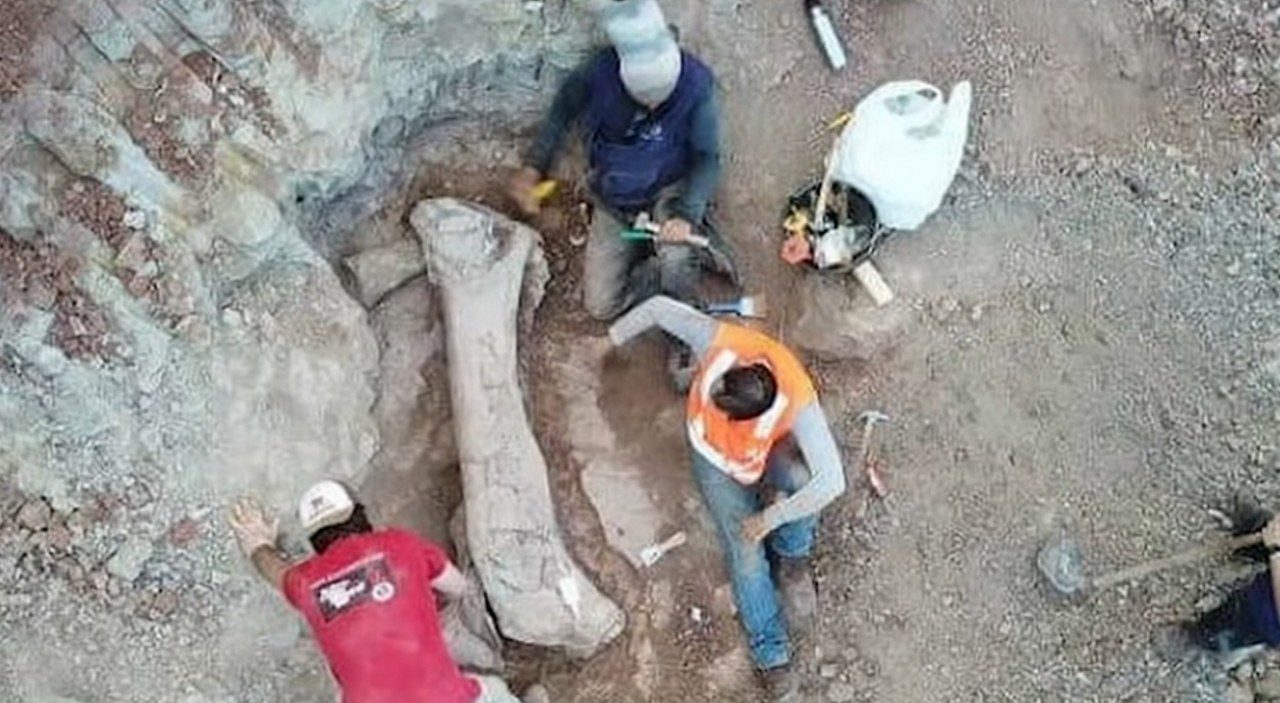
Workers uncovered the fossil of a giant dinosaur at an infrastructure project in northeastern Brazil that reveals an ancient connection between South America and Europe from 120 million years ago. The biological link connects the continents through shared evolutionary traits.
Scientists identified the new species from remains found during earthworks in the state of Maranhão, providing fresh data on continental dispersals.
Researchers named the species Dasosaurus tocantinensis in the Journal of Systematic Palaeontology after examining bones from an animal that reached 20 meters in length during the Cretaceous period. Heavy machinery uncovered the material at a road-rail terminal site in the municipality of Davinópolis. The skeleton rested eight meters below the modern surface.
The dinosaur maintains a close biological relationship with an Iberian species found in Spain. The transatlantic tie demonstrates that related reptiles occupied land tracts on opposite sides of the current ocean basin before tectonic rifting finalized the separation.
Fossil dispersals across Gondwana occurred when dinosaur predecessors crossed North Africa between 140 and 120 million years ago.
Size record set among prehistoric animals in Maranhão
“It’s the largest known dinosaur for Maranhão, which has other species, but not sauropods like this one; rather, it has smaller ones, such as the diplodocid Amazonsaurus maranhensis, which was about 10 meters long,” says Elver Luiz Mayer, a professor at the Federal University of the São Francisco Valley (UNIVASF) in Bahia. The specimen doubles the length of the previous record holder from that state.
Mayer investigates Quaternary mammals and entered the project in 2021 while teaching at the Federal University of Southern and Southeastern Pará (UNIFESSPA) in São Félix do Xingu.
Archaeologists working on mandatory environmental licensing for the Davinópolis transit terminal extracted the bones from the sediment. Technicians first suspected the fossils belonged to megafauna that coexisted with prehistoric human groups.
Mayer suspected ancient origins.
“Given its depth of about eight meters, I realized that it was much older. The age of the geological formation was already known from previous research and indicated that it was material from the transition from the Lower to the Upper Cretaceous, about 120 million years ago,” says Mayer. The lead investigator quickly organized an academic team to secure the quarry.
Unusual preservation level of the excavated skeleton
Specialists conducted mechanical preparation and stabilization inside laboratories located in Pará. Technicians then shipped the material back to the State Center for Natural History and Archaeology Research in São Luís. The institution curates the cataloged pieces for physical visits.
Excavators recovered a 1.5-meter femur alongside dorsal elements and pelvic fragments.
“Because it includes tail vertebrae, a 1.5-meter femur, ribs, foot bones, and arm and leg bones, this is considered a relatively complete specimen. We believe there are more fossils from this same specimen yet to be excavated at the site,” says Max Langer, a professor at the Ribeirão Preto School of Philosophy, Sciences, and Letters at the University of São Paulo (FFCLRP-USP).
Langer directs a FAPESP-funded research initiative examining South American Cretaceous faunas.
Origins behind the scientific name of the specimen
The taxonomic title reflects local geographical features and early colonial terminology recorded in northeastern Brazil. The roots link the animal to local waterways and thickets.
The word “Daso” stems from the ancient term for thick woodland, matching the Portuguese phrase “maranhão” applied to regional vegetation. The specific epithet “tocantinensis” denotes the Tocantins River. The fossil bed sits directly on the eastern margin of this major fluvial corridor.
Microscopic analyses of bone histology were conducted under the direction of Tito Aureliano and Aline Ghilardi at the Federal University of Rio Grande do Norte (UFRN). The cellular matrices show an intermediate growth pattern between ancestral sauropods and later titanosaurs.
The laboratory results demonstrate that specialized bone development mechanisms arose earlier in the Cretaceous than previous academic models indicated.
Infrastructure developments exposing ancient underground layers
Industrial machinery frequently disturbs buried bone beds during earthmoving operations, yet industrial trenching allows field teams to inspect strata hidden beneath dense tropical soils. Scientists cannot penetrate such deep layers with standard manual tools.
“Brazil is a tropical country with dense vegetation where geologists and paleontologists rely heavily on human activity to excavate, expose the rocks, and reveal the fossils across highways and quarries, which makes specialized monitoring and artifact recovery necessary,” says Langer. Specialized field salvage remains sporadic across rural worksites.
“That’s why it’s urgent to foster closer cooperation between the parties to reconcile construction projects with federal legislation on fossils and promote new discoveries while ensuring the proper preservation of our heritage,” Mayer comments.
Scientists are negotiating with the infrastructure contractor to secure field permits for follow-up digging at Davinópolis. Field crews expect to recover matching parts from the single buried skeleton.
FAPESP financed the analytical study through regular doctoral, postdoctoral, and Young Investigator grant mechanisms.






