
Geomagnetic storm impacts planet as solar plasma hits Earth

The Space Weather Prediction Center of the National Oceanic and Atmospheric Administration identified how successive coronal mass ejections strike the terrestrial shield to trigger minor G1 geomagnetic storm conditions alongside brief G2 disturbances across the upper atmosphere. Confidence remained low.
Analytical simulation models confirmed that multiple eruptions logged across a thirty-six-hour window produce formal G1 conditions as dense plasma clouds travel outward through interplanetary space.
Solar wind shocks and traveling magnetic clouds induce temporary disturbances in the terrestrial magnetosphere by transferring substantial amounts of kinetic energy into surrounding magnetic structures. This physical interaction produces broad magnetic fluctuations across the planetary shield whenever plasma batches collide with ambient fields. Direct impacts from dense plasma bodies escalate disturbance levels to a moderate G2 rating.
Deep-space sensors recorded elevated solar wind activity ahead of the main plasma arrival, capturing a total magnetic intensity peaking at 18 nT while particle speeds accelerated to 434 km/s and the north-south Bz magnetic vector dropped down to -14 nT.
The Space Weather Prediction Center linked these early baseline shifts to a corotating interaction region embedded within a fast solar wind stream. Residual plasma expelled by an earlier solar filament eruption reinforced that outward flow.
Orbital monitors tracked a steady high-speed stream flowing from an active coronal hole while fresh plasma waves merged directly into the outgoing current.
Disturbances intensify whenever interplanetary magnetic fields orient southward over sustained periods, linking directly with terrestrial magnetic lines to funnel solar energy straight into the upper atmosphere. This coupling dictates whether the planetary environment stays stable or undergoes an active geomagnetic disturbance.
Standard G1 events induce weak power grid fluctuations in electrical systems, generate slight satellite navigation deviations, and push visible auroras down into high mid-latitude regions as G2 conditions widen that disruption.
Solar energetic proton counts above 10 MeV settled back toward quiet baseline thresholds. Radiation exposure risks remained contained.
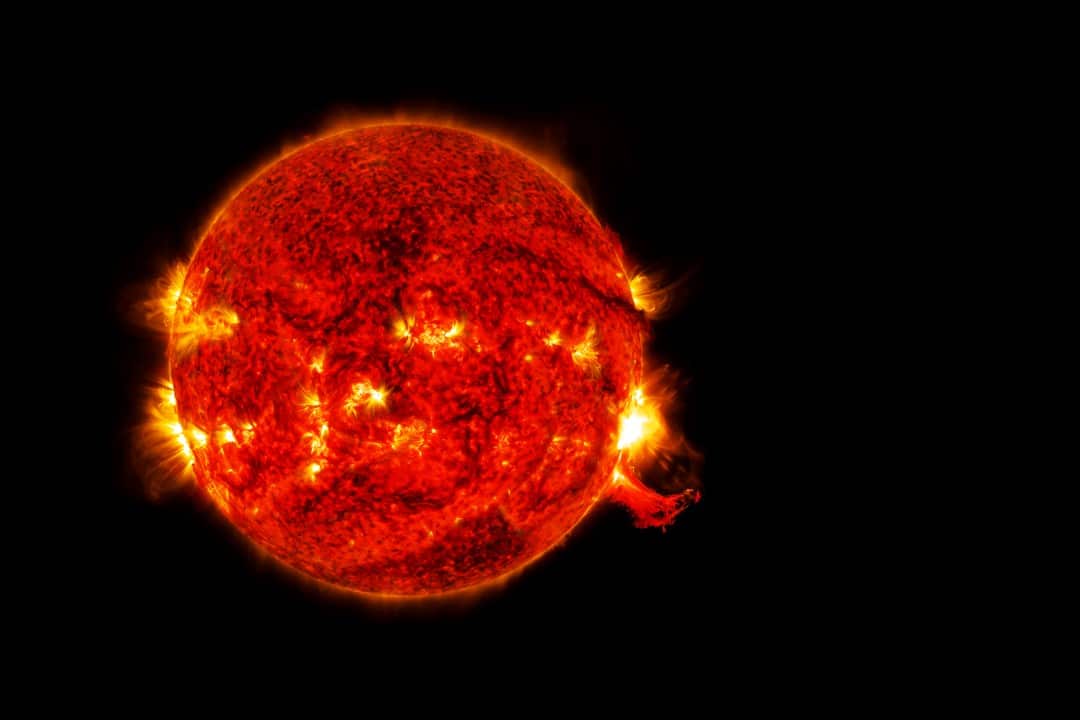
Instruments detected an additional coronal mass ejection bursting from the eastern solar limb, but spatial trajectory modeling confirmed the blast propelled its material away from Earth.
Predictive space models confront persistent uncertainties regarding arrival timelines and magnetic orientation across forty-eight-hour forecast windows. Such variables shape the total impact.
Solar activity maintained low background emissions with sporadic C-class events and isolated M-class flare chances across the surface.





