
Kevin Boardman reveals detailed gas filaments of Crescent Nebula

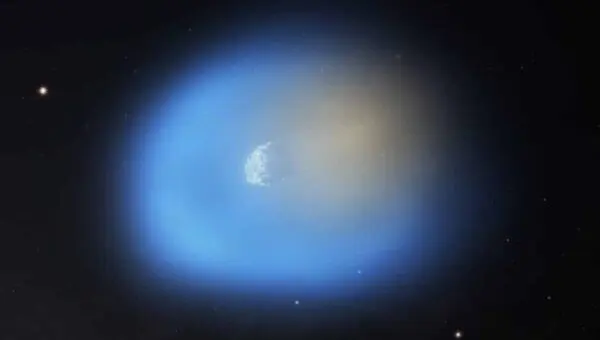
Astrophotographer Kevin Boardman documented the intricate gas filaments of the Crescent Nebula in the constellation Cygnus during late July. The celestial formation sits approximately 4,700 light-years away from Earth and surrounds an aging massive star.
WR 136 will explode.
Astronomers designate the central body as colossal Wolf-Rayet star WR 136, also recorded as HD 192163, visible as a blue point of light at the heart of the structure. NASA reported that the 25-light-year-wide bubble formed from stellar material shed by the star during its transition into a red giant. Repeated impacts from fast-moving stellar winds generated shockwaves across the outer shell to carve the tangled gas filaments.
Read also: Green comet lights up the Namibian sky in astronomical photography
Structure of the cosmic bubble around WR 136
The stellar wind drives material outward while the system approaches its final evolutionary stage. Scientific forecasts estimate that WR 136 will conclude its existence in a supernova explosion in approximately 100,000 years.
Astronomical catalogues identify the cloud as NGC 6888 or Caldwell 27.
Learn more: High-precision lenses capture the greenish trail of a celestial body on the African continent
Narrowband exposures collected over five nights
Boardman captured the nebula across five nights in late July by dedicating 16 hours and 18 minutes of total exposure time through specialized narrowband filters, which isolated distinct light wavelengths from ionized gases before combining exposures in PixInsight software during digital post-processing. The imaging protocol allocated roughly 12 hours of data to the nebula itself alongside four hours and 20 minutes focused on the surrounding star field.
“In the image, orange-red H-alpha reveals the tangled filaments while blue-cyan [O III] outlines emission from doubly ionized oxygen around the shell,” Boardman stated in an email. Each filter isolates specific wavelengths of light emitted by ionized gases, allowing different structural layers within the gas cloud to emerge clearly against the background of space. PixInsight software then combined the separate astronomical exposures during post-processing to align the faint details with the starry backdrop.
Technical specifications of the imaging equipment
Kevin Boardman operated dedicated astro camera equipment to record the faint gas structure. The hardware system relies on several performance specifications:
On the same topic: Astrophotographers record rare green comet shining over Namibian skies
- Sensor resolution reaches 9MP.
- Quantum efficiency stands at 80%.
- Capture rate operates at 20FPS.
- Sensor architecture features zero amp glow.
The ZWO ASI533MC Pro camera served as the capture device for the multi-night project.
How observers can locate the formation in Cygnus
The Crescent Nebula remains too faint for naked-eye detection, but observers can view it throughout September with a moderate-to-large telescope equipped with a light pollution filter. The object gained its popular designation because it resembles a crescent moon when viewed across specific optical wavelengths.
Stargazers can locate magnitude +2.34 star Sadr at the center of the cross-shaped constellation Cygnus high overhead during late summer in the Northern Hemisphere. Observers must next find magnitude +4.03 star Eta Cygni with a star chart or a smartphone astronomy application. The Crescent Nebula sits directly between Sadr and Eta Cygni.
Dark skies surrounding the new moon phase on Sept. 10-11 provide optimal visibility for telescope observation.
More news in Latest News (EN)
See more → Webb and Hubble identify primitive icy bodies past Neptune
 Seven global phones receive early access to Xiaomi HyperOS 4
 Comet 3I/ATLAS shows origin in deep freeze of distant star
 Apple prepares rollout of seven new devices for September
 Samsung modifies Galaxy support timeline in September 2026
 Instagram welcomes Jennifer Lawrence as verified profile debuts
 Prince Louis and Princess Charlotte begin new term at Lambrook
 Sony launches preorders for two limited GTA 6 controllers
 Retailers release cases for iPhone 18 Pro and iPhone Duo
More news on Mix Vale
- 1Samsung patches 90 security flaws in September 2026 update
- 2Apple unveils AirPods 5 alongside new Watch Ultra 4 lineup
- 3Apple unveils Series 12 watch with advanced health sensors
- 4Fatal Amazon cargo jet crash: new data reveals pilot warnings about excessive speed before Miami runway overrun
- 5Apple iPhone Duo challenges Samsung Galaxy Z Fold8 Ultra
- 6Major retailer faces scrutiny as key product costs reportedly rose during price freeze campaign
- 7Kremlin alleges Kyiv sought to ignite conflict between Russia and United Kingdom, London refutes claim
- 8Green Bay Packers’ Josh Jacobs enters no contest plea, setting stage for NFL ban
- 9Homeowner association records online may expose personal data to scammers, fueling fraud risks
- 10Mudança imigratória: proposta busca extinguir carência de 60 dias para vistos H-1B em caso de demissão