
Lensed gravitational waves explain black hole collision

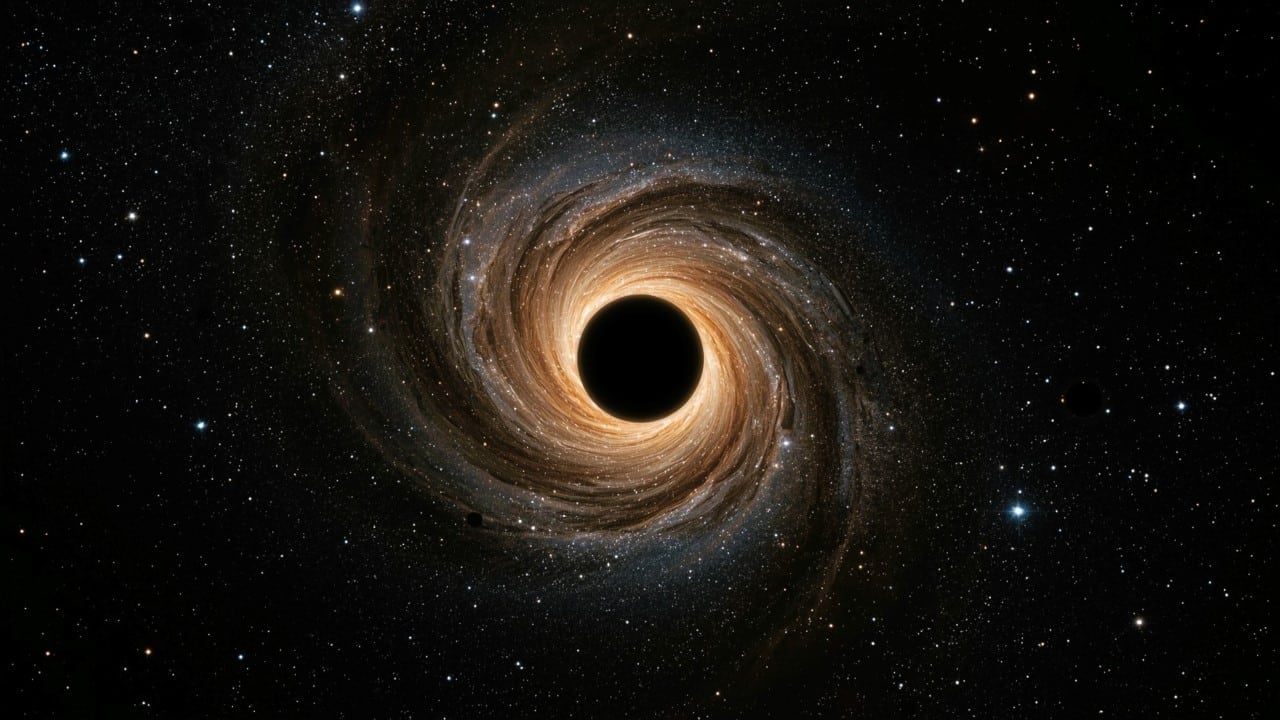
The Laser Interferometer Gravitational-Wave Observatory detected ripples in spacetime from a massive black hole collision on November 23, 2023. Designated GW231123, the event initially registered as an impact between two objects measuring 140 and 100 times the mass of the sun. New analysis published on August 25 in the Astrophysical Journal Letters indicates that gravitational lensing warped the signal and produced an optical magnification of smaller masses.
Standard stellar evolution models do not easily produce rapidly spinning black holes of that scale.
According to research conducted at the Albert Einstein Institute, the physical system held a total of 140 solar masses instead of the theoretical 240 solar masses calculated during initial observations. Albert Einstein formulated the underlying mechanism within his 1915 theory of general relativity, which established that mass curves four-dimensional spacetime to generate gravitational force.
Distortion effects predicted by general relativity
Gravitational lensing alters the path of radiation when mass bends spacetime along a trajectory toward detectors on Earth. The resulting diversion causes signals from a single background origin to arrive along distinct paths at differing times. This process magnifies distant targets across cosmic distances.
Researchers confirmed that the identical physical principle influences gravitational waves emitted during violent cosmic collisions.
“Like light, gravitational waves can also be deflected, magnified and split into multiple signals by massive objects,” said Miguel Zumalacárregui, group leader in the Astrophysical and Cosmological Relativity Department at the Albert Einstein Institute. “For gravitational waves, diffraction and interference effects give us an additional way to identify and study lensed signals.”
Mathematical modeling revises mass estimates
The research team built dedicated analytical software to simulate the mathematical behavior of magnified gravitational waves. Their model demonstrated that intervening cosmic structures explain the high readings obtained by monitoring stations.
Several distinct factors explain the altered parameters recorded during the November 23, 2023 observation:
- Intervening compact masses ranging between 190 and 850 solar masses diverted the signal path.
- Extended formations such as globular clusters generated similar wave distortions.
- The physical binary system contained a collective 140 solar masses rather than 240 solar masses.
- Orbital rotation rates remained within ordinary physical thresholds without requiring extreme spin rates.
“If we assume that GW231123 was deflected and distorted by a compact object of about 190 to 850 solar masses — or by an extended structure such as a globular cluster — we can understand the observed high masses,” said researcher Srashti Goyal. “Moreover, the lensing interpretation does not require unusually high spins.”
Gravity bends spacetime paths.
Mystery remains over the intervening lens
Astrophysicists have not identified the physical body that distorted the GW231123 transmission. Isolated objects within the range of 100 to 1,000 solar masses remain uncommon across astronomical surveys.
“The nature of the lens remains a major mystery in our analysis, as individual compact lenses with 100 to 1,000 solar masses should be exceedingly rare,” Zumalacárregui said. “Future work will need to establish whether such lenses can form, or whether an ensemble of lighter objects, including stars, can explain this event.”
Technical upgrades planned for wave detectors
Confirming GW231123 as the first proven instance of a lensed gravitational wave requires hardware enhancements at facilities like LIGO. The study appeared in the Astrophysical Journal Letters on August 25.





