
Astronauts service lab gear and spacesuits on orbital station

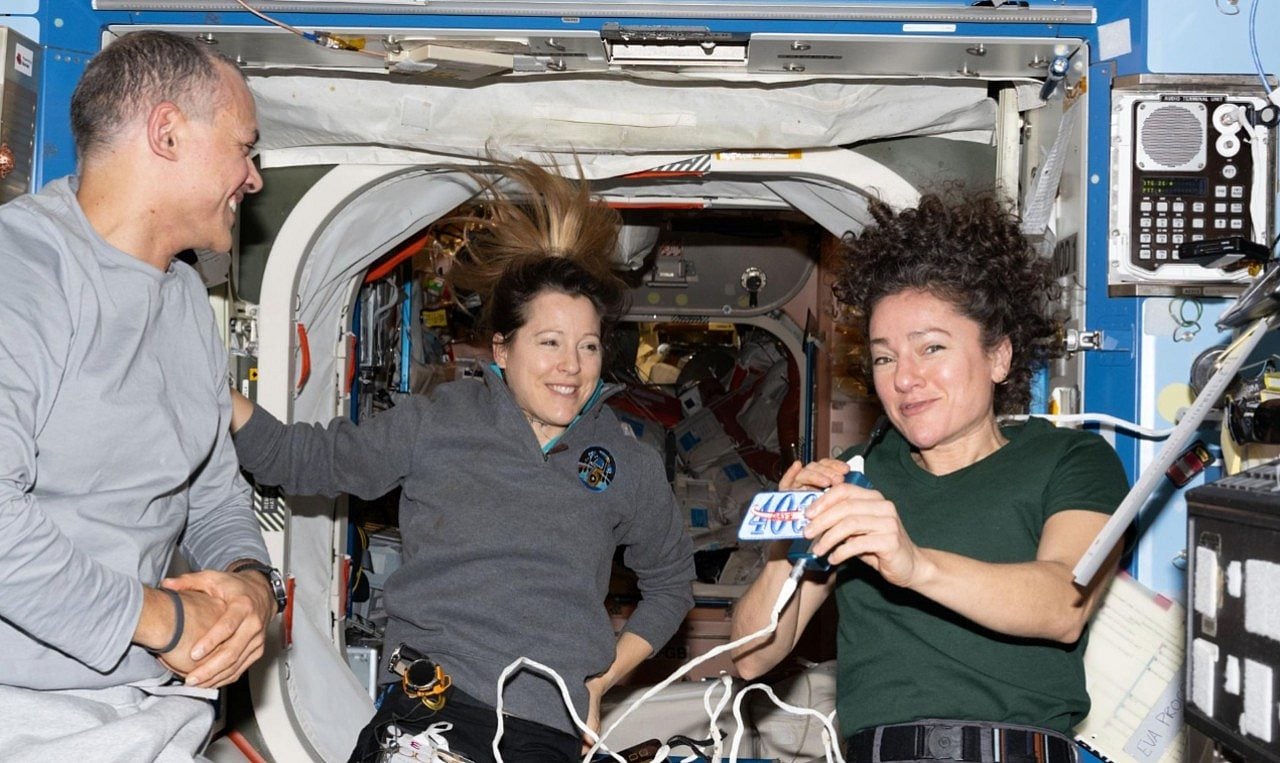
Astronauts aboard the International Space Station prioritized spacesuit maintenance and laboratory hardware operations on September 10, 2026. The Expedition 75 crew members also filmed and photographed their routine activities inside the orbiting laboratory to share visual documentation with public audiences on Earth.
Station commander Jessica Meir of NASA set up the newly delivered NEMO microscope inside the Destiny laboratory module. Meir assembled the biological research instrument, placed tissue specimens inside the observation chamber, adjusted dedicated hardware designed to regulate and track ambient carbon dioxide levels, and ran a comprehensive series of checks to verify electrical power supply and baseline mechanical operation across all integrated systems. The device, officially named the Nikon Experimentation Microscope in Orbit, captures automated imagery of cellular development to help researchers assess how microgravity alters disease pathways, tissue growth, and pharmaceutical reactions.
Meir later unhooked and packed physics equipment from Destiny’s Microgravity Science Glovebox after the completion of crystal growth experiments aimed at improving terrestrial semiconductor production.
Inside the Quest airlock, Meir assisted NASA flight engineer Anil Menon as he exchanged radio communications components across two spacesuits. Menon tested communication units. He checked multiple frequency channels and established live data links with ground controllers, while Meir inspected and stowed safety tethers deployed during four earlier spacewalks conducted between August 6 and September 1.
NASA flight engineer Jack Hathaway started work by verifying laptop computer batteries and assessing general computer operations before securing cargo inside a hatch located above the Unity module and mounting protective window covers. Hathaway dedicated the remainder of his work shift to plumbing upkeep within the Tranquility module.
Flight engineer Sophie Adenot of ESA, the European Space Agency, recorded bilingual narrated tours in French and English while floating across interconnected station modules to promote space science engagement among youth and adult audiences.
Roscosmos flight engineers Pyotr Dubrov and Anna Kikina conducted visual assessments and photographed storage compartments situated inside the Zarya and Nauka modules. Dubrov also recorded photos and video footage of crew members performing routine station duties. Kikina focused her efforts on ventilation maintenance within the Zvezda service module.
Roscosmos flight engineer Andrey Fedyaev examined a tablet computer alongside its cabling and power storage before replacing dust filters inside the Nauka science module. Fedyaev concluded his scheduled duties with a run on the Zvezda treadmill and resistance training on the exercise device in Tranquility.





