
Black hole hair searches advance with new collision model

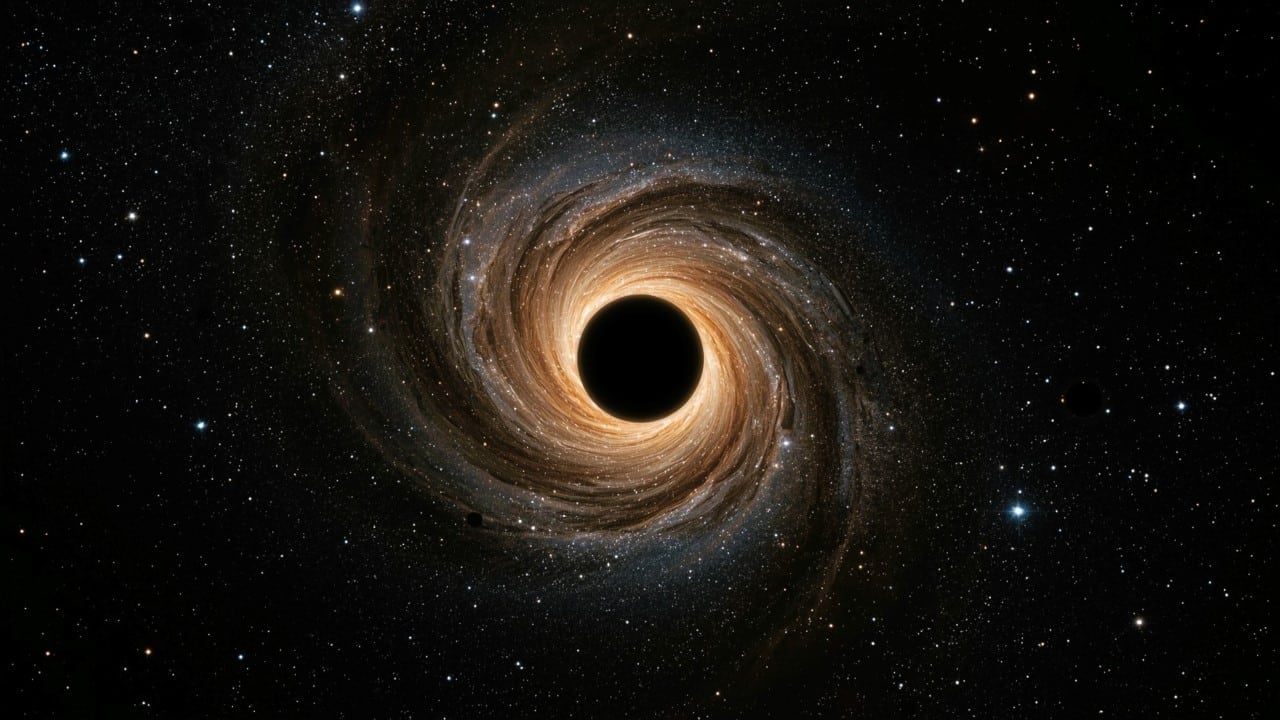
Nagoya University physicists in Japan presented on September 7, 2026, a theoretical framework to detect whether black holes carry unobserved external structures.
Albert Einstein formulated general relativity under principles establishing that three measurable parameters define any basic black hole: total mass, rotational rate, and electric charge. Because no other surface characteristics exist under this standard model, researchers historically described these cosmic objects as completely bald.
Alternative calculations departing from Albert Einstein’s baseline suggest that extraneous matter fields could gather near the horizon, creating what theorists term hidden hair.
The research team based at Nagoya University in Japan identified a method on September 7, 2026, to isolate these hypothetical structures by analyzing the gravitational ripples emitted during cosmic mergers. These spacetime disturbances register unique signatures as two massive bodies coalesce.
The academic findings appeared on September 7, 2026, following formal peer review in the Journal of Cosmology and Astroparticle Physics.

Gravitational vibrations reveal merger dynamics
A fusion of 2 black holes unleashes massive spacetime ripples across surrounding space. This cataclysmic impact resonates in a manner analogous to a struck chime.
Nagoya University investigators track the fading frequency pattern known as the ringdown phase, which discloses physical traits as the newly formed single body stabilizes.
Standard objects exhibit 3 properties. Calculations by the Nagoya University team establish that extraneous matter surrounding the newly formed boundary distorts the natural vibration frequencies, producing distinct deviations that alert astronomers to physical structures situated outside the classic parameters formulated by Albert Einstein. These subtle distortions give researchers an empirical pathway to detect the missing hair.
Theoretical framework traces subtle wave variations
The investigators at Nagoya University clarified that their work does not confirm an observed discovery, but rather provides an exact detection strategy. The team modeled simulated black holes to determine how minor quantities of surrounding material alter ringdown waveforms.
Their simulations demonstrated that exterior matter alters 2 distinct components of the signal: oscillation frequency and dissipation rate. Because these 2 parameters shift at unequal rates, the discrepancy indicates whether matter surrounds the object. The data also reveals environmental pressure variations across the boundary.
Lead author Ariadna Uxue Palomino Ylla of Nagoya University explained the implications of these signal shifts:
“The ringdown waves may not only show that something extra is affecting the black hole; the way the signal changes could also give us clues about what this hidden matter is actually like,” Palomino Ylla stated. Her assessment outlines how future detectors could classify exotic materials.
Rotational effects alter surrounding particle behavior
The Nagoya University study also examined 1 rotating model, observing that photons orbit along 2 contrasting paths depending on whether trajectory aligns with or opposes the spin axis.
External matter modifies ringdown frequency and decay rate differently based on the orientation of the spin axis. Analyzing this precise pattern enables astrophysicists to categorize the physical properties of the surrounding matter.
When gravitational observatories record future mergers involving 2 colliding black holes, researchers will apply this mathematical framework to test for anomalous physics near the fused boundary.
Astronomers measure wave variations to confirm whether non-standard matter surrounds the horizon. This observational approach focuses on the distinct decay traits of gravitational signals.





