Comet 3I/ATLAS forms at 30 Kelvin in deep interstellar space

Astronomers identified that interstellar comet 3I/ATLAS developed under extreme cold conditions outside the Solar System, according to an investigation in the Monthly Notices of the Royal Astronomical Society. The celestial visitor represents the third interstellar object cataloged by modern science. Spectroscopic measurements captured volatile chemical elements preserved since the formation of the object in its home planetary system.
Cold preserves volatile ice. The deep thermal freeze locked primordial matter into the comet nucleus without chemical breakdown over eons.
Spectroscopic signals reveal cold nursery conditions
Spectral examination of the coma surrounding 3I/ATLAS revealed high proportions of carbon monoxide and additional compounds that solidify exclusively below 30 Kelvin, a thermal threshold found on the remote outer margins of foreign protoplanetary disks. Because of this peculiar chemical mixture, researchers publishing in the Monthly Notices of the Royal Astronomical Society determined that the comet remained completely shielded from stellar radiation during the entire dust accumulation phase before massive gravitational perturbations ejected it into deep space. That volatile profile differs sharply from comets that take shape in the interior regions of active nebulae. The low temperature prevented thermal reactions from modifying the original building blocks of the nucleus.
Relative abundances of simple gases functioned as a chemical thermometer to pin down the birthplace of the visitor. Detectors measured the sublimation pace as solar radiation warmed the outer surface crust of 3I/ATLAS.
Carbon monoxide vaporizes with unusual ease compared to conventional water ice. This physical property produced a dense particle cloud around the body well before its perihelion passage. Astronomers used ground-based observatories to break down this light into distinct wavelengths.
Hyperbolic course verifies an interstellar crossing
Sun gravity failed to capture the speeding object. The comet crossed the Solar System at a rate faster than solar gravitational escape velocity.
Orbital mathematics verified an eccentric hyperbolic value well above 1, demonstrating that the icy wanderer does not originate from the Oort Cloud or the Kuiper Belt. The object traces an unbound path across the ecliptic plane at a steep inclination, preventing any return to solar orbit after its departure. The astrophysics team matched the observed velocity curve against records from the ATLAS survey, which first logged the interloper. Planetary tides within the Solar System merely bent the escape trajectory of the rock and ice structure.
Hyperbolic excess velocity measures tens of kilometers per second. This high kinetic energy confirms the icy body originated outside our planetary neighborhood.
Periodic comets native to the Solar System maintain closed elliptical paths with an eccentricity below 1. For 3I/ATLAS, solar gravitational pull served only as a brief turning point during an ongoing interstellar journey. Ground observatories tracked the rapid motion across constellations in the night sky.
Molecular makeup contrasts with local cometary bodies
Carbon-to-oxygen ratios in 3I/ATLAS diverge from Solar System baselines. The object possesses an elemental balance that differs from the native inventory of the local planetary system.
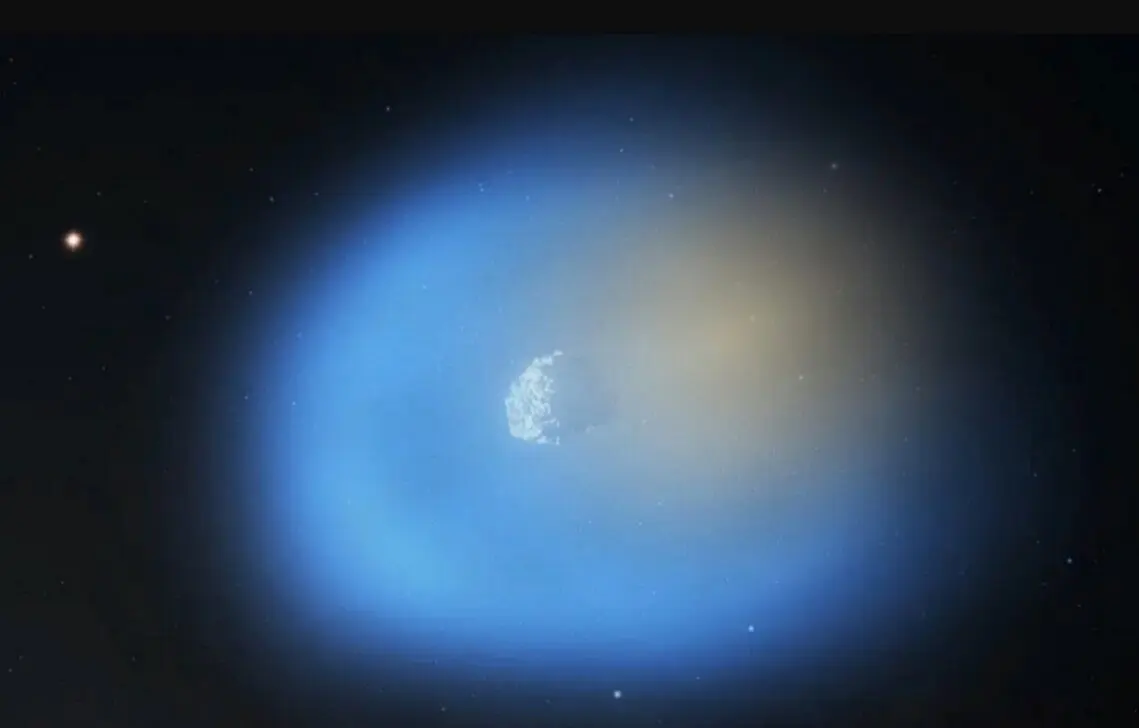
Comets such as Halley and 67P/Churyumov-Gerasimenko hold dominant signatures of water ice, whereas the interstellar visitor displays excessive amounts of hyper-frozen volatiles. The study in the Monthly Notices of the Royal Astronomical Society shows that this distribution reflects the chemical makeup of the interstellar cloud where the comet formed. Researchers recorded cyanogen detections at levels that diverge from Oort Cloud specimens. The complete absence of prior heating preserved these compounds intact inside the inner strata of the core.
The chemical structure survived the interstellar crossing intact. High-energy cosmic rays altered only the outermost crust, leaving the deeper rocky core undisturbed.
Three identified interstellar intruders expand astronomical records
Astronomers detected the first interstellar visitor in October 2017 with the discovery of 1I/Oumuamua, which exhibited an elongated shape without a noticeable dust coma. In August 2019, 2I/Borisov joined the astronomical catalog as the second foreign intruder, displaying classic cometary activity driven by water ice sublimation. The arrival of 3I/ATLAS expands this registry of analyzed extrasolar objects.
- 1I/Oumuamua entered observation logs in October 2017 without an observable dust coma.
- 2I/Borisov appeared in August 2019 displaying standard volatile water sublimation.
- 3I/ATLAS arrived as the third cataloged specimen carrying deep freeze volatiles.
Alien comets provide insight into faraway planetary origins. Researchers extract physical and chemical baselines from these wandering objects.
The discovery of 1I/Oumuamua triggered scientific debate due to non-gravitational acceleration without an apparent cometary tail. In contrast, 2I/Borisov demonstrated that standard comet physics functions similarly across separate protoplanetary disks in the Milky Way. The detection of 3I/ATLAS proves the survival of icy bodies formed within the coldest boundaries of distant star systems. Data collected in the Monthly Notices of the Royal Astronomical Society helps calibrate numerical models of planetary migration.
Space telescopes monitored brightness shifts across multiple approach phases. Photometric tracking helped scientists calculate the physical dimensions of the solid nucleus.
Planetary gravitational scattering expels frozen debris outward
Dynamic interactions during the early stages of the home star system explain the presence of 3I/ATLAS in deep space, where migrating gas giants hurled trillions of icy fragments outward. Three-body gravitational interactions between massive protoplanets and smaller planetesimals accelerated cometary nuclei beyond the escape velocity of the host star. Computational models indicate that the original protoplanetary disk carried sufficient mass to form gas giants while expelling remnant material into the galaxy. This dispersal mechanism distributes condensed matter throughout the Milky Way over billions of years.
Dynamic expulsion preserved the initial thermal conditions of the nucleus. The violent ejection hurled the body into deep space before local stellar heat could alter its interior.
Interstellar space maintains an ambient temperature around 2.7 Kelvin, governed by the cosmic microwave background radiation. This absolute thermal baseline prevented melting or internal chemistry during a voyage spanning millions of light-years across starless voids. As the comet approached the Sun, solar heat reactivated volatile vaporization processes that had remained dormant since its initial ejection.
Ground observatories continue gathering positional data on 3I/ATLAS before it fades past visual range. The trajectory measurements will refine the exit arc as the frozen traveler heads toward outer space.