Dinosaur footprints alter motion models in sedimentary rocks
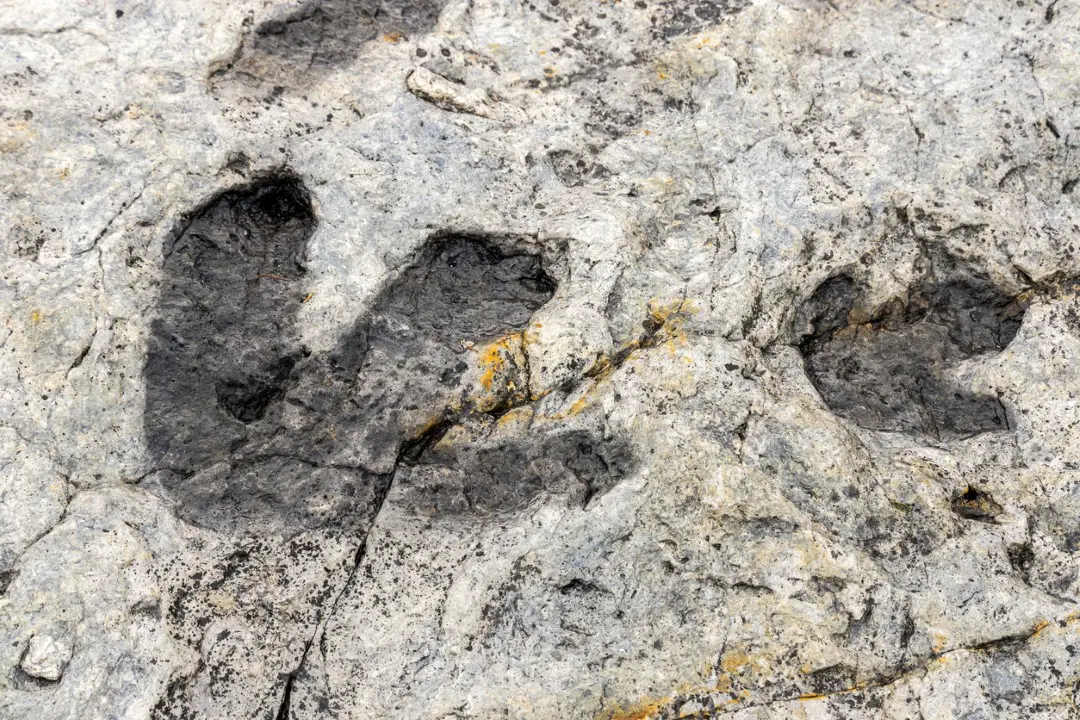
Paleontologists identified an unexpected, asymmetrical walking gait in dinosaur tracks preserved within sedimentary rock formations. Digital mapping of depth and stride angles confirmed that the prehistoric animal moved with dynamic limb flexibility rather than rigid, upright postures.
Mechanical shifts in stride and weight distribution
Researchers mapped the depth, spacing, and angles across sedimentary rock formations to reconstruct physical movement, showing that the creature shifted its mass onto hind limbs in an asymmetrical pattern that contradicted previous biomechanical models of rigid, frontal locomotion. The scientists evaluated the ratio between stride length and imprint depth to calculate body mass distribution during motion. Soil composition at the time of track formation ruled out external geological shifts as the source of these structural variations.
The prints showed marked asymmetry.
Track intervals indicated that the animal alternated between slow pacing and rapid acceleration during travel. This variable speed profile reflects locomotion strategies modern birds and reptiles display in dynamic environments.
Digital mapping tools and modern locomotion models
The team deployed high-resolution laser scanning, optical photogrammetry, and three-dimensional surface software to evaluate the fossil impressions without damaging the substrate. Virtual replicas allowed researchers to rotate, cross-section, and measure depth contours from coordinates across the print bed. These structural measurements clarified how force transferred through the foot during movement.
- High-resolution laser scanners created exact three-dimensional digital replicas of each depression.
- Photogrammetry software calculated surface variations across multiple angles without disturbing the original matrix.
- Data algorithms matched anomalous pressure points against modern avian and reptilian locomotion records.
Data systems and machine learning tools processed footprint geometry against motion datasets recorded from living terrestrial animals. Computational comparisons isolated gait anomalies that manual visual examinations overlooked.
Field investigations across sedimentary fossil deposits
The revised locomotion data requires institutions to adjust natural history museum skeletal armatures and academic textbook reconstructions. Anatomists will recalculate mechanical models of soft tissue, leg musculature, and joint articulation to accommodate asymmetric weight transfer. These locomotion parameters also alter assessments of how dinosaurs pursued prey, avoided rival carnivores, and maintained stability during mating interactions. Virtual simulation software now integrates these footprint metrics to render biological motion accurately.
Field teams plan to search additional sedimentary horizons for related trace fossils. The upcoming surveys will examine whether adjacent rock layers preserve fossilized bone specimens matching these biomechanical characteristics.