
Nagoya University maps 2 black hole wave shifts in mergers

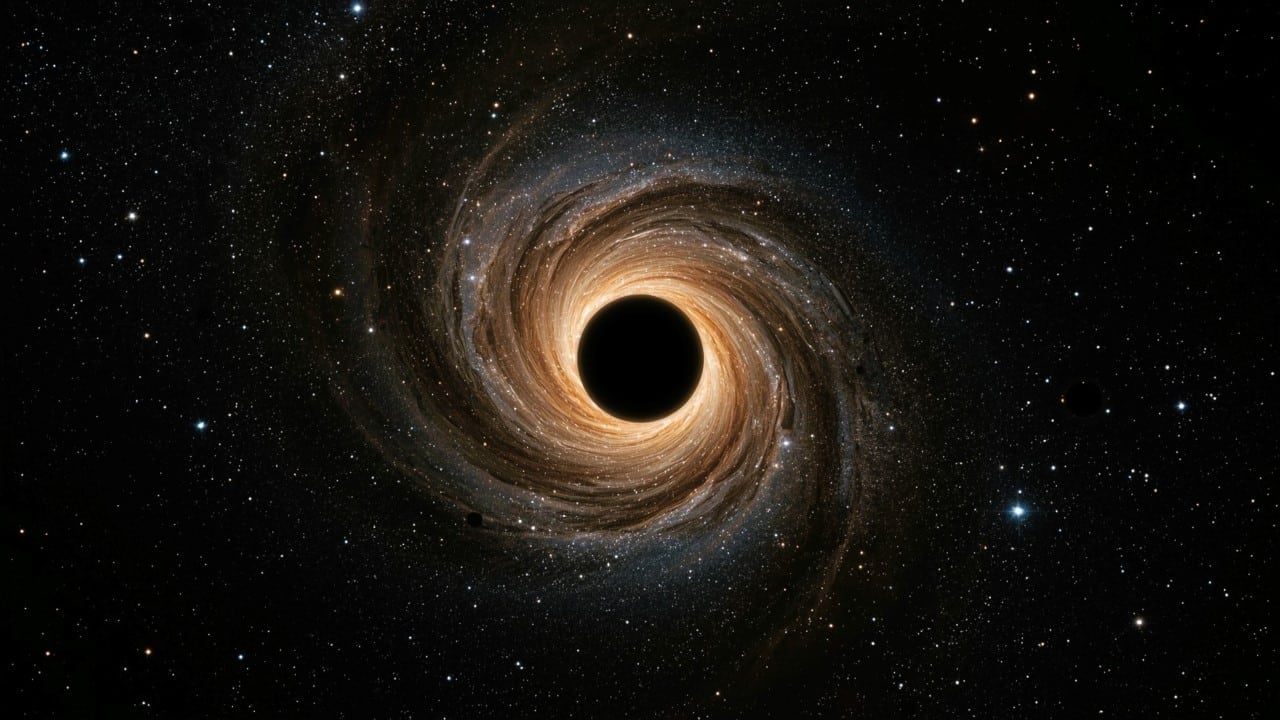
Physicists from Nagoya University in Japan presented a mathematical detection framework on September 7, 2026, to identify whether black holes carry unobserved external structures. The theoretical study appeared following peer review in the Journal of Cosmology and Astroparticle Physics. The modeling focuses on gravitational waves emitted when two massive celestial objects merge.
Gravitational signals after collision expose hidden boundaries
The violent collision of 2 black holes unleashes massive spacetime ripples across the surrounding cosmos. The collisions warp spacetime.
Nagoya University investigators track the fading frequency pattern known as the ringdown phase during these events. This stage discloses physical traits as the newly formed single body stabilizes. Standard general relativity formulated by Albert Einstein dictates that basic black holes remain completely bald. Theorists term any extraneous matter gathering near the event horizon as hidden hair.
Core differences from standard relativity parameters
Under the baseline established by Albert Einstein, only 3 measurable parameters define an ordinary black hole. Any deviation from these standard characteristics signals anomalous physics:
- Total mass determines the baseline scale of the object.
- Rotational rate dictates how the surrounding spacetime drags.
- Electric charge governs fundamental electromagnetic interactions.
Standard calculations derived by the Nagoya University team establish that extraneous matter surrounding the newly formed boundary distorts natural vibration frequencies, producing deviations that alert astronomers to physical structures situated outside the classic three parameters formulated by Albert Einstein. These subtle distortions provide an empirical pathway to detect the missing hair. The academic analysis originated on September 7, 2026.
Simulated collision dynamics track signal decay variations
Investigators clarified that the Nagoya University study does not confirm a direct physical observation. Instead, the team designed an exact detection strategy through numerical simulations.

The computational models demonstrated that exterior matter alters 2 distinct components of the gravitational signal during ringdown. These affected parameters consist of the oscillation frequency and the dissipation rate. Because these 2 parameters shift at unequal rates, the discrepancy exposes environmental pressure variations across the boundary. Lead author Ariadna Uxue Palomino Ylla of Nagoya University evaluated these signal variations.
“The ringdown waves may not only show that something extra is affecting the black hole; the way the signal changes could also give us clues about what this hidden matter is actually like,” Palomino Ylla stated. Her evaluation outlines how future detectors could classify exotic materials.
Spinning masses produce distinct orbital pathways
The Nagoya University study also examined 1 rotating model to analyze angular momentum effects. Photons in this setup orbit along 2 contrasting paths depending on whether their trajectory aligns with or opposes the spin axis. External matter modifies the ringdown frequency and decay rate based on this orientation.
Analyzing this directional behavior enables astrophysicists to categorize the physical properties of surrounding material. When observatories record future mergers involving 2 colliding bodies, researchers will apply this mathematical framework to test for anomalous fields.
Theoretical physicists at Nagoya University established that ringdown frequencies change measurably when matter surrounds the event horizon. These mathematical proofs provide gravitational wave observatories with precise numerical targets. Future detector runs will search for these subtle frequency shifts during binary coalescences. Astronomers measure these wave variations to confirm whether non-standard matter surrounds the horizon.
This observational approach focuses specifically on the distinct decay traits of gravitational signals. The mathematical framework applies directly to binary merger data recorded across ground-based detector networks.





