
Interstellar comet 3I/ATLAS travels at 66 km/s near Jupiter


NASA released updated orbital trajectory calculations for interstellar comet 3I/ATLAS based on observations gathered by ground telescopes in Hawaii. Instruments recorded the celestial body moving at 66 kilometers per second relative to the Sun.
The interstellar traveler continues along its trajectory through the solar neighborhood. Gravitational forces fail to alter its outward momentum as it progresses across interplanetary space. The object poses no danger.
Spectral measurements collected by ground telescopes in Hawaii detected substantial concentrations of carbon monoxide, water ice, and hydrogen cyanide within the surrounding gas envelope, revealing a chemical profile distinctly different from celestial objects that formed in our solar system. The survey operated by the Asteroid Terrestrial-impact Last Alert System initially tracked the object as it crossed regions near the orbit of Jupiter. Astronomers stationed at the Jet Propulsion Laboratory in Pasadena subsequently calculated an orbital eccentricity of 1.45 for the hyperbolic trajectory. This measurement confirms the visitor originated from outside our planetary system.
An eccentricity value exceeding 1 demonstrates that solar gravity cannot capture the object into a closed elliptical orbit. This dynamic state ensures the comet will escape back into interstellar space after reaching perihelion.
Telescopes record physical dimensions and surface heat
The James Webb Space Telescope constrained the solid core diameter between 800 meters and 1.2 kilometers. Sublimation causes the comet to shed approximately 45 kilograms of mass every second during its approach to the Sun. Thermal detectors at the W. M. Keck Observatory on Maunakea registered an apparent visual magnitude of 16 alongside a surface temperature of 140 Kelvin on the sunlit hemisphere.
Calculations confirm the incoming object will not strike Earth. Trajectory projections rule out any possibility of impact with our planet.
The Center for Near Earth Object Studies in Maryland calculated a closest planetary approach of 240 million kilometers, which equals 1.6 astronomical units. The perihelion point lies 180 million kilometers from the solar surface. Flight teams use these exact orbital coordinates to calibrate deep space radars and ground sensors.
Spectroscopic readings reveal carbon monoxide and frozen water
The released gas contains three times more carbon monoxide than comets originating from the distant Oort Cloud. Researchers working at the La Silla Observatory in Chile also confirmed microscopic silicate dust grains dispersed across the coma.
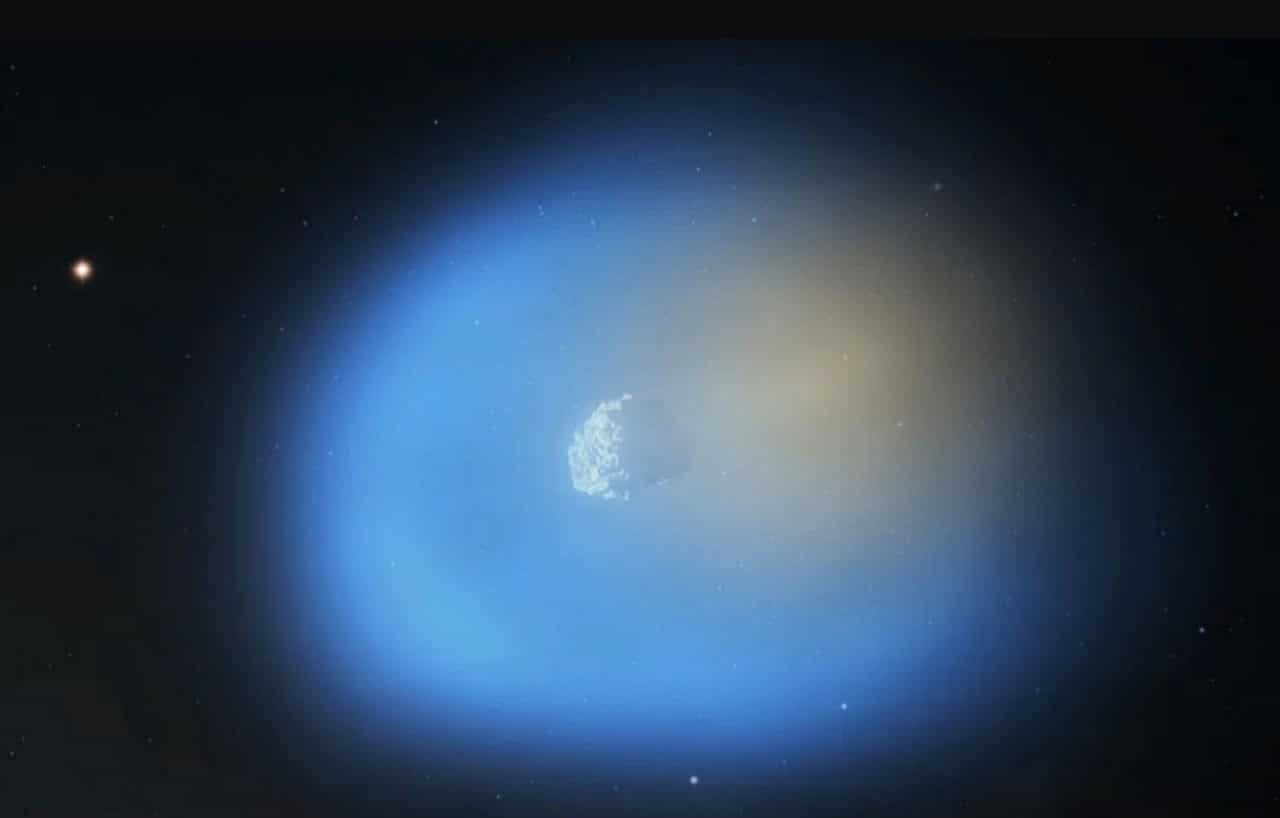
Telescopic instruments identified multiple distinct chemical signatures across the gaseous envelope. Spectrographs cataloged various volatile molecules discharging from the core. These analytical findings confirmed the following core components:
- Moderate amounts of frozen water across the external crust
- Continuous spectral emissions generated by carbon monoxide gas
- Hydrogen cyanide signatures detected within the inner coma
- Simple organic compounds structured on carbon chains
- Dust particles rich in iron and magnesium within peripheral gas jets
The ALMA radio telescope in the Atacama Desert determined that the nucleus completes a full axial rotation every 14 Earth hours. Radio dishes captured thermal data indicating controlled structural fragmentation along the eastern crust. This erosion exposes interior material that remained undisturbed since the object was ejected from its home star system. Spectrographic charts also recorded low amounts of free molecular nitrogen.
Astrophysicists compared the incoming data to records from 1I/’Oumuamua and 2I/Borisov, which entered the solar system in 2017 and 2019. Those earlier interstellar detections provide baseline metrics for evaluating this third visitor.
Global observatories deploy sensors to track interstellar path
The international observation campaign connects space platforms with ground stations situated across three continents. Technicians at the European Southern Observatory altered detector exposures to record emissions from the ionized gas tail. The Hubble Space Telescope captured image series to separate core reflectance from diffuse coma glare, while flight controllers in Baltimore scheduled four ultraviolet observation runs.
Hyperbolic momentum propels 3I/ATLAS toward the constellation Pegasus and away from the planetary plane. The visitor continues to gain distance from the ecliptic as it recedes into deep space.
NASA plans to end high-resolution optical tracking in November 2026 when solar glare blocks terrestrial instruments. Research teams will deposit final observational records into the Planetary Data System repository in Washington. That archive preserves raw telemetry for future planetary defense evaluations.
The tracking campaign required an operational expenditure of 3.8 million dollars from the planetary science division budget. Accounting ledgers marked the allocation as part of annual monitoring costs.





