NASA orbiter detects rare century crater on lunar surface

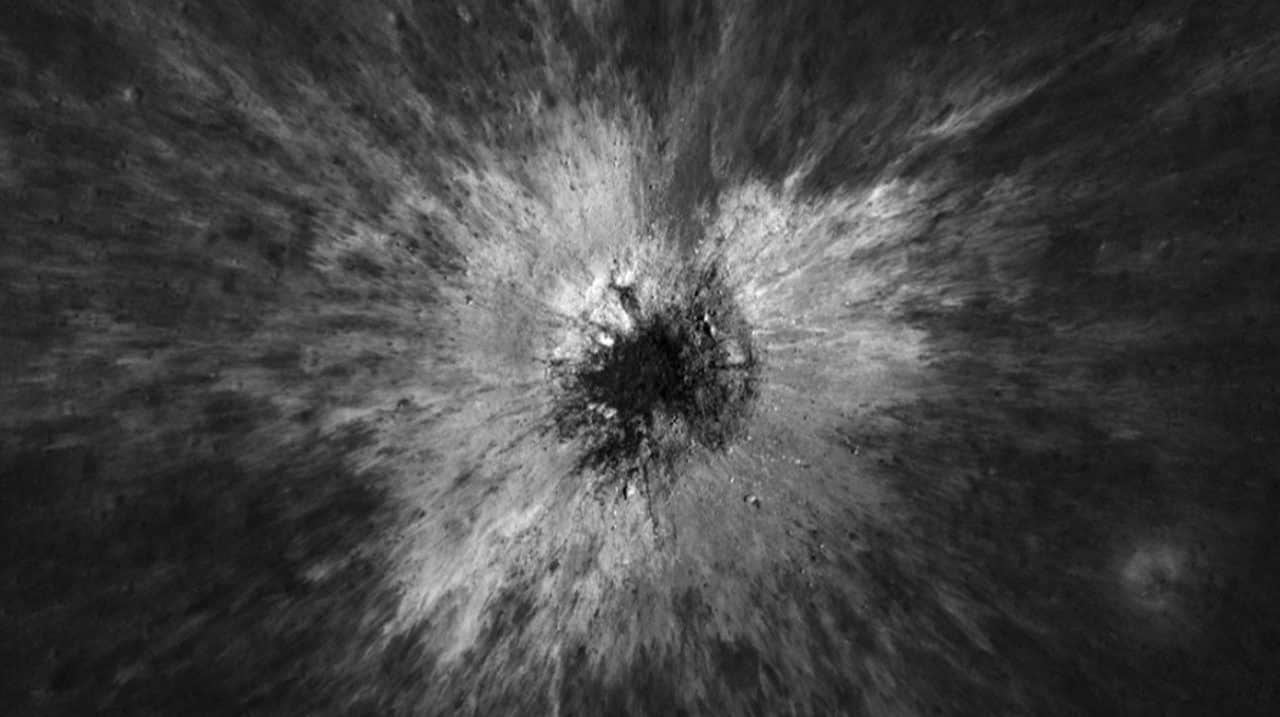
Robert Wagner, an image specialist connected to NASA’s Lunar Reconnaissance Orbiter mission, spotted an extensive luminous patch bordered by a dark ring across a digital Moon mosaic during routine verification work. The distinct marking showed that geological material on the celestial body had suffered a powerful disturbance.
“I just stopped, dropped everything, and started looking into what that spot was,” stated Wagner, an image-processing specialist from Intuitive Machines who analyzes Lunar Reconnaissance Orbiter Camera records.
Wagner examined contrasting historical and modern frames of the lunar surface, uncovering the most expansive fresh impact basin identified across the entire solar system according to findings published in Science Advances. The observation confirmed an ongoing seismic and physical evolution across the lunar crust. NASA utilizes orbital sensor records to examine surface changes as the agency develops long-term crewed missions and expands commercial activity on the Moon.
Named McGetchin in honor of lunar researcher Tom McGetchin, the cavity emerged along the eastern edge of the Moon between April 11, 2024, and May 22, 2024, when a comet or asteroid measuring between three and six stories struck the surface. The collision carved an excavation 728 feet across, matching the span of two football fields. Its depth reaches 141 feet, an opening large enough to hold three yellow school buses placed end to end. Researchers calculate that a strike of this size hits the Moon roughly once every century.
The Lunar Reconnaissance Orbiter has circled the Moon for more than 17 years, deploying seven distinct scientific packages to track elevation, mineral distribution, temperature shifts, and environmental radiation. Mission operators cataloged at least 1,000 fresh impact craters alongside 100,000 localized surface shifts caused by direct strikes or secondary debris scatter.
Lunar ground lacks atmospheric shielding. Most incoming fragments remain far smaller than the body that created McGetchin. Orbital cameras resolve craters as compact as 30 feet across, comparable to a fallen three-story structure, generated by impactors roughly 43 inches wide, matching a monster-truck wheel. Around 140 depressions of this size appear across the Moon each year. Microscopic particles generate the vast majority of fresh lunar punctures, producing scars that orbiters cannot visually distinguish.
Multiple sensors on the probe register ground alterations invisible to visual cameras alone. Researchers directed the thermal radiometer Diviner toward the coordinates following the visual detection of the site. The measurements revealed a surrounding thermal anomaly four miles wide, where nocturnal temperatures drop 16 degrees Fahrenheit below neighboring terrain.
Research documented in Science Advances explains that the blast disturbed and loosened the lunar regolith, lowering material density and restricting heat retention.
The wide scale of this cold zone demonstrates that hypervelocity strikes modify lunar regolith far beyond the rim of an excavated cavity. Such altered soil consistency directly influences how the tires of planetary rovers grip the ground.
From a polar orbit roughly 60 miles high, the Lunar Reconnaissance Orbiter Camera gathers continuous visual data. The imaging package incorporates two high-resolution monochrome cameras alongside a third multispectral instrument. Thousands of orbital sweeps enabled specialists to assemble comprehensive lunar atlases over multiple years. The resulting resolution exposes ground collapses, robotic landing hardware, tectonic fault lines, and probable lava tubes.
Investigators frequently inspect localized swaths of lunar soil through the Narrow-Angle Camera to detect alterations under 30 feet wide. At broader intervals, analysts assemble updated global mosaics to search for expansive landscape features exceeding 150 feet in diameter. The team flags macro-scale variations by contrasting current planet-wide coverage against earlier digital baselines.
Wagner conducted this cartographic comparison on October 24, 2025, using frames from the Wide-Angle Camera, whose individual pixels cover spaces equivalent to athletic fields. Computational alignment software layered prior and recent imagery, rendering unchanged ground in gray tones while converting modified terrain into distinct bright or dark anomalies.
Identifying actual strike locations requires intensive visual verification because automated software flags ordinary illumination variations, producing hundreds of false leads. Wagner manually evaluates flagged anomalies to isolate genuine structural disruptions. He identifies legitimate impacts by spotting diffuse halos encircling single-pixel light points, representing ejecta blankets scattered during a strike.
Because the newly formed McGetchin feature stretched across hundreds of pixels, its presence appeared unmistakable during screening. “It was by far the most obvious impact debris pattern I’ve ever seen in one of these images,” Wagner said.
Following the identification, astronomers pointed the Narrow-Angle Camera at the coordinates, capturing high-definition details at a resolution of roughly three feet per pixel during subsequent orbital passes. Those focused frames documented the cavity’s dimensions, crater morphology, and structural disturbances across the adjacent surface. The orbital data assisted specialists in calculating the projectile’s physical dimensions and kinetic energy ahead of upcoming research publications.