NASA confirms youngest planet Elias 2-24 b at 450 light-years

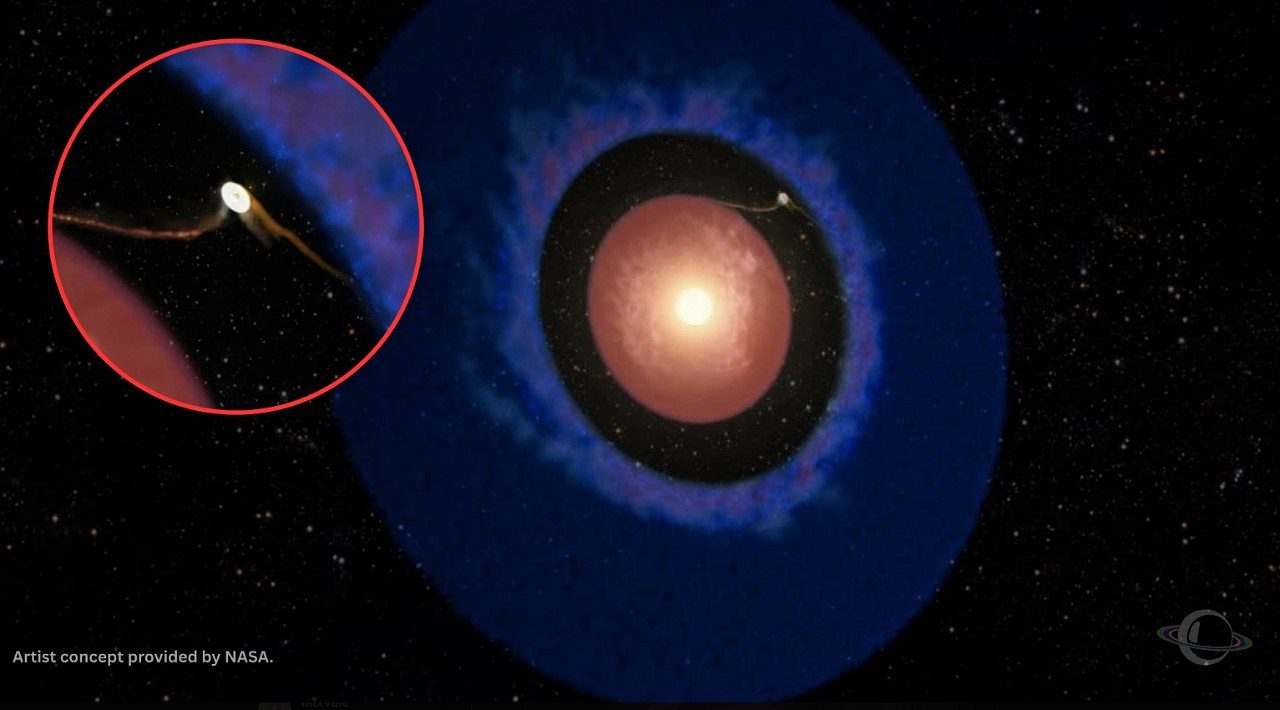
Astronomers verified the existence of Elias 2-24 b, the youngest planet ever detected in deep space, through data extracted from archival records at NASA. The infant celestial body completed less than 1 million years of existence while continuing its active rotation inside a primordial disc of circumstellar gas and dust.
Lucas Cieza, a professor at the Instituto de Estudios Astrofísicos in Chile and co-author of the investigation, pointed out that established scientific models struggled to explain the formation timelines of earlier record-holders like four objects older than 5 million years around PDS 70 and WISPIT 2. He addressed the theoretical gap directly. “Elias 2-24 b shows us that even our best planet formation models still do not account for important processes,” Cieza stated.
Researchers led by doctoral candidate Andrea Bernardi from the Universidad Diego Portales in Chile detailed the findings in The Astrophysical Journal Letters after examining coronagraph records of seven stars documented at the W. M. Keck Observatory in Hawaii. Every examined stellar target hosted debris structures packed with dense rocks, ice, gas, and dust whose pronounced physical gaps pointed to the active birth of emerging worlds.
By deploying the coronagraph mechanism to suppress the intense direct glare radiated by the host stars, the research team actively searched for dimmer and smaller exoplanets that remained completely concealed within the thick dust clouds.
“Planets should sit inside those gaps because they carve them,” Bernardi explained. The astronomer added that this theoretical deduction matched the physical coordinates where the research team pinpointed Elias 2-24 b.
The newfound world carries a physical mass comparable to Jupiter and maintains an orbit around the central star Elias 2-24 at a distance of 450 light-years from Earth. Scientists treat the comprehensive analysis of this distant planetary system as a direct journey backward through cosmic history. The discovery clarifies the specific evolutionary mechanisms that governed our own Solar System billions of years ago.
Stellar bodies emerge from dense gas and dust clouds, producing secondary companions when clumps of residual material aggregate along stable orbital pathways. Dense dust rings routinely obstruct optical observations and hinder the direct inspection of these critical initial stages of cosmic development.
The overwhelming majority of documented exoplanetary discoveries occurred through the transit method. That specific observational strategy identifies planets by recording the momentary decrease in stellar light caused when an orbiting object crosses directly in front of its parent star. Planetary transits offer clear measurements only under favorable viewing geometries.
This transit technique fails whenever thick dust blankets target worlds or whenever planets circle vast distances away from the central star, which explains why the primary share of the 6,000 known exoplanets consists of mature bodies billions of years old located immediately adjacent to their host suns. Current astrophysics frameworks rely heavily on computer simulations to compensate for the severe shortage of direct observations within young circumstellar discs. Detecting additional worlds identical to Elias 2-24 b will allow researchers to recalibrate these mathematical calculations against real physical measurements. Observational records remain scarce for baby planets.
“The galaxy continually creates new stars and planets, leaving systems at every conceivable stage of development,” Cieza explained. The astrophysicist stressed that contemporary astronomical instruments barely detect newly born celestial bodies, leaving a substantial void between theoretical predictions and recorded data.
Following ten years of scientific uncertainty stemming from detections by the ALMA radio telescope in Chile and a bright emission registered by the Very Large Telescope, Bernardi’s group cross-referenced archival datasets from the W. M. Keck Observatory collected in 2018 and 2020 to confirm the definitive orbital track of Elias 2-24 b. While theoretical formulas estimated that an object of such mass would require approximately 5 million years to assemble at Jupiter’s distance from the Sun, this infant exoplanet sits 55 times farther from its host star than Earth is from the Sun. Bernardi noted that Elias 2-24 b tests current telescope thresholds before better tools arrive, while the Nancy Grace Roman Space Telescope, launched on August 30 with an advanced coronagraph, will track worlds closer to their stars as Elias 2-24 b orbits ten times farther out, prompting Cieza to conclude that Roman will elevate real-time planet observation to a new level.