
SpaceX fleet achieves 700 launches while ULA faces crisis

United Launch Alliance faces declining market dominance across the United States as corporate parents Boeing and Lockheed Martin evaluate the enterprise’s dependence on expendable launch architecture in September 2026. Ten years ago the joint venture commanded the domestic launch industry, but operational shifts have weakened that position.
Italian manufacturer Avio targets commercial launch clients turning away from Falcon 9
Italian launch provider Avio registered an influx of satellite operators unable to book flight slots with SpaceX. ‘I can tell you SpaceX has already gone captive because we have a whole bunch of customers coming to us and saying, ‘Oh my God, can you fly us?” Avio chief executive Giulio Ranzo said during an earnings presentation on 10 September 2026. SpaceX informed several prospective operators that the company stopped accepting fresh commercial bookings for Falcon 9 flights.
Prospective customers turned away by SpaceX lobbied European institutions during the International Space Summit in Paris for financial backing to bridge costs, given that a single mission on Avio’s solid-fueled Vega C rocket approaches an estimated price of 60 million dollars.
Vega C rocket successfully delivers European environmental satellites into orbit
A Vega C vehicle lifted off from French Guiana carrying the European Space Agency’s FLEX Earth Explorer spacecraft and the Copernicus Sentinel-3C directly into low-Earth orbit. This flight marked the second mission of the Italian-built vehicle during 2026, using a specialized Vespa adapter to stack both payloads inside the fairing.
Vega C carries up to 2.3 metric tons of payload into low-Earth orbit. ‘Preparing and launching two satellites together is no easy task,’ Simonetta Cheli, director of Earth observation programs at the European Space Agency, said. Cheli commended the engineering teams who prepared and tested both spacecraft for safe orbital insertion.
Sirius Space Services completes first full hot-fire test of STAR-1 engine
French startup Sirius Space Services fired a complete prototype of its STAR-1 rocket engine at Airborne Engineering’s propulsion facility located in southern England.
The campaign verified the joint operation of critical subsystems, including turbopumps, combustion chambers, injector plates, avionics, and software across multiple ignition cycles. Fueled by liquid oxygen and methane to generate 55 kilonewtons of thrust, nine STAR-1 units will power a shared booster stage across the company’s planned rocket family.
Chinese launch operators complete four orbital missions within 44 hours
Four rockets lifted off across a 44-hour window from the Jiuquan and Hainan spaceports as well as a sea platform in the East China Sea. The flight manifest comprised LandSpace’s Zhuque-2E, Orienspace’s Gravity-1, ExPace’s Kuaizhou-11, and the Chinese space agency’s Long March 12. The tempo set records.
Commercial or quasi-commercial enterprises conducted three of the four flights, demonstrating that constellation assembly in China is moving beyond state-operated Long March vehicles and shifting rapidly into recurring operational missions.
SpaceX completes 700th Falcon mission with SES satellite deployment
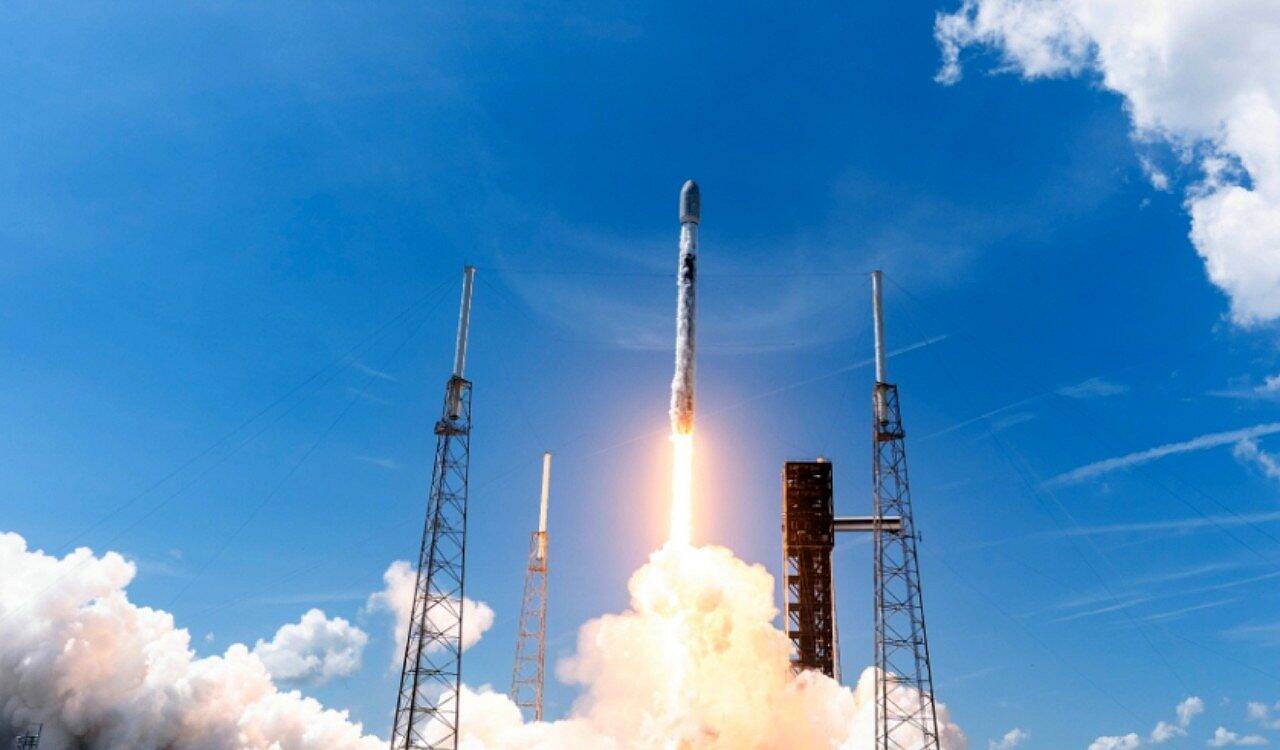
SpaceX deployed three communications satellites from Florida for SES, marking the company’s 700th total Falcon flight. That flight total includes 687 missions conducted by Falcon 9 vehicles and 13 launches using the Falcon Heavy configuration.
The mPOWER-F flight utilized first-stage booster B1080 on its 29th journey into space. The hardware previously completed four flights to the International Space Station, carried the European Space Agency’s Euclid telescope, orbited Astra 1P, and delivered 22 Starlink groups. This event also represented the 400th orbital launch conducted from Space Launch Complex-40, with SpaceX managing 345 of those departures.
Rocket Lab challenges NASA contract award to Blue Origin for Mars communications
NASA selected Blue Origin to build, launch, and manage a 700 million dollar Mars Telecommunications Network spacecraft, prompting rival bidder Rocket Lab to submit a formal bid protest with the US Government Accountability Office.
‘The agency’s punitive review of Rocket Lab’s technical volume was inconsistent, making incorrect assertions and conclusions,’ Rocket Lab stated in its filing. Blue Origin warned the protest could jeopardize the target 2028 launch date while affirming confidence in its proposal and NASA’s competitive procurement process.
SpaceX prepares Starship for maiden orbital flight test from Texas
Subject to regulatory authorization, SpaceX scheduled its 14th Starship flight test with an initial target window opening at 7:15 am local time in Texas (12:15 UTC). Maritime safety notices subsequently indicated that the target departure date shifted to 28 September 2026. The test represents the first attempt to send the experimental spacecraft into an orbital path.
The super heavy-lift rocket will carry 26 larger V3 Starlink satellites to an orbit 275 kilometers above Earth, aiming to complete six revolutions across a 10-hour flight plan that follows developmental milestones begun during the vehicle’s maiden flight on 20 April 2023.
United Launch Alliance faces competitive pressure over expendable rocket strategy
Founded in 2006 when federal contracts steered the domestic industry, United Launch Alliance stands apart from competitors by not fielding reusable boosters. Two decades later, commercial startups and SpaceX have eroded that operational lead with cheaper alternatives.
Solid rocket booster issues hindered the rollout of the Vulcan launch vehicle. The booster may resume flights before October with a payload of Amazon satellites. Boeing and Lockheed Martin continue seeking additional capital or an outside buyer to fund new propulsion development.
Space Pioneer reveals methane rocket engine design echoing Raptor 3 architecture
Chinese launch enterprise Space Pioneer, which accumulated nearly 1 billion dollars in funding, unveiled a design for its Tianhuo-21 methane-liquid oxygen engine producing 2,450 kilonewtons of sea-level thrust that mirrors the performance profile of the Raptor 3 engine built by SpaceX.
Elon Musk commented on social media that replicating the system presents severe manufacturing challenges. ‘I would recommend against a new company trying to make Raptor 3,’ Musk stated, explaining that ‘the inside has very complex geometry that can only be manufactured using highly modified 3D metal printing.’
Precise Falcon Heavy launch doubles fuel lifetime for Roman space telescope
NASA’s Nancy Grace Roman Space Telescope moves toward its observation post along a trajectory that will preserve propellant reserves far beyond primary mission estimates. Engineers originally filled the four propellant tanks on the 4.3 billion dollar observatory to support a five-year baseline mission with a potential five-year extension. Navigation accuracy conserved significant fuel.
‘As a result of exquisite planning by our orbital dynamics team, brilliant execution by the operations team, and a precise launch from SpaceX, Roman has fuel for at least 22 years of potential science operations,’ Jamie Dunn, center director at NASA’s Goddard Space Flight Center, said following the launch on 30 August from Kennedy Space Center in Florida.
Blue Origin and Air Force research lab partner on advanced propulsion systems
Blue Origin and the Rocket and Space Propulsion Division of the Air Force Research Laboratory at Edwards Air Force Base entered an expanded partnership to advance high-performance propulsion systems. Nicholas Robertson, senior vice president of engines at Blue Origin, said the agreement grounds corporate engineering models in government research.
The Air Force facility previously developed oxygen-rich and full-flow staged combustion architectures. Both entities will also continue maturation testing of the BE-7 lunar lander engine at the Area 1-42 High Altitude Rocket Test Facility at Edwards. Work focuses on high-altitude performance.
- 19 September: Electron carrying Owl by the Dozen from Māhia Peninsula, New Zealand, at 03:15 UTC
- 19 September: Long March 2D carrying unspecified payload from Taiyuan Satellite Launch Center, China, at 10:50 UTC
- 20 September: Falcon 9 carrying Starlink 15-27 from Vandenberg Space Force Base, California, at 01:47 UTC





