
AMD outpaces RTX 5090 by 25% in 4K with Radeon RX 10800 XT

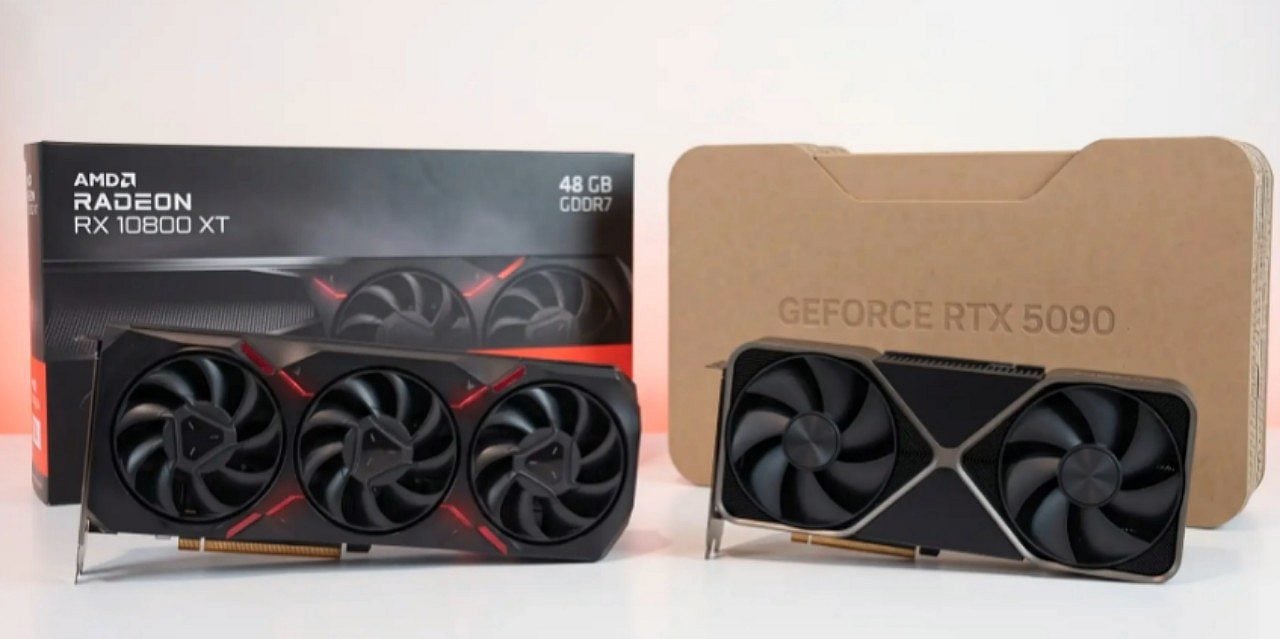
Industry leakers Moore’s Law is Dead and Kepler_L2 published technical specifications detailing AMD’s flagship Radeon RX 10800 XT graphics card built around the RDNA 5 microarchitecture. Leaked schematics show up to 200 compute units manufactured on an advanced 3-nanometer semiconductor fabrication node. Factory documentation indicates sustained clock speeds reaching between 3.1 GHz and 3.4 GHz alongside a wide 512-bit physical memory bus. Board partners will configure the retail product with up to 48 GB of high-speed GDDR7 video memory to handle massive graphics data. The technical rollout positions this RDNA 5 platform directly against competing silicon from Nvidia.
Architectural contrast between RDNA 5 and Blackwell
AMD adopted an aggressive quantitative scaling design for the Radeon RX 10800 XT that diverges completely from Nvidia’s structural approach on the GeForce RTX 5090 and RTX 6090. The competing architectures follow opposing engineering principles regarding execution cluster volume, internal arithmetic logic density, and hardware-level coprocessors. Comparing both graphics platforms requires evaluating sheer raster arithmetic throughput alongside specialized circuits dedicated to modern rendering techniques.
Nvidia designed the GeForce RTX 5090 around the GB202 graphics die with 170 active streaming multiprocessors enabled out of 192 physically present silicon clusters. Because each streaming multiprocessor contains 128 execution units, the flagship processor operates 21,760 FP32 computing cores alongside 170 dedicated ray tracing units and 680 specialized tensor cores.
Silicon configurations and streaming processor counts
AMD configured 200 compute units inside the Radeon RX 10800 XT, connecting 64 stream processors to each module for a final count of 12,800 arithmetic logic units. That specification yields fewer raw shader cores than the 21,760 processing units powering Nvidia’s primary competitor. However, a multi-chiplet packaging strategy enables AMD to drive sustained frequencies between 3.1 GHz and 3.4 GHz while embedding a substantial Infinity Cache pool that balances single-precision compute performance across heavy floating-point calculations without generating excessive electrical resistance. The performance margin holds steady.
- Nvidia GeForce RTX 5090 operates 170 active streaming multiprocessors and 21,760 CUDA cores across a 512-bit memory bus.
- AMD Radeon RX 10800 XT features 200 compute units, 12,800 stream processors, and up to 48 GB of GDDR7 memory.
- Nvidia GeForce RTX 6090 deploys 192 active streaming blocks totaling 24,576 CUDA cores on the Rubin graphics architecture.
In traditional rasterization tasks without ray tracing overhead, those 200 compute units operating at aggressive clock speeds deliver an immediate advantage for AMD at extreme display resolutions. The combined impact of high core clocks, a 512-bit memory interface, and 48 GB of GDDR7 memory allows the Radeon RX 10800 XT to surpass the Nvidia GeForce RTX 5090 by 15% to 25% during native 4K gaming runs.
Ray tracing capabilities and neural reconstruction
Benchmark tests evaluating ray tracing workloads indicate that redesigned Ray Accelerators inside RDNA 5 successfully close the gap with the RTX 5090 in hybrid rendering titles. AMD doubled the processing throughput of bounding volume hierarchy trees within each compute unit to remove recurring hardware bottlenecks during dynamic lighting calculations. The graphics manufacturer also integrated Wave Matrix units to run machine-learning frame generation under FidelityFX Super Resolution with visual clarity rivaling Nvidia Deep Learning Super Sampling.
In pure path tracing scenarios with intensive global illumination passes, the upcoming RTX 6090 maintains an operational advantage between 35% and 50% using fifth-generation ray tracing cores. That platform outpaces the Radeon RX 10800 XT across heavy lighting calculations because dedicated tensor hardware processes spatial math with noticeably lower operational latency.
Professional rendering and artificial intelligence execution
Professional software environments running through ROCm or HIP allow the 48 GB memory pool of the RX 10800 XT to load complex 8K textures without encountering the out-of-memory errors reported on the 32 GB RTX 5090. A 512-bit memory bus and dual VCN media encoders accelerate raw video processing and compile Nanite assets inside Unreal Engine 5. Artificial intelligence researchers can deploy large models such as Llama 3 70B on a single graphics board with larger inference batch sizes than competing hardware supports. The upcoming Rubin-based RTX 6090 preserves Nvidia’s computational lead in specialized CUDA environments through its 192 active streaming multiprocessor blocks.





