Lunar Reconnaissance Orbiter logs 222-meter McGetchin crater

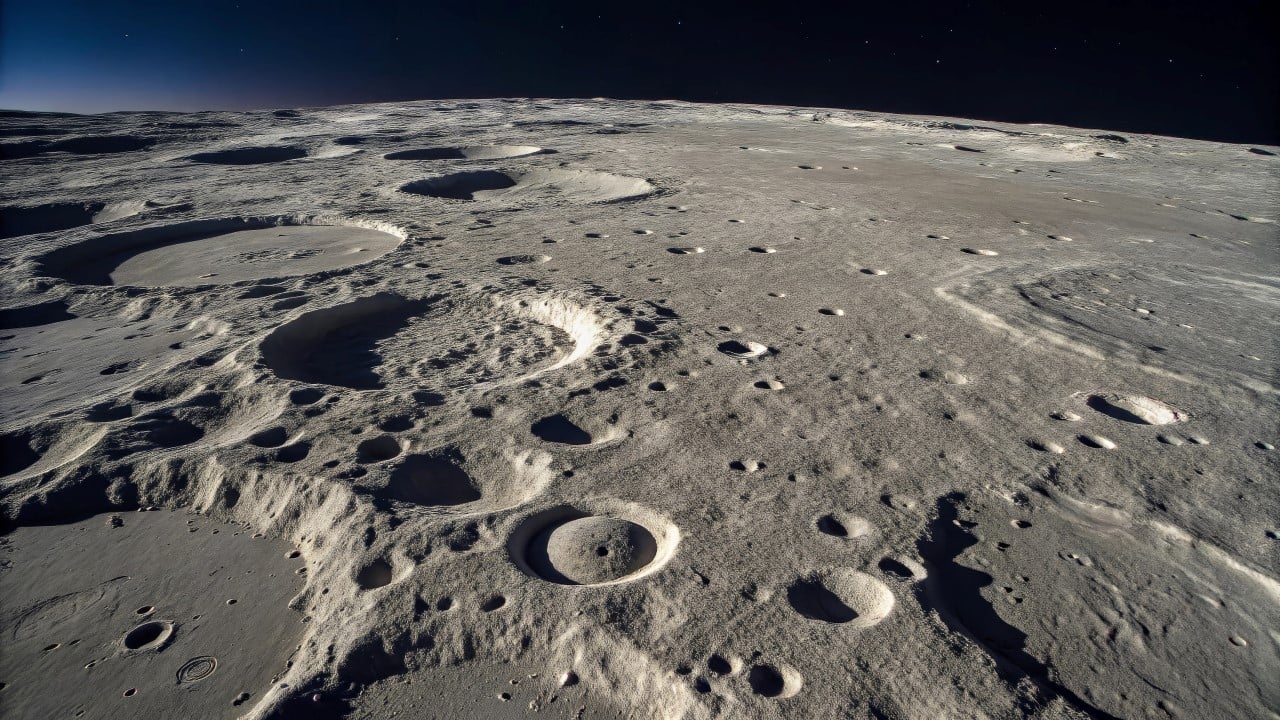
Planetary scientists identified a deep geological scar across the Moon after a space rock slammed into the lunar crust. The impact carved an extensive basin that reshaped the immediate lunar surface.
The celestial body struck the eastern limb of the Moon between April 11, 2024, and May 22, 2024. This collision opened a cavity measuring 222 meters across that stayed hidden until recent imaging assessments. Ground measurements confirmed that the excavation reaches 43 meters in depth.
Researchers publishing in Science Advances documented that this opening represents the largest fresh impact feature formed across the entire solar system in recent history. The study classified the formation as an extraordinary structural event.
Mathematical models calculate that strikes of this magnitude occur on the lunar terrain once every 132 years. Astronomers hailed the detection as an exceptional event for planetary defense monitoring. The observation provides empirical validation for collision rate theories.
The science team named the geological structure McGetchin to honor researcher Thomas McGetchin. The late scientist contributed key geological research during the Apollo program.
The previous record holder for a newly observed crater measured approximately 70 meters across. The McGetchin basin surpassed that benchmark by more than triple its width. Analysts updated planetary records following the confirmed measurement.
The Moon accumulates countless circular craters because it lacks a protective atmosphere that would burn incoming space debris. Meteoroids strike the exposed regolith at terminal velocities without atmospheric drag.
Instruments aboard Nasa spacecraft operating in lunar orbit for 17 continuous years tracked subtle alterations across the terrain. The orbiter detected a distinct high-reflectance signature surrounded by a dark halo of scattered dust. Mission controllers isolated the coordinates for immediate multi-spectral analysis.
Imagery from the Lunar Reconnaissance Orbiter revealed how the blast disturbed slope stability in a strategic territory earmarked for crewed exploration missions. Debris sheets spread outward across adjacent terrain.
Scientist Mark Robinson of Intuitive Machines confirmed via email that the orbital photographs disclose remarkable geological features. He emphasized that the ejecta pattern provides rare insight into explosive excavating physics. Robinson outlined the preliminary findings to lunar specialists.
Sensors on lunar orbiter track thermal shifts and debris
The Lunar Reconnaissance Orbiter maps surface radiation and thermal fluctuations using seven primary instruments at an average altitude of 97 kilometers. Its payload gathers baseline measurements to identify rapid environmental transformations.
Systematic surveys enabled researchers to catalog 1,000 fresh craters caused by incoming cosmic projectiles. The onboard instruments also recorded gravel displacement along steep slopes. Sensor sweeps captured hardware debris from spent space modules striking the surface.
Small incoming boulders measuring 109 centimeters in diameter produce roughly 140 distinct depressions every year across the Moon. These continuous impacts slowly pulverize the exposed rocky crust.
Investigators compare updated cartographic charts against older photographic archives to spot localized surface variations. This constant verification routine ensures high statistical accuracy across lunar mapping catalogues. Analysts flag even minor contrast differences between operational passes.
Image processor Robert Wagner of Intuitive Machines pinpointed the McGetchin structure on October 24, 2025, while overlaying photos captured at different intervals. His cross-examination revealed a prominent anomaly on the eastern lunar limb.
Wagner described the initial shock.
Automated software regularly generates false flags triggered by varying solar angles and shifting shadows across ridges. Robinson and his technical group must review each automated warning manually to confirm genuine impacts.
The McGetchin feature displayed distinct alterations in how surrounding rocks and regolith dispersed across the rim. That visible disruption separated the site from recurring imaging errors. High-contrast ejecta rays extended outward across hundreds of meters.
Wagner stated that the ejecta debris field formed the most prominent geological signature he observed during his career scanning lunar imagery. He noted that the pattern stood out sharply against baseline background readings.
The Narrow Angle Camera onboard the spacecraft transmitted high-definition imagery to determine the basin dimensions and assess adjoining wall slopes. The crisp optical resolution facilitated immediate topographic reconstructions. Engineers derived elevation profiles directly from the raw frames.
Thermal instruments on the Diviner sensor detected a zone extending 6.4 kilometers where nighttime temperatures drop 16 degrees Fahrenheit below regional averages. This thermal depression outlines the full reach of surface disruption.
Geologist Tyler Powell of Johns Hopkins University confirmed in an official statement that young craters routinely feature chilled thermal zones. Powell investigates physical processes that govern surface evolution on airless bodies. His assessment validated the Diviner thermal anomaly.
Powell explained that impact shock disrupts the physical structure of regolith across a radius substantially larger than the central cavity itself. Shockwaves break up consolidated subsurface material during excavation.
Mechanical disruption fluffs up the topsoil, generating a low-density porous surface layer that sheds heat quickly once sunlight disappears. This thermal inertia drop accounts for the frigid readings recorded by orbiting sensors. The churned soil radiates stored warmth into the vacuum rapidly.
Artemis program incorporates collision data for crew safety
Systematic tracking of meteoroid impacts yields accurate data on strike frequency and structural shattering mechanics during celestial collisions. These empirical records help calibrate hydrocode models of hypervelocity impacts.
Evaluating newly carved rims provides direct evidence regarding total kinetic energy released when space rocks strike bedrock. Robinson underscored that calculating these energy signatures refines orbital risk projections. Mission planners rely on these metrics to assess lunar infrastructure resilience.
Calculating meteoroid strike probabilities has grown vital for engineers designing surface habitats for the Artemis program managed by Nasa. Future exploration blueprints require protective shielding capable of sheltering crews during extended expeditions.
Cometary and asteroidal collisions helped construct the early crust of terrestrial planets orbiting the Sun, according to professor Jeff Andrews-Hanna of the University of Arizona. Andrews-Hanna did not participate directly in the published study. He analyzed the broader planetary implications of the strike.
Andrews-Hanna compared the asteroid that produced McGetchin to the space rock that entered Earth’s atmosphere over the Russian city of Chelyabinsk in 2013. That historic atmospheric entry revealed the destructive potential of mid-sized near-Earth objects.
That Russian meteor measured between 17 and 20 meters across and detonated in the atmosphere with a flash brighter than the Sun, damaging 7,000 buildings in the region and injuring more than 1,000 residents with energy exceeding the Hiroshima explosion thirtyfold. The blast wave shattered windows across hundreds of square miles. Seismographs detected the atmospheric disturbance globally.
Andrews-Hanna stated that an identical direct ground impact on Earth would unleash severe localized destruction, reinforcing the need to catalog near-Earth objects. Planetary defense programs monitor these trajectories to anticipate collision hazards.