
NGC 4698 displays reverse stellar rotation in Hubble survey

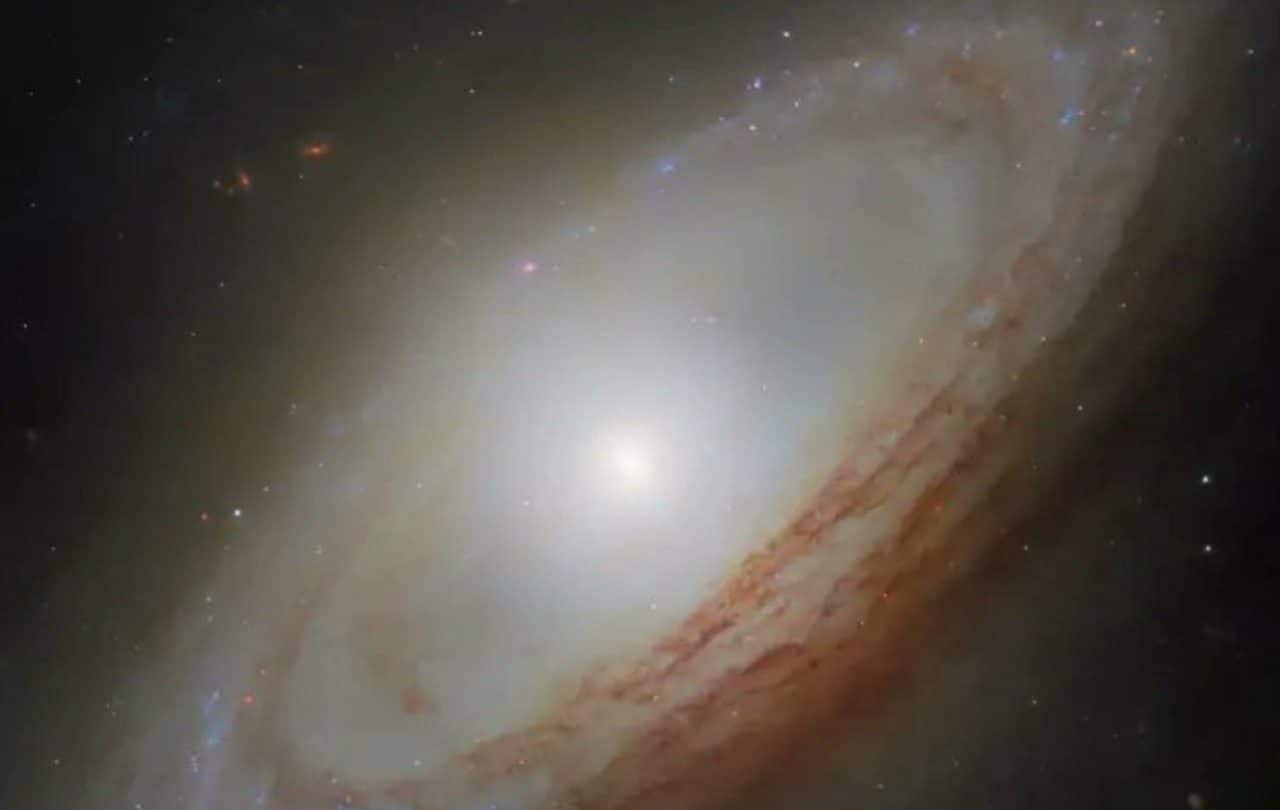
The Hubble Space Telescope imaged spiral galaxy NGC 4698, revealing a central stellar bulge that rotates in reverse compared to the outer galactic disc. This astronomical formation sits 55 million light-years from Earth inside the Virgo constellation. The galaxy belongs to the Virgo Cluster, where intense gravitational pull binds hundreds of cosmic systems across deep space.
Perpendicular alignment shapes inner galactic disc
Astronomers recorded conventional spiral characteristics along the outer boundaries, where dust bands and gas clouds shape broad stellar arms. The interior section differs sharply from standard spiral galaxies because the elongated core projects outward at a right angle relative to the primary disk.
Hubble measurements confirm that stars near the galactic center spin along a decoupled path. The core moves independently. This unusual geometry keeps the inner stellar population circulating perpendicularly to the main galactic body. Data verified that gravitational forces sustain this rare orientation without tearing the broader star disc apart.
Gas clouds feed the central black hole
NGC 4698 harbors a supermassive black hole at its focal point with a mass equal to millions of solar masses. According to NASA records, this dense gravitational anchor steadily pulls neighboring gas reservoirs into its gravitational field to expand the cosmic structure over time.
- Central bulge stars rotate perpendicularly against the outer disc rotation.
- Secondary gaseous structures formed around the central black hole following cosmic accretion.
- Extended hydrogen tails trace physical debris from past galactic interactions.
Research models attribute this counter-rotation to the historical absorption of stray material drifting through surrounding intergalactic space. Captured gas accumulated into a secondary disc of young stars around the core rather than merging seamlessly into the older host system. Because incoming clouds carried independent angular momentum, the newborn disc established an autonomous plane of rotation.
Hydrogen trail signals past galactic collision
Astronomers detected an extended hydrogen gas trail projecting from the outer rim of NGC 4698. This tail of remnant matter provides direct physical evidence that a smaller companion galaxy collided with the primary system in the distant past.
The ongoing survey targets multiple star systems across the dense Virgo Cluster to record how high-density environments alter galactic evolution. By tracing star nurseries and dense gas pockets throughout the Virgo constellation, researchers can reconstruct the sequence of ancient collisions that systematically delivered foreign matter into NGC 4698 and altered its internal rotational kinematics without destroying the surrounding spiral arms. The Virgo cluster monitoring catalog provides comparative snapshots across hundreds of neighboring galaxies.
Cluster environment drives galactic evolution
The Virgo survey logs environmental pressures exerted on member galaxies through high-speed encounters and gravitational stripping. Dense cluster environments force systems into close proximity, accelerating gas exchange across cosmic distances. Observations of NGC 4698 supply precise kinematic markers for cataloging these ongoing structural transformations.
Astronomical teams continue analyzing the Virgo Cluster database to identify similar counter-rotating cores across nearby spiral galaxies. Archival exposures from the telescope remain accessible for comparative structural assessments.





