
NGC 4698 reveals a perpendicular core spin in Virgo cluster

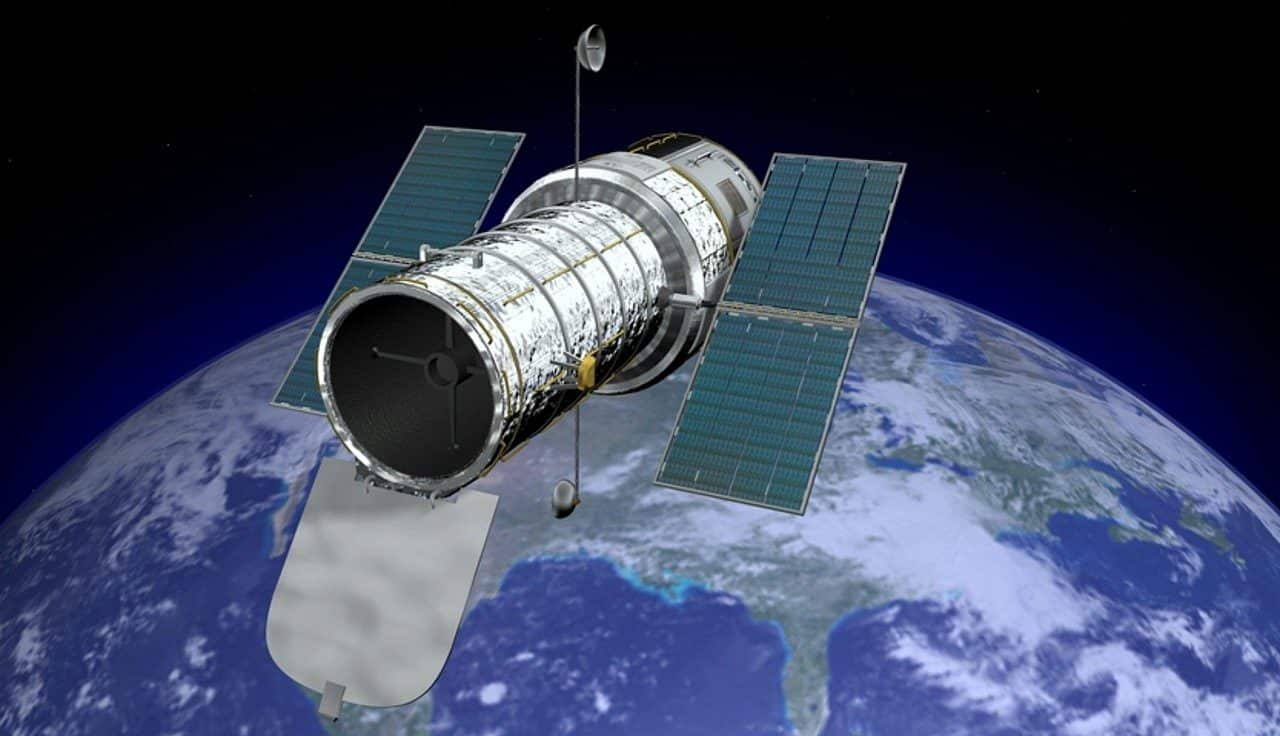
The Hubble Space Telescope recorded the anomalous internal rotation of NGC 4698, a spiral galaxy situated 55 million light-years from Earth in the constellation Virgo. Billions of stars within the outer stellar disk orbit along a trajectory positioned perpendicular to the rotational plane of the material circling the supermassive black hole at the core. This physical misalignment directly contradicts the rotational symmetry observed in most cataloged spiral galaxies across the observable universe. High-resolution optical sensors aboard the orbital observatory mapped the structural discrepancy during ongoing deep-space observation campaigns.
Optical data show that this perpendicular geometry splits the galaxy into two distinct kinematic zones. A compact stellar disk near the core rotates vertically, while the primary disk of gas and dust maintains an independent horizontal trajectory.
High-resolution images captured by the orbital observatory detail how this smaller internal structure operates inside NGC 4698 without tearing apart the massive outer spiral framework. Astronomers evaluating the gathered orbital telemetry confirmed that such geometric divergence points toward a violent history of structural transformation. In conventional spiral formations, gas clouds and star clusters share an identical angular orientation because conservation of angular momentum governs the primordial collapse of matter. Observations of NGC 4698 demonstrate that secondary mechanical forces overrode this standard evolutionary path. The telescope detected clear spatial boundaries between these conflicting orbital realms.
Perpendicular alignment disrupts traditional spiral mechanics
A 90-degree tilt between the central stellar disk and the exterior arms challenges standard celestial mechanics formulated for mature spiral systems. Gravitational interactions within the Virgo cluster generated this misalignment during ancient structural encounters.
A cannibalistic galactic merger represents the primary physical explanation for the loss of rotational synchronization within NGC 4698. During this ancient collision, a smaller satellite system plunged toward the gravitational center along an oblique orbital trajectory, depositing substantial amounts of mass and angular momentum into the central reservoir while leaving the surrounding stellar disk remarkably intact. This infalling material supplied gas that rotated in an entirely different direction, feeding the central region without disrupting the preexisting periphery. The central supermassive black hole preserved the orientation of this secondary influx, locking the inner stars into an enduring perpendicular circuit.
Central black hole governs orbital trajectories
The supermassive black hole at the center of NGC 4698 directs matter moving through intense gravitational fields within the inner parsecs. Spectroscopic measurements confirm that dense nuclear gas clouds follow this shifted orbit rather than matching the broader galactic plane.
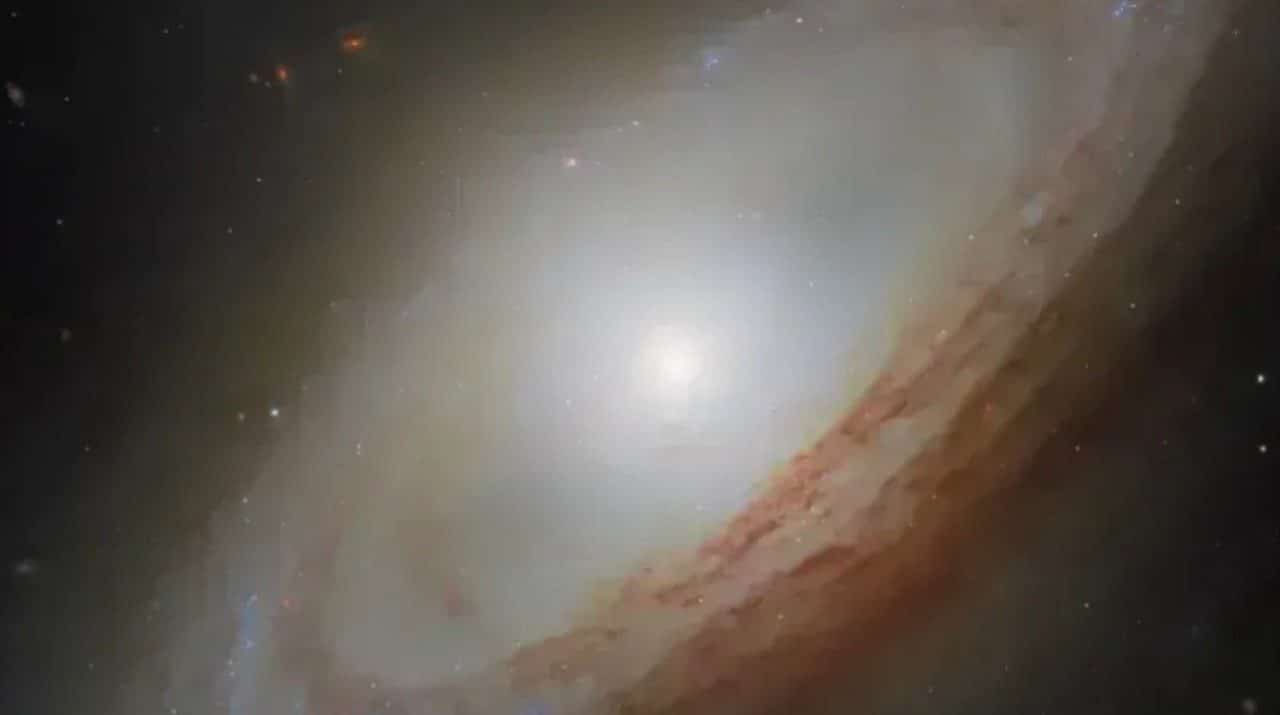
Images from the Hubble Space Telescope reveal prominent lanes of dark interstellar dust cutting across the luminous spiral arms of NGC 4698. Older stars concentrated near the core emit a warmer visual tone that contrasts with the blue light radiating from outer star-forming nurseries. This chromatic gradient preserves the timeline of stellar migration across the 55 million light-years separating the galaxy from orbital detectors.
Past galactic mergers preserved peripheral star formation
Secondary mergers preserved this structure. The galactic nucleus absorbed the kinetic shock wave while peripheral star clusters retained their circular orbits.
Numerical simulations of cosmic dynamics demonstrate that perpendicular galactic configurations require highly specific collision angles to survive without losing their spiral arms. A direct head-on collision would unleash severe tidal forces capable of tearing apart delicate spiral lanes and transforming NGC 4698 into an amorphous elliptical galaxy. Astrophysical models show that intermediate impact vectors allow the central bulge to decouple kinematically from the disk. Such exact orbital conditions occur rarely across cataloged galactic clusters.
The intact outer disk proves that the nucleus absorbed the bulk of the collision momentum without destabilizing the galactic boundary. The Hubble Space Telescope tracks NGC 4698 in visible and ultraviolet light to refine stellar evolution models in the Virgo cluster. Scientists archive these spatial measurements to evaluate dust distribution and determine the precise mass of the central black hole.





