
Chandra maps 84 hypersoft cosmic emitters across six galaxies


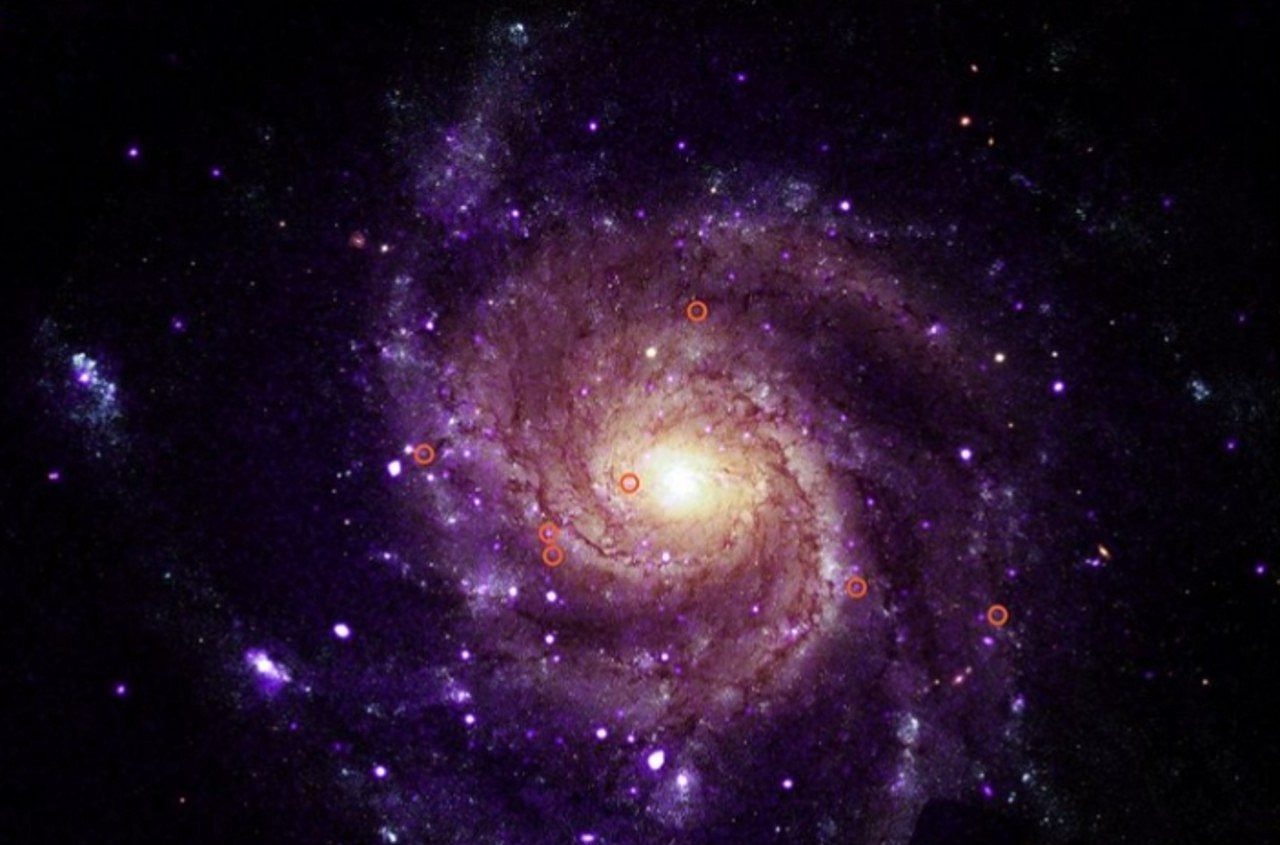
Researchers led by Mustafa Muhibullah from the University of Alabama identified 84 hypersoft X-ray objects across six galaxies using archival data from NASA’s Chandra X-ray Observatory. The findings, published in Nature Astronomy, describe an unrecognized class of celestial bodies that generate low-energy X-rays alongside intense ultraviolet emissions. The team established that these energetic signatures could resolve two central debates regarding cosmic expansion and interstellar gas behavior.
Distribution of unusual sources across target galaxies
The team located these objects across diverse cosmic environments, detecting them in active star-forming regions as well as older stellar neighborhoods. Astronomical records show that the 84 signals appeared across multiple structural environments:
- The spiral galaxy M31, widely known as the Andromeda Galaxy
- The spiral galaxy M101, cataloged as the Pinwheel Galaxy
- Four distinct elliptical galaxies documented in the Chandra public archives
Astronomers isolated these cosmic sources because they emitted distinctly at minimal X-ray wavelengths while vanishing across high-frequency observations, leading the researchers to determine that massive volumes of previously undetected ultraviolet radiation leak into interstellar space across the target galaxies. The gas bordering these systems absorbs heat rapidly as it falls toward the primary star, generating binary conditions never recorded with comparable ultraviolet intensity.
Such binary populations remained hidden.
Binary systems and Type Ia supernova progenitors
Researchers suspect the sources consist of black holes, neutron stars, or white dwarfs pulling material from companion stars. Muhibullah stated that these discrete X-ray sources rank among the most luminous in their galaxies and can address two cosmic mysteries at the same time. The collected data provide direct insight into the internal mechanics of complex stellar partnerships.
The scientists determined that white dwarfs siphoning matter from companion stars can eventually trigger Type Ia supernovas. These standard explosions previously enabled cosmologists to confirm that the expansion of the universe accelerates.
“Finding these Type Ia supernova explosions prior to detonation would represent an indispensable advance,” said Jimmy Irwin, study co-author and professor at the University of Alabama. Irwin pointed out that researchers regularly investigate the remnants of stellar explosions without understanding which stars initiated the event.
Ionization processes and observational hurdles
The newly identified radiation also explains how electrons detach from gas dispersed between stars. That ongoing electron loss influences star creation rates and directly governs galactic evolution. While hot, massive stars perform part of this ionization, the intense ultraviolet light from hypersoft sources supplies the missing energetic component.
Astronomers faced decades of detection hurdles because orbital instruments struggle to register ultra-low-energy X-rays. Furthermore, interstellar hydrogen and helium clouds absorb ultraviolet radiation before it reaches orbital sensors near Earth.
“By searching the Chandra archive, we eliminated a telescope blind spot and found this class with singular properties,” said co-author Rosanne Di Stefano of the Center for Astrophysics Harvard Smithsonian. NASA’s Marshall Space Flight Center in Huntsville manages the Chandra program, while the Smithsonian Astrophysical Observatory oversees flight operations and science activities from Massachusetts.





