GJ 3090 b puzzles astronomers with backward orbit around its star By Thiago Lemos
4 min read
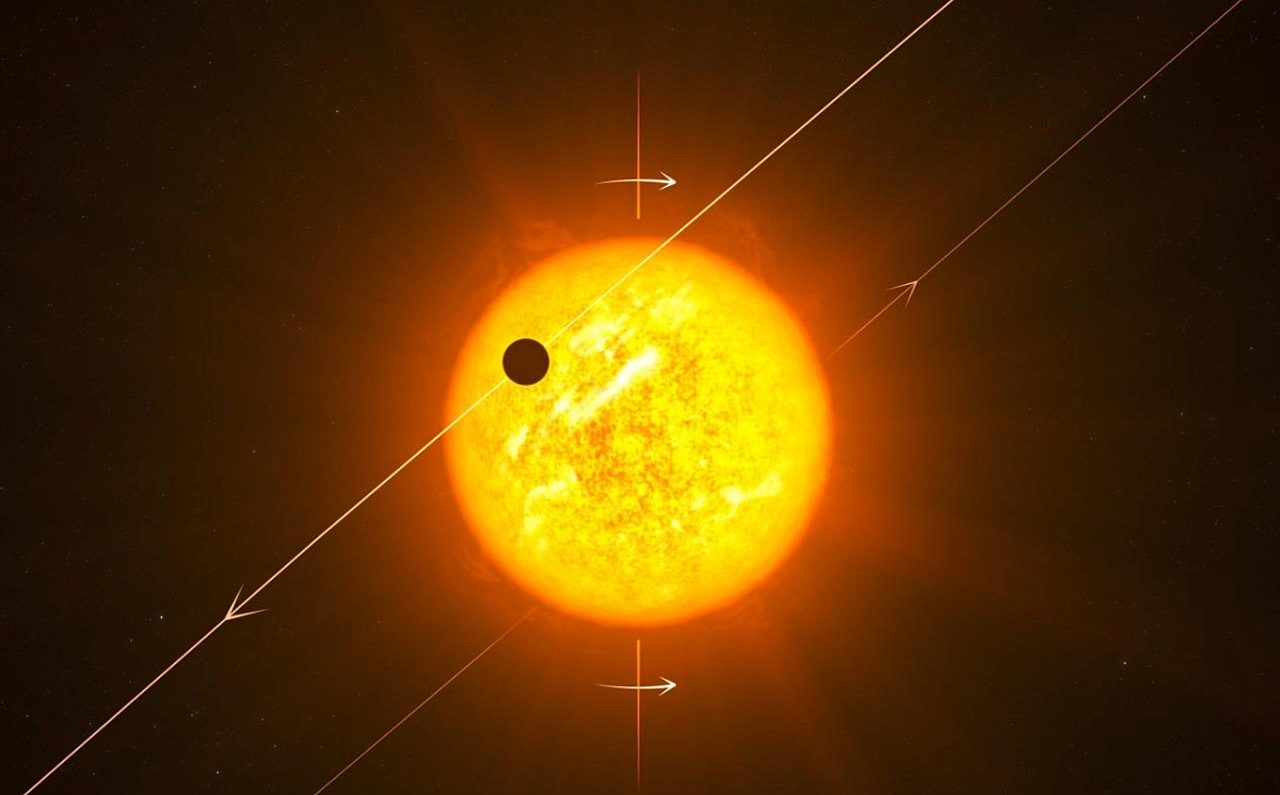 |
An international research team based at the University of Geneva, working alongside scientists from the Instituto de Astrofísica de Canarias, has identified a planet that travels around its star in the opposite direction to the star’s own spin. Researchers named the object GJ 3090 b, and the findings appeared in the journal Astronomy & Astrophysics.
What makes the discovery unusual is the absence of any explanation. Other star systems with reversed orbits typically have a heavy companion object nearby that could account for the disruption, but nothing of the sort has turned up around GJ 3090.
The Instituto de Astrofísica de Canarias notes that stars and their planets form when a cloud of gas and dust collapses inward under its own gravity. That collapse produces a spinning disk surrounding the newborn star, and planets take shape inside that same disk.
Both the young star and its surrounding disk rotate in the same direction during this process. Under what the institute calls an ideal scenario, planets born from that disk move along the star’s spin direction and sit roughly in the same plane as the star’s equator, at a right angle to its rotational axis. Scientists call these aligned systems.
Our own solar system offers a real-world example of this pattern, though not a perfect one. All eight planets orbit the Sun in the same direction as its spin, yet each orbital plane sits at a slight angle to the Sun’s equatorial plane. That angle, known as Psi, ranges from roughly three to seven degrees across the planets, with Earth’s tilt exceeding seven degrees.
Researchers at the Instituto de Astrofísica de Canarias suggest that even this small deviation from the ideal layout may trace back to disturbances during the solar system’s early formation, such as a close pass by another star or an uneven collapse of the original gas cloud.
“Measuring the Psi angle gives us clues about how planetary systems form and evolve, so it made sense to try measuring it in other systems too,” said Yann Carteret, a doctoral student in the Department of Astronomy at the University of Geneva’s Faculty of Science and lead author of the study.
“We were genuinely surprised to find that GJ 3090 b doesn’t just show a strongly misaligned orbit, it actually moves in the opposite direction from its star’s rotation,” Carteret added.
GJ 3090 is a red dwarf, a class of star smaller and cooler than the Sun. The planet circling it was first spotted by the TESS space telescope, an instrument that scans the sky for transits, the tiny dips in starlight that occur when a planet crosses in front of its star.
The planet measures roughly 2.2 times Earth’s radius and carries about 4.5 times Earth’s mass, placing it in the sub-Neptune category, the most common type of exoplanet found across the galaxy.
To carry out the study, the team relied on NIRPS, a highly stable spectrograph mounted on the 3.6-meter telescope at the La Silla Observatory in Chile. The instrument detected two additional planets in the same system, confirmed GJ 3090 b’s existence, measured its mass and revealed its unusual orbital tilt.
“NIRPS delivers infrared performance precise enough to measure the angle between a planet’s orbital plane and its star’s equatorial plane, even for a planet this small,” said Jonay González, a researcher at the Instituto de Astrofísica de Canarias who leads the Spanish contribution to the project.
GJ 3090 b’s Psi angle measures close to 136 degrees. Among all known multi-planet systems, only five others contain a planet with a misalignment greater than 70 degrees.
Unlike those five systems, though, nothing suggests a massive body, whether another star or a large planet, orbits GJ 3090 in a way that could account for such an extreme tilt.
“The lack of a massive companion that could explain this unusual orbit pushed us to consider other possibilities,” said Vincent Bourrier, a professor and researcher in the Department of Astronomy at the University of Geneva’s Faculty of Science and co-author of the study.
“In the case of GJ 3090, the star may have built up a second, misaligned and retrograde disk, and the system’s planets could have formed later inside that structure,” Bourrier concluded.
Spain’s contribution to building NIRPS was coordinated by the Instituto de Astrofísica de Canarias, which took part in the project’s design, construction and commissioning of the instrument’s fiber-feed system.
On the Spanish side, researchers Vera Passegger, Rafael Rebolo, Alejandro Suárez Mascareño and Atanas Stefanov joined Jonay González Hernández in contributing to the latest study.