
Hubble reveals retrograde core motion inside galaxy NGC 4698

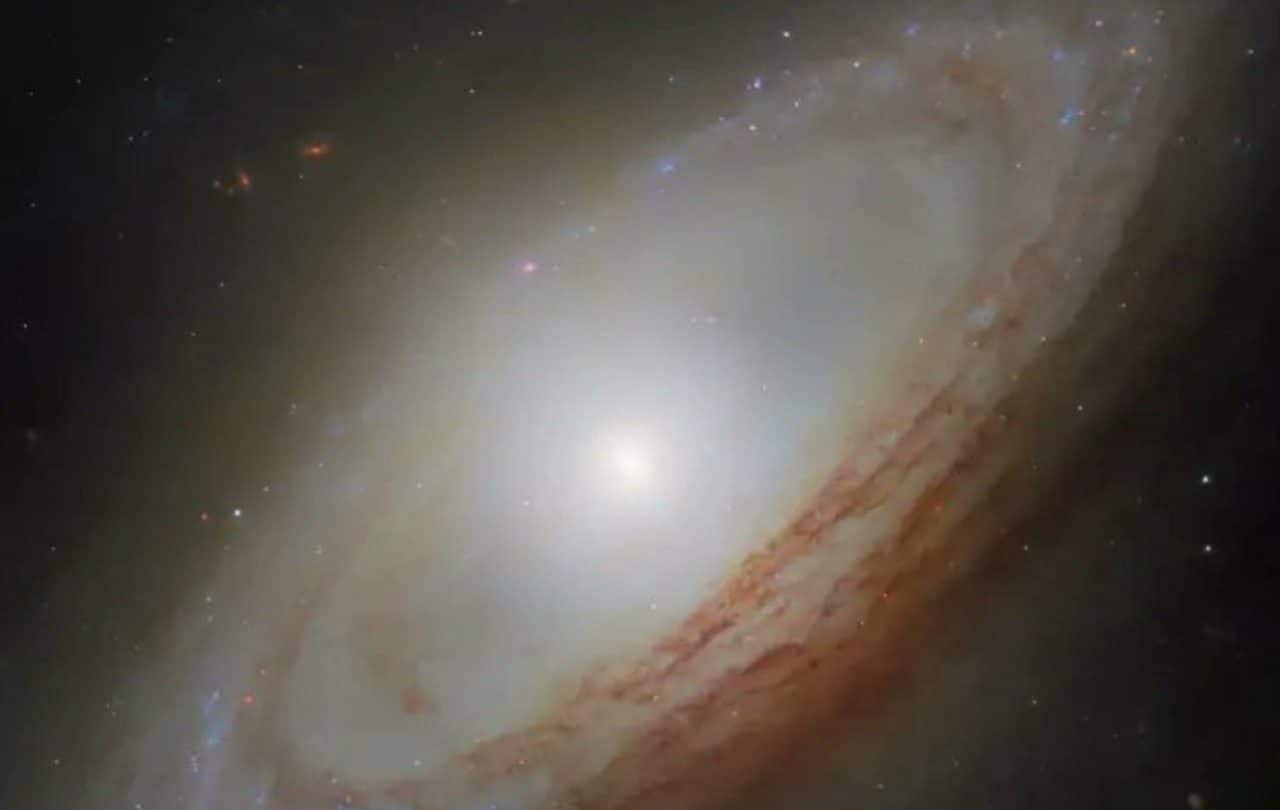
The Hubble Space Telescope recorded new imagery of spiral galaxy NGC 4698 confirming that its dense stellar core rotates in the opposite direction of its expansive outer disk. Space agency researchers verified that stars concentrated in the galactic nucleus circle backward against the primary spin of the system. This contradictory dynamic persists across the entire nuclear structure.
The stellar formation sits 55 million light-years from Earth within the constellation Virgo. Strong gravity binds hundreds of neighboring star systems across this dense sector identified as the Virgo Cluster. Teams continue systematic astronomical tracking of the region.
Transverse central bulge separates NGC 4698 from common spiral shapes
Typical spiral formations maintain orderly rotational trajectories throughout their disks. Gas pockets, cosmic dust tracks, and stellar nurseries generally follow matching paths toward the outer boundaries of spiral systems.
NGC 4698 disrupts this normal structural balance with an irregular central architecture. Its inner stellar bulge forms an elongated shape aligned perpendicular to the main disk plane. Scientists consider this perpendicular arrangement exceedingly rare among cataloged spirals.
Spectroscopic evaluations indicate that molecular gas reservoirs and star groupings near the center move detached from the outer disk. These internal and external components travel along distinct orbital axes. Gravity binds them nevertheless.
- Perpendicular central bulge aligned transverse to outer stellar plane
- Nuclear gas rotating in opposite direction to external disk stars
- Extended neutral hydrogen trail extending from outer galactic border
Supermassive central singularity consumes adjacent matter
A supermassive black hole anchors the middle of NGC 4698. While standard spiral galaxies preserve uniform angular momentum throughout their arms, this singular central void possesses a mass calculated at millions of times that of the Sun and exerts intense gravitational pull on passing hydrogen clouds to reorganize orbital dynamics. Core material swirls continuously inward.
NASA files show that the dense gravitational center absorbs ambient interstellar matter across its inner threshold. This steady intake expands the nuclear boundary as fresh debris gathers near the event horizon.
Ancient galactic collision triggers opposing spin directions
Astronomers link this retrograde rotation to an ancient absorption event involving outside cosmic material. NGC 4698 gathered roaming gas clouds from surrounding space during a past merger that restructured internal kinematics. Gas clouds shifted rapidly.
Incoming matter formed an isolated secondary disk of newborn stars and dust around the central void. This newer structure settled at an angle separate from the original plane.
Researchers mapped an elongated stream of neutral hydrogen gas trailing from the periphery of NGC 4698. This remaining gaseous feature confirms that a smaller companion system crashed into the primary spiral body. The encounter altered internal orbital tracks permanently.
Survey inside the Virgo Cluster evaluates structural environmental changes
The visual data forms part of an expansive astronomical project analyzing celestial structures located inside the Virgo Cluster. Research teams compile high-resolution imagery covering dozens of galaxies situated across this populated zone.
Scientists rely on the project data to pinpoint active star-forming pockets and dense gas clouds throughout the cluster. The research team measures how high-density environments reshape the morphology of member systems over cosmic periods.
Measurements of NGC 4698 show how external gas reorganizes the structure of massive disk systems. These data points assist researchers cataloging collision patterns across the Virgo Cluster.





