
NGC 4698 spins backward across 55 million light-years of space

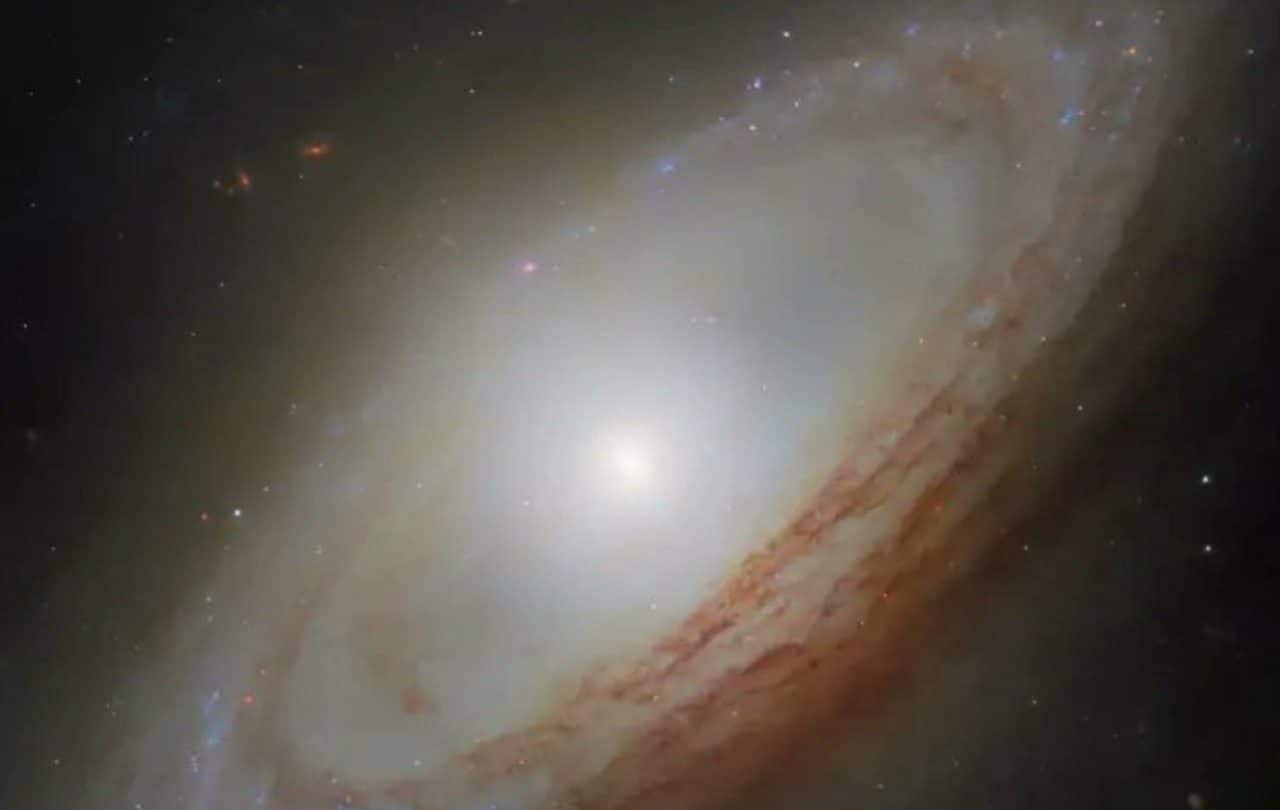
The Hubble Space Telescope captured new imagery of spiral galaxy NGC 4698 showing a stellar core that rotates in reverse relative to its outer disc. Observations confirm that the central stars move in direct opposition to the surrounding spiral structure.
This celestial structure sits approximately 55 million light-years from Earth within the constellation Virgo. Gravitational forces hold hundreds of member galaxies together across this dense region known as the Virgo Cluster. Space agencies continue monitoring the system.
Perpendicular stellar bulge sets NGC 4698 apart from normal spirals
Standard spiral systems typically share a uniform rotational pattern throughout their disks. In most cataloged formations, interstellar dust, clouds of gas, and vast stellar populations revolve along predictable paths toward the outer boundaries.
NGC 4698 breaks this structural uniformity with an unusual central architecture. Its inner stellar bulge forms an elongated shape aligned perpendicular to the primary disk plane. This perpendicular orientation remains rare among documented spirals.
Spectroscopic measurements show that gas reservoirs and star groupings near the nucleus operate entirely decoupled from the outer disk. The components drift along contrasting orbital axes.
Supermassive black hole consumes surrounding matter in the core
A supermassive black hole anchors the precise center of NGC 4698. This dense gravitational anchor possesses a total mass calculated at millions of times that of the Sun. Core material continues to swirl.
NASA records show that this supermassive singularity draws in massive clouds of gas through intense gravitational pull, steadily swelling the physical dimensions of the nuclear structure as fresh matter accretes along the inner boundary. Gravity drives this continuous growth.
Past galactic merger explains opposing rotational directions
Researchers attribute this retrograde rotation to past absorption of exterior cosmic material. NGC 4698 swept up stray gas clouds from surrounding space during an ancient gravitational encounter that transformed the core mechanics. That influx reorganized internal motion.
Captured matter settled into an independent secondary disk of stars and gas immediately surrounding the central void. This newer formation organized itself at an angle detached from the original galactic framework.
Astronomers identified an extended tail of neutral hydrogen gas trailing from one outer edge of NGC 4698. This lingering gaseous remnant confirms that a smaller companion galaxy collided with the primary structure. The collision altered local kinematics permanently.
Virgo Cluster survey investigates environmental effects on galaxies
The image forms part of an expansive astronomical survey focused on member systems inside the Virgo Cluster. Scientists continue compiling high-resolution data on dozens of galaxies inhabiting this crowded sector of deep space.
Researchers use the survey data to locate active star-forming nurseries and regions of high gas density across the cluster. The project evaluates how high-density environments alter the morphology of nearby galaxies over cosmic timeframes. Multiple targets remain under active review.
Detailed observations of NGC 4698 demonstrate how the influx of foreign matter alters the mechanical structure of massive disk galaxies. These measurements help astronomers reconstruct the historical sequence of galactic collisions in Virgo.





