Motorola plans Razr Flex foldable to challenge wide rivals

Motorola is developing the Razr Flex, a wide passport-style folding smartphone with unusually compact dimensions, according to engineering documentation leaked on Monday (28). The internal project, engineered under the codename Parker, introduces a shorter and broader form factor to the brand lineup, departing from the elongated profile seen on traditional book-style folding devices.
The leak details a pocketable mobile build configured with dual high-resolution displays, flagship-tier silicone, and dual-cell power architecture. Motorola previously hinted at an unconventional folding silhouette on Wednesday, September 9, 2026, when company promotional posts teased hardware profiles while competing brands presented alternative hardware, stating: “That feeling when you hang up, and your razr says everything you didn’t. Some are just discovering it. We’ve been making it even better. Just wait for our next move. #Razr”.
Motorola Razr Flex hardware and display dimensions
The upcoming handset relies on an exterior 4.97-inch OLED panel operating at a native resolution of 1736 x 1140 pixels, providing full device operation without unfolding. When opened, the Motorola Razr Flex displays an interior 6.92-inch folding OLED screen with 2364 x 1728 pixels and an adaptive refresh rate reaching 165 Hz, which regulates frame rendering during continuous interface interaction.
The physical footprint of the Parker project prioritizes a lower and wider frame than conventional folding devices. Unfolded, the chassis measures 110 millimeters in height, 149 millimeters in width, and 5.8 millimeters in thickness. Once closed along its central mechanical hinge, the phone measures 110 x 76 x 12.6 millimeters and records a total weight of 215 grams on hardware scales, balancing internal thermal components and glass panels.
Learn more: Apple faces Samsung backlash over $1,999 iPhone Duo launch
Snapdragon 8 Gen 5 processing core and dual 50 MP cameras
Internal processing relies on Qualcomm’s octa-core Snapdragon 8 Gen 5 system-on-chip, engineered with prime core speeds reaching up to 3.8 GHz to sustain high computational loads. The processor pairs with 12 GB of RAM and 256 GB of non-expandable onboard flash storage, with no integrated microSD slot. The software layer runs Android 17 straight out of the box, incorporating standard platform multitasking capabilities customized for wide-aspect dual panels.
See also: Apple equips foldable iPhone Duo with new iOS tools in October
Imaging duties are handled by two external rear sensors mounted inside a horizontal camera bar located along the chassis casing. Both rear cameras deliver 50 MP resolution, dividing tasks between a stabilized primary focal lens and a dedicated secondary ultrawide lens. Self-portraits and real-time video conferencing use two individual 32 MP front-facing camera sensors embedded into designated screen cutouts across both exterior and interior displays.
Battery specifications and charging infrastructure
Energy delivery centers on a 5,000 mAh battery distributed across two interconnected physical cells to distribute weight across both folding halves. The charging system supports the wireless Qi2 magnetic standard with transfers rated at up to 25 W, alongside wired delivery regulated via USB Power Delivery protocols. The exterior housing also carries dual certified IP48 and IP49 ingress ratings, certifying measured resistance against solid particulate intrusion and pressurized water exposure.
Exterior styling includes textured aesthetic finishes developed in direct collaboration with color system firm Pantone. Leaked factory documentation lists two launch hues: Coriander, configured as a soft light beige tone, and Dark Botanical Garden, applied as a deep green coat across the rear shell.
Motorola Razr Flex technical specifications
- Displays: 4.97-inch outer OLED panel at 1736 x 1140 pixels; 6.92-inch folding inner OLED panel at 2364 x 1728 pixels with 165 Hz refresh rate
- Dimensions and weight: 110 x 149 x 5.8 mm unfolded; 110 x 76 x 12.6 mm folded; total weight of 215 grams
- Processor and memory: Qualcomm Snapdragon 8 Gen 5 clocked at up to 3.8 GHz, 12 GB of RAM, 256 GB internal storage
- Power and protection: 5,000 mAh dual-cell battery, 25 W Qi2 wireless charging, USB-PD support, IP48 and IP49 certified ingress protection
- Cameras: dual 50 MP rear cameras (primary and ultrawide), dual 32 MP front cameras
- System and finishes: Android 17, Pantone Coriander and Pantone Dark Botanical Garden colorways
Market comparison across passport-style foldables
Motorola entered the full-size folding category in April 2026 with the debut of the Razr Fold, an elongated book-style device. The emergence of the Razr Flex establishes a parallel product line aimed at users seeking a reduced vertical footprint without surrendering expanded interior workspace. While both share functional design principles, the newer passport form alters daily handling ergonomics.
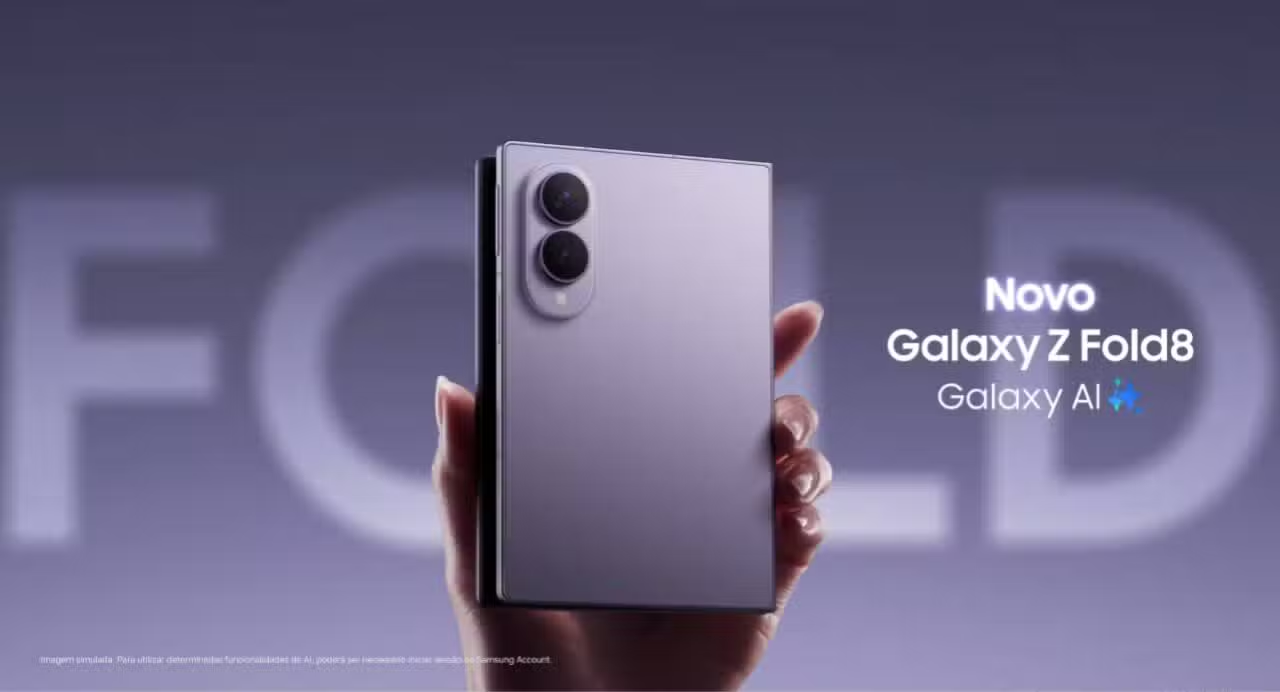
Against contemporary market rivals, the 215-gram Motorola device lands in an intermediate weight class. Samsung’s Galaxy Z Fold 8 registers a lighter build at 201 grams while housing larger screens, including a 5.5-inch cover screen and a 7.6-inch folding interior panel. In contrast, Apple’s competing iPhone Duo registers a heavier total weight of 254 grams while maintaining comparable screen real estate, positioning the compact Razr Flex as one of the densest and shortest foldables in the class.
Pending details and expected announcement window
Official retail pricing for the upcoming smartphone has not been disclosed, and the manufacturer has not confirmed the maximum wattage ceiling for wired fast charging. It remains unconfirmed whether storage capacities beyond the discovered 256 GB baseline configuration will be manufactured for international retail networks. Internal project documentation notes that the label Razr Flex serves as a development working title and could be adjusted prior to consumer distribution.
The company is targeting an official public introduction around Tuesday, December 15, 2026, marking mid-December as the formal product rollout window.