
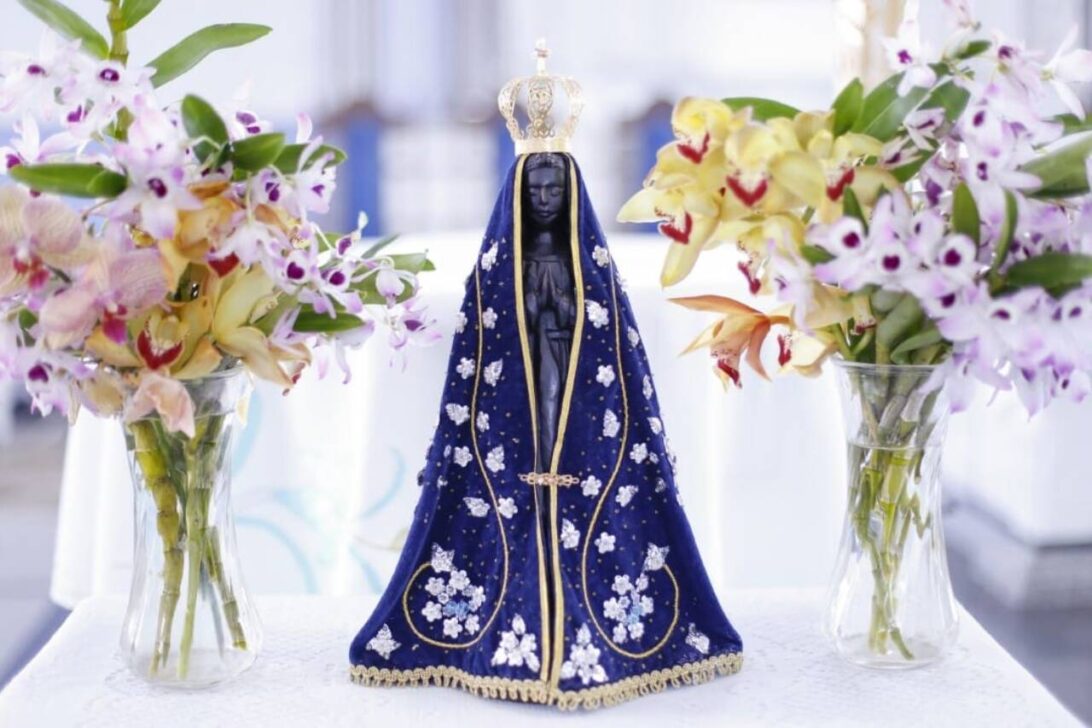
Devotion to Nossa Senhora da Conceição Aparecida continues to mobilize roughly 12 million pilgrims every year at the Santuário Nacional in the municipality of Aparecida, located in the Vale do Paraíba region of São Paulo state. The religious tradition stands as the largest collective Catholic manifestation in South America, drawing continuous pilgrimages from every corner of the country. Historical records, canonical decisions, and federal statutes continue to define the official status of the patroness in public life.
Official records clarify the standing of the patroness following online misinterpretations that sought to connect past political discussions with unfounded claims of changes to the national holiday. The legal standing of Nossa Senhora Aparecida relies on two definitive historical milestones: the pontifical decree signed by Pope Pius XI on July 16, 1930, and Federal Law 6,802, enacted on June 30, 1980, by President João Figueiredo. That federal legislation firmly designated October 12 as an official national holiday for public and institutional religious observance across Brazilian territory.
River recovery by local fishermen established the Marian devotion in 1717
The original terracotta sculpture of Nossa Senhora da Conceição Aparecida was pulled from the waters of the Paraíba do Sul River in October 1717. The recovery took place at the site designated as Porto Itaguaçu, which belonged at the time to the colonial village of Santo Antônio de Guaratinguetá. Three local fishermen—Domingos Garcia, João Alves, and Filipe Pedroso—were the individuals who recovered the broken image from their nets.
The fishing crew had faced intense pressure from colonial authorities to secure fish for a lavish welcoming banquet arranged for Dom Pedro de Almeida e Portugal, the Count of Assumar and governor of the Captaincy of São Paulo and Minas de Ouro, who was travelling toward Vila Rica. After numerous unsuccessful casts into the river, the net cast by João Alves retrieved the headless body of the sculpture, followed moments later by the retrieval of the head further downstream. Once the two sections were drawn into the boat, subsequent net casts brought forth an overwhelming volume of fish that nearly sank the vessels.
The earliest surviving ecclesiastical documentation of the event is cataloged in the First Book of Records of the Parish of Santo Antônio de Guaratinguetá, recorded in 1757 by parish priest João de Morais e Aguiar. The priest noted in the official ledger that João Alves threw his dragnet into the waters and drew out the body of the Lady without the head, and casting the net a second time slightly lower downstream, drew out the head of the same Lady. Following the assembly of both pieces, the fishermen secured full cargo loads that fulfilled their requisition.

The two severed clay fragments were first joined together with beeswax by Silvana da Rocha Alves, a relative of the fishermen who lived nearby. The repaired sculpture remained kept for years inside the private home of Filipe Pedroso, where it served as a domestic altar that drew neighbors together for regular evening rosary prayers. Over the ensuing decades, word of answered prayers spread throughout neighboring settlements, gradually establishing regular devotional visits to the residence.
Physical specifications and colonial origins of the terracotta sculpture
The historic figure of Nossa Senhora Aparecida exhibits specific material characteristics that art conservators and sacred art specialists have detailed over decades of examination. The physical attributes documented in institutional evaluations highlight the colonial manufacturing of the piece:
- Material composition: sculptured fired clay modeled in late colonial Brazilian baroque style
- Height: 36 centimeters in the original clay body and roughly 40 centimeters when including the nineteenth-century supportive base
- Total weight: approximately 2.5 kilograms
- Permanent location: the specialized security niche within the Santuário Nacional de Aparecida
Technical studies confirm that the sculpture originally featured light-toned polychrome painting with colorful pigments across its drapery. The dark, near-black coloration that distinguishes the image developed through two separate physical factors: months or years of submersion in the organic silt and mud along the bed of the Paraíba do Sul River, followed by continuous, decades-long exposure to soot generated by beeswax candles and olive oil lamps burned inside narrow colonial chapels.
No primary signature or official workshop documentation survives to confirm the direct authorship of the sculpture. Sacred art historians widely attribute the piece to the seventeenth-century Benedictine monk Frei Agostinho de Jesus, basing the attribution on structural and stylistic similarities found in contemporary clay representations of the Immaculate Conception, though definitive historical records confirming the sculptor remain absent.
See also: Swift telescope faces reentry after LINK rescue craft disintegrates in orbit

Ecclesiastical decisions and legislative acts built the national devotion
The institutional standing of the patroness expanded through an established progression of architectural developments, papal decrees, and state laws over more than two and a half centuries. Key milestones mark the trajectory of the devotion:
- October 1717: Domingos Garcia, João Alves, and Filipe Pedroso retrieve the fragmented clay sculpture from the Paraíba do Sul River and record an extraordinary haul of fish
- July 26, 1745: Father José Alves Vilela blesses and opens the initial public chapel built for Nossa Senhora Aparecida atop the Morro dos Coqueiros hill
- June 24, 1888: Church officials inaugurate a large brick-and-mortar temple, later designated historically as the Basílica Velha
- July 16, 1930: Pope Pius XI signs the pontifical decree declaring Nossa Senhora Aparecida as the principal patroness of Brazil following a formal petition from Brazilian bishops
- May 31, 1931: Cardinal Sebastião Leme presides over a gathering of approximately one million devotees at the Esplanada do Castelo in Rio de Janeiro for the solemn national proclamation
- May 16, 1978: The historic terracotta sculpture is removed from its niche in the Basílica Velha during an attack and fractures into hundreds of pieces
- June 30, 1980: President João Figueiredo signs Federal Law 6,802, establishing the official national holiday observed every October 12
- July 4, 1980: Pope John Paul II consecrates the main altar of the Basílica Nova during his inaugural pastoral tour of Brazil
Vandalism incident in 1978 required extensive museum restoration
During evening services on May 16, 1978, the historic clay figure was targeted in an act of vandalism inside the sanctuary of the Basílica Velha. A young man shattered the protective glass enclosure of the niche, snatched the sculpture, and fled toward the nave before dropping the figure on the hard floor when confronted. The structural impact broke the hollow terracotta artifact into approximately 200 distinct fragments.
Church authorities gathered the dispersed fragments in secret and arranged for their immediate transfer to São Paulo for emergency preservation. The complex task of reconstructing the shattered artwork was assigned to artist and conservator Maria Helena Chartuni, who led the restoration department at the Museu de Arte de São Paulo. Working within the museum laboratories, Chartuni meticulously pieced the clay puzzle back together.
The conservation undertaking required 33 consecutive days of precise structural bonding and reintegration inside the museum. On August 19, 1978, the fully assembled sculpture was transported back to the municipality of Aparecida atop an open fire engine, accompanied by dense lines of devotees lining the Presidente Dutra Highway before being reinstalled in its secure custody niche.
Oral accounts and regional miracles documented in local traditions
The steady rise of regional pilgrimages throughout the eighteenth and nineteenth centuries drew momentum from traditional oral accounts of miraculous events connected to prayers before the image. Aside from the sudden catch of fish by the trio of Guaratinguetá fishermen in 1717, four specific occurrences became central to local historical lore.
The account of the candles describes an evening gathering in the home of Silvana da Rocha, where two flames illuminating the small domestic altar suddenly flickered out in an unexpected draft, only to reignite spontaneously without human assistance before the assembled family. The narrative of Zacarias recounts an enslaved man fleeing custody who was permitted to kneel and pray before the chapel altar, whereupon the heavy iron chains fastening his wrists cracked open and fell to the stone floor.
Check out: State Department October 2026 Visa Bulletin reopens India lines and cuts worldwide dates
A third traditional account records the story of a horseman from Cuiabá who attempted to ride his horse through the front doors of the sanctuary to display his contempt for the pilgrims; the animal stopped abruptly at the threshold, its hooves wedged into the stone steps until the rider relented. A fourth account records the sudden healing of a visually impaired girl traveling from Jaboticabal, whose vision returned as her family reached the crest of the hill and first saw the towers of the sanctuary on the horizon.
Santuário Nacional infrastructure coordinates massive yearly pilgrim traffic
The architectural complex erected to host pilgrims stands as the largest Catholic pilgrimage destination in Latin America. The Santuário Nacional de Aparecida is recognized as the largest cathedral structure globally and ranks as the second largest Catholic church building in covered interior area, trailing only St. Peter’s Basilica in Vatican City.
The central nave of the Basílica Nova provides covered space for up to 45,000 worshippers during liturgical celebrations. Across all twelve months of the year, administrative teams and support personnel manage the logistical needs of approximately 12 million visitors traveling by bus caravans, private vehicles, and long-distance walking routes across the federal highway network.
The sanctuary maintains continuous year-round hospitality infrastructure, providing daily religious services across multiple shifts. On the official October 12 national holiday, when federal legislation mandates a paid day off across public and private sectors, municipal authorities, state highway patrol officers, and sanctuary administrators deploy coordinated traffic management, medical response posts, and specialized security teams to oversee the immense influx of travelers.
Statutory foundation of October 12 and archived legislative proposals
The legal recognition of Nossa Senhora Aparecida rests upon both historical canonical proclamations and civil legislation enacted by the federal government. The civil mandate took effect on June 30, 1980, when President João Figueiredo signed Federal Law 6,802 into law. The statutory text establishes the holiday directly in its initial article:
“October 12 is declared a national holiday for public and official worship of Nossa Senhora Aparecida, Patroness of Brazil.” This statutory mandate remains fully active in the federal legal register, having never been repealed, suspended, or modified by the National Congress.
Public inquiries regarding the holiday in September 2026 stemmed from recirculated claims citing an outdated, defunct legislative proposal. That proposal, Bill 2,623 of 2007, was introduced by then-deputy Victório Galli and sought to reassign the commemorative focus of the October date. Committee members across the Chamber of Deputies rejected the bill unanimously, resulting in its permanent archiving in August 2008 without any legal impact on the national calendar. Federal Law 6,802 continues to govern the annual observance of the national holiday across all Brazilian states.