
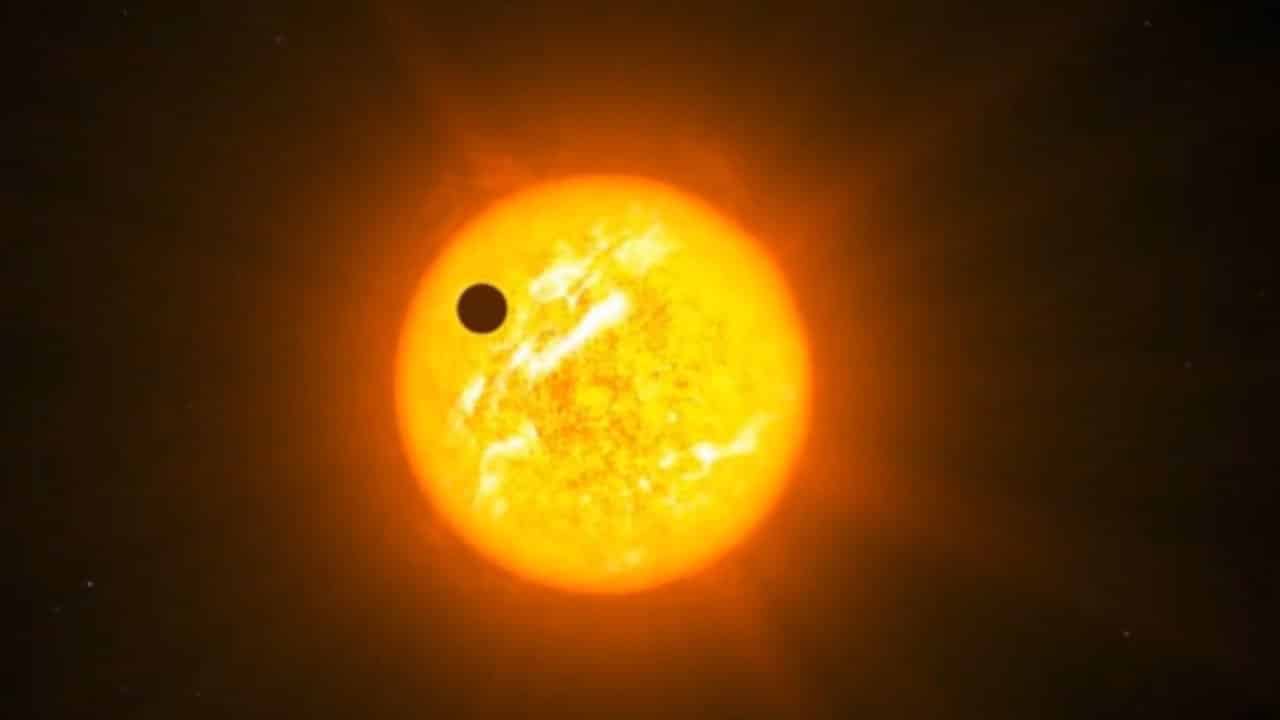
An international team of astrophysicists confirmed that the exoplanet GJ 3090 b travels around its parent star in the opposite direction of the stellar rotation, defying standard orbital patterns seen across the cosmos. Observational measurements established a three-dimensional orbital inclination of roughly 136 degrees. This measurement designates the celestial body as the first documented retrograde exoplanet orbiting an M-dwarf star in the history of observational astronomy.
The investigation was spearheaded by researchers from the University of Geneva and submitted to the journal Astronomy & Astrophysics Letters on September 21, 2026. Classified as a sub-Neptune, the planet possesses a physical radius between 2.18 and 2.2 times that of Earth alongside an estimated mass between 4.5 and 4.52 terrestrial masses. Located approximately 73 light-years from our Solar System within the southern constellation Phoenix, the world executes a full lap around its small stellar host once every 2.9 days.
Infrared spectrograph at La Silla tracks stellar velocity shifts
Astronomers reconstructed the unusual flight path of GJ 3090 b using high-precision data collected by the Near-InfraRed Planet Searcher, known as NIRPS. The specialized instrument operates on the European Southern Observatory 3.6-meter telescope situated at the La Silla Observatory in the Atacama Desert of Chile. Initial detection of the planetary companion dates back to January 1, 2022, when the Transiting Exoplanet Survey Satellite managed by NASA recorded repetitive dimming in the brightness of the star during orbital crossings.
Pinpointing the precise geometry required scientists to analyze subtle anomalies in the star’s radial velocity caused by the Rossiter-McLaughlin effect. This spectroscopic phenomenon occurs whenever a traversing planet successively occults portions of the rotating stellar surface that are either moving toward or away from the observer. The infrared capabilities of the Chilean instrument proved essential for tracking these minute signals, as red dwarf stars emit lower levels of visible light and maintain significantly cooler surface temperatures than yellow dwarfs like the Sun.
“To our great surprise, not only is the planet GJ 3090 b on a highly misaligned orbit, but it also orbits retrogradely, in the opposite direction to the rotation of its star,” said Yann Carteret, lead author of the study and doctoral researcher in the Department of Astronomy at the University of Geneva.
Léna Parc, a doctoral researcher at the University of Geneva and co-author of the scientific paper, highlighted the technical precision required for the discovery. “It was the performance of NIRPS in the infrared that made it possible to achieve the precision needed to measure the angle between the planet’s orbital plane and the star’s equatorial plane for such a small planet,” stated Léna Parc.
See also: MeerKAT telescope detects direct radio signals from Beta Pictoris b
Absence of massive planetary companions forces new physical models
Standard astrophysical models dictate that star systems emerge from the gravitational collapse of a single primordial cloud composed of interstellar gas and dust. As conservation of angular momentum flattens the surrounding material into a circumstellar accretion disk, newly formed worlds typically inherit the rotation direction of their host star. In the Solar System, all eight major planets circulate in the same direction that the Sun spins, showing modest deviations such as Earth’s orbital tilt of approximately 7 degrees relative to the solar equator.
Previous discoveries of inverted or misaligned orbits have routinely pointed to violent gravitational disturbances triggered by heavy external perturbers, such as massive gas giants or companion stars. In the case of GJ 3090 b, extensive observation campaigns revealed no massive outer bodies capable of exerting the gravitational torque necessary to tip the sub-Neptune upside down.
Scientific literature records only five other multi-planet systems containing worlds with orbital misalignments exceeding 70 degrees. GJ 3090 b stands out uniquely among this rare group because it lacks any detectable gravitational culprit in its immediate cosmic neighborhood.
Faced with an isolated system devoid of massive outer companions, the research group led by Yann Carteret collaborated with astronomer Andrew Winter from Queen Mary University of London to explore alternative mechanisms. The team proposed that the red dwarf may have captured a secondary accretion disk from the surrounding interstellar medium long after its birth. Because this late gas stream entered with a distinct angular momentum, the inner planet condensed directly from material that was already moving in reverse.
“The idea that a planetary system could be rebuilt from a second, differently oriented disk is particularly exciting,” said Vincent Bourrier, assistant professor of astronomy at the University of Geneva and co-author of the study. “It suggests that the environment around a young star can play a much bigger role in defining the architecture of its planets than we might have expected”.
Check out: Deep space planet Elias 2-24 b sets record under 1 million years
Longitudinal radial velocity tracking defines the next research phase
Despite the mathematical viability of the late-disk accretion hypothesis, astronomers caution that empirical verification of the historical trigger remains open to ongoing investigation. While computer simulations favor the capture of an external gas envelope over internal orbital scattering, confirmation requires finding similar developmental markers in younger stellar nurseries.
Future observational campaigns will center on rigorous radial velocity monitoring of the host dwarf to exclude the existence of elusive, long-period companions. In parallel, upcoming spectroscopic runs will probe the chemical composition and atmospheric retention of GJ 3090 b to clarify how its inverted migration impacted its internal structure.
- Radius measured between 2.18 and 2.2 times Earth’s radius
- Calculated planetary mass between 4.5 and 4.52 Earth masses
- Orbital period of 2.9 days around an M-type red dwarf
- Measured three-dimensional orbital tilt reaching 136 degrees
- Location positioned roughly 73 light-years away in Phoenix constellation
Astronomers plan to coordinate high-resolution infrared spectrographs across both hemispheres to track related dwarf stars. Those measurements will establish whether retrograde orbits represent an exceptional anomaly or a regular outcome of stellar disk evolution.