Webb telescope detects ammonia on cold giant planet HATS-6 b

Exoplanet HATS-6 b contains ammonia, water vapor, and methane in an atmosphere measuring more than three times colder than theoretical models predicted, according to spectroscopic data collected by the James Webb Space Telescope. The gas giant maintains an upper atmospheric temperature of roughly 120 °C (514 Kelvin), sharply conflicting with the expected thermal baseline of 425 °C (713 Kelvin) calculated for its proximity to an active host star.
Conducted by an international research team led by the University of Maryland, the analysis marks only the second time that ammonia has ever been identified in the atmosphere of an exoplanet through transmission spectroscopy. “These smaller stars don’t have enough material or enough time to create planets as big as Jupiter and as big as Saturn. So, the fact that HATS-6 b can exist is really interesting because it shouldn’t be possible with what we know,” said Giannina Guzmán Caloca, lead author of the study and doctoral candidate in astronomy at the University of Maryland.
Chemical fingerprints detected across the atmosphere of HATS-6 b
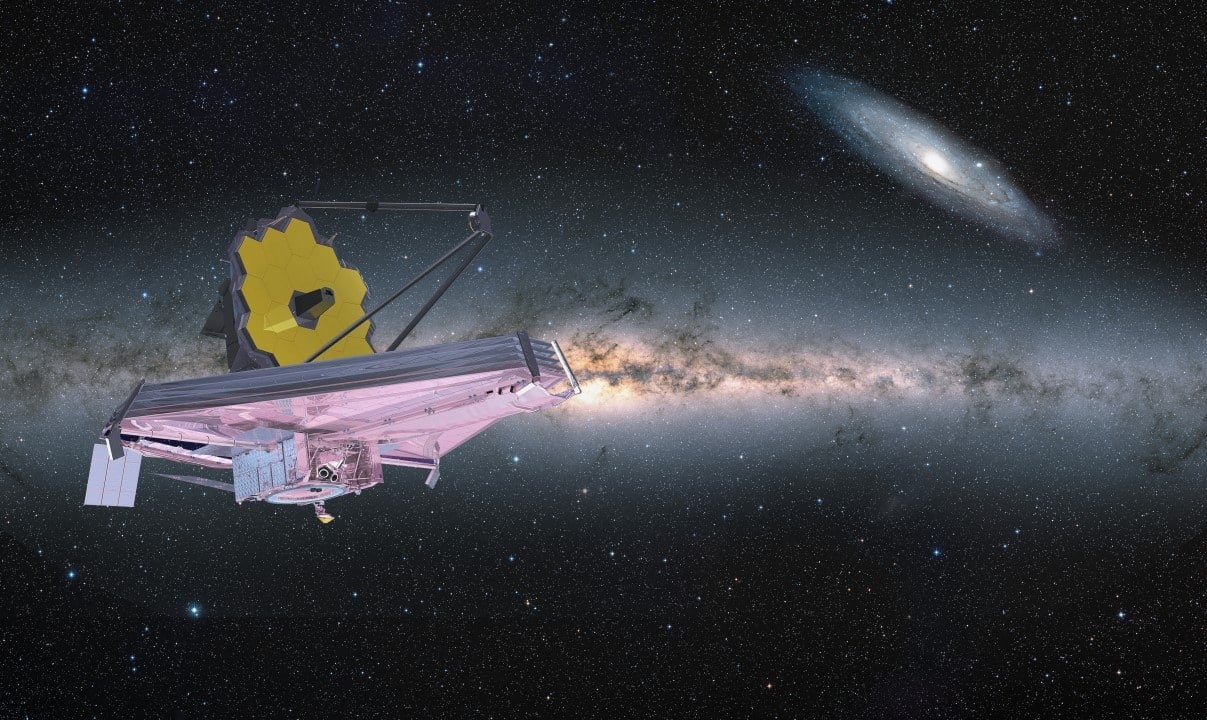
Researchers acquired the atmospheric measurements using the Near-Infrared Spectrograph (NIRSpec) on the James Webb Space Telescope, monitoring the system as the planet crossed directly between its host star and the observatory. When starlight filtered through the planetary atmosphere during these transits, different gases absorbed specific wavelengths, generating distinct spectral absorption lines that revealed the presence of water vapor, methane, and ammonia, alongside weaker, preliminary traces of carbon dioxide.
The clear detection of ammonia provides researchers with a rare window into nitrogen chemistry beyond our solar system, an element that typically eludes detection in intensely irradiated giant exoplanets where high temperatures break nitrogen compounds apart. “Carbon, hydrogen and oxygen are all things that have been previously found in atmospheres of giant planets outside our solar system, but ammonia is something almost never detected before. It’s an entirely new molecule to think about,” Guzmán Caloca stated.
Why is the temperature on HATS-6 b lower than expected?
Standard astrophysical models assume that close-in gas giants absorb incoming stellar radiation and redistribute that heat evenly across their atmospheric layers, which led theorists to calculate an equilibrium temperature of 425 °C for HATS-6 b. The retrieved temperature of 120 °C recorded by the space observatory exposed an extreme thermal deficit, indicating that fundamental physical mechanisms are preventing stellar energy from warming the deeper gas layers.
The primary scientific hypothesis proposed by the study team attributes this low temperature to dense, highly reflective cloud decks and photochemical hazes that encircle the entire planet. These aerosol layers possess a high albedo that deflects incoming starlight back into the void before it can penetrate and heat the atmosphere. “If the planet is genuinely that cool, it means that something is probably reflecting a great deal of starlight back into space before it can warm anything. The likeliest explanation is cloud and haze wrapping the planet the way they wrap Venus,” Guzmán Caloca explained.
Physical metrics and orbital measurements of exoplanet HATS-6 b
The physical composition of HATS-6 b presents a structural contradiction, exhibiting the expansive volume and radius of Jupiter while retaining a total gravitational mass comparable only to Saturn. This disparity classifies the world as an inflated, low-density gas giant orbiting deep within the gravitational well of an M-dwarf star.
- Distance from Earth: approximately 500 light-years
- Orbital period: 3.3 terrestrial days to complete a full revolution
- Planetary mass: 0.33 Jupiter masses (one-third of Jupiter, matching Saturn)
- Measured atmospheric temperature: 120 °C (514 Kelvin)
- Theoretical equilibrium temperature: 425 °C (713 Kelvin)
Research program GEMS examines gas giants around low-mass stars
Under traditional core accretion models of planetary formation, small M-dwarf stars possess protoplanetary disks with limited dust and gas reserves that dissipate too rapidly to assemble gas giants before the material blows away into space. Despite those theoretical constraints, astronomers have confirmed roughly 40 giant planets orbiting M dwarfs, out of more than 6,000 confirmed exoplanets discovered across the Milky Way.
The new observations are part of the Giant Exoplanets around M-dwarf Stars (GEMS) initiative, a Cycle 2 research project using the James Webb Space Telescope to examine seven gas giants orbiting cool dwarf stars in order to test alternative assembly processes. “Every one of these planets is a challenge to formation theory. By measuring what their atmospheres are made of, we can start to ask whether they were built the same way as the hot Jupiters around sun-like stars or whether something different is going on,” Guzmán Caloca noted.
Scientific timeline for the discovery and peer review of HATS-6 b
The formal release and verification of the James Webb Space Telescope observations followed a structured review process:
- August 17, 2026: scientific preprint deposited by the research group in the arXiv repository
- September 8, 2026: formal publication of the peer-reviewed study in The Astronomical Journal
- September 24, 2026: institutional briefing published by the University of Maryland
Definitive confirmation of the specific chemical compounds that form the high-altitude cloud decks and reflective hazes on HATS-6 b remains unverified. Researchers are also waiting for follow-up observations at longer infrared wavelengths to confirm preliminary spectral absorption signatures detected near 3 micrometers, which may point to the presence of photochemical hydrocarbons or hydrogen cyanide.