Beta Pictoris b auroral radio bursts reveal 1,250-gauss magnetic field
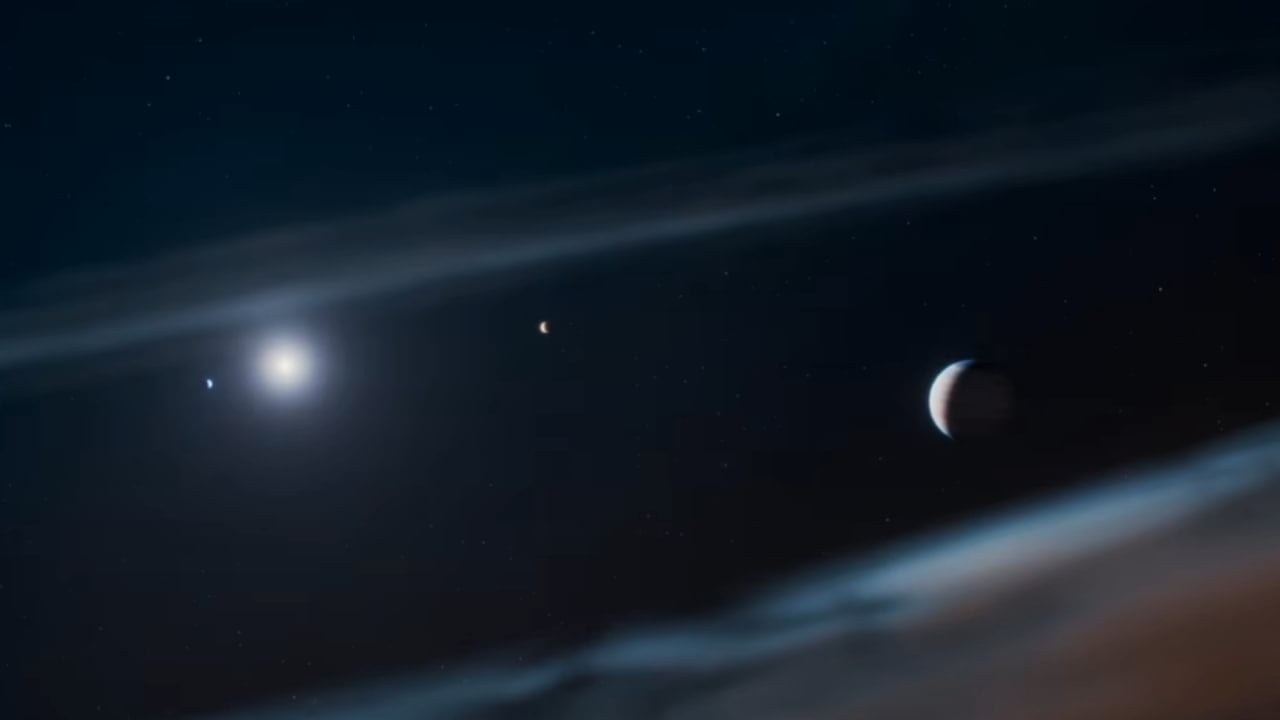
Astronomers at Harvard University have registered direct radio wave emissions originating from an extrasolar world for the first time. The repeating transmissions emanated from Beta Pictoris b, a gas giant located approximately 63 light-years from Earth in the southern sky. Detailed spectral readings confirmed the exoplanet generates a colossal magnetic field at least 200 times stronger than the magnetic envelope surrounding Jupiter.
The detected radiation does not indicate alien technology or any form of extraterrestrial biological activity. Instead, the recurring signals stem from powerful auroral mechanisms driven by high-velocity charged particles crashing into the planetary magnetosphere. This energetic interaction mirrors the physical processes behind Earth’s northern lights and the intense polar storm belts monitored across Jupiter.
Kevin N. Ortiz Ceballos, lead author of the study and doctoral researcher at the Center for Astrophysics | Harvard & Smithsonian in Cambridge, Massachusetts, identified the planetary pulses during routine observation processing. The investigation was co-authored by Edo Berger, professor of astronomy at Harvard University, alongside Yvette Cendes, an astrophysicist at the University of Oregon. Both researchers worked with Ortiz Ceballos to verify the celestial origin of the burst events.
The scientific team established that the recorded radio emissions did not stem from stellar activity produced by the host star. Utilizing background reference quasars mapped by the Gaia space observatory, the researchers pinpointed the planet’s exact spatial offset from its primary star with a statistical significance of 4.4 standard deviations. This calculation confirmed the signal emerges via the electron cyclotron maser instability, a physical mechanism where electrons spiraling along intense magnetic field lines release concentrated electromagnetic radiation.
Physical characteristics and detection parameters of the exoplanet
The observational dataset collected across multiple campaigns outlines the fundamental planetary and instrumentation properties recorded during the study:
- Planetary location: Pictor constellation, roughly 63 light-years from the Solar System
- Calculated planetary mass: approximately 12 times the mass of Jupiter
- Minimum magnetic field strength: 1.25 kilogauss, corresponding to 1,250 gauss
- Burst frequency coverage: between 0.85 and 3.5 gigahertz
- Receiving facility: South Africa’s MeerKAT radio telescope array, operating with 64 parabolic dishes

Planetary magnetic envelopes serve as natural defense shields that divert destructive stellar radiation away from orbital bodies. For terrestrial worlds like Earth, this unseen barrier preserves breathable atmospheric gases and deflects incoming streams of energetic solar plasma. Without this protective layer, unrelenting stellar winds would erode atmospheric molecules into deep space over cosmic timescales.
Edo Berger noted that the research group did not anticipate finding such extreme magnetic values around Beta Pictoris b. “I know radio signals are associated with searches for extraterrestrial intelligence. But this is something very different,” Berger stated. The Harvard professor added that the initial observation program was designed as an exploratory survey before the raw data exposed an unprecedented magnetic structure.
“In order to see radio waves that extend all the way to the frequencies that we observed, you need an incredibly strong magnetic field,” Berger said. According to the astronomer, the sheer magnitude of the readings surpasses baseline thresholds established by planetary dynamo models developed for celestial bodies within our own solar neighborhood.
“The magnetic field on this planet is at least 200 times stronger than the magnetic field of Jupiter,” Berger affirmed when summarizing the measurements. Recalling the day the initial graphs were finalized, the professor described how the discovery emerged inside the laboratory: “My graduate student, Kevin, was analyzing the data. He came into my office one day with the detection and he said, ‘I don’t think you’re going to believe this.'”
Stellar environment and previous planetary radio detection attempts
The stellar framework hosting Beta Pictoris b is considered newborn by galactic standards, possessing an estimated age of only 23 million years compared to the 4.5-billion-year history of the Solar System. The central star holds roughly 1.75 times the mass of the Sun and maintains a massive circumstellar disk of gas, debris, and at least thirty mapped cometary structures leftover from early accretion stages.
Learn more: Elias 2-24 b reveals giant planet birth at 450 light-years
Past astronomical initiatives conducted by other observational teams attempted to capture exoplanetary radio signatures, including surveys aimed at the red dwarf system YZ Ceti in 2023. However, ground stations during those observations were unable to disentangle planetary signals from turbulent flare events produced directly by the host star. The inability to isolate the true radiation origin left those earlier claims open to scientific debate.
The successful spatial decoupling between the star and Beta Pictoris b drew praise from independent astrophysicists following the project. Joseph Callingham, an associate professor at the Anton Pannekoek Institute for Astronomy at the University of Amsterdam, evaluated the team’s methodology. “What makes this study unique is that they localize the emission to the planet itself, separately from the star,” Callingham remarked regarding the astrometric precision.
Jonathan Nichols, a professor specializing in planetary auroras at the University of Leicester, emphasized the significance of radio frequencies for modern astrophysics. “Auroral radio emissions are important because they allow us to understand how an object interacts with its local space environment,” Nichols explained. He noted that this radio methodology provides access to planetary properties that optical instruments cannot detect.
Timeline of major milestones in the Beta Pictoris planetary system
Key observational landmarks have reshaped scientific understanding of Beta Pictoris and its surrounding planetary bodies over recent decades:
- November 18, 2008 — Direct imaging instruments discover the massive gas giant Beta Pictoris b
- 2019 — Astronomers identify a second planet within the circumstellar disk, designated Beta Pictoris c
- September 15, 2026 — Harvard researchers deposit the preprint manuscript documenting the radio signals on arXiv under code 2609.16720
- October 2, 2026 — International astronomical bodies publicize comprehensive analyses evaluating the planet’s auroral emissions
Peer review process and upcoming MeerKAT observation campaigns
Researchers and readers tracking the discovery can inspect the underlying data sets published in open-access academic archives. The full manuscript presents data gathered across four distinct MeerKAT observing sessions conducted between 2025 and 2026, outlining polarization angles and frequency behaviors associated with the circular waves.
Formal scientific verification remains tied to the standard peer review workflow, during which independent referees evaluate the mathematical models and instrument calibrations. This technical evaluation process is expected to continue through academic journals over the coming months.
The research team has already submitted formal requests for additional observing time on the MeerKAT radio array to scan neighboring frequencies. These scheduled follow-up campaigns aim to clarify the internal convective dynamo that allows Beta Pictoris b to sustain such intense magnetic fields without losing energy.