
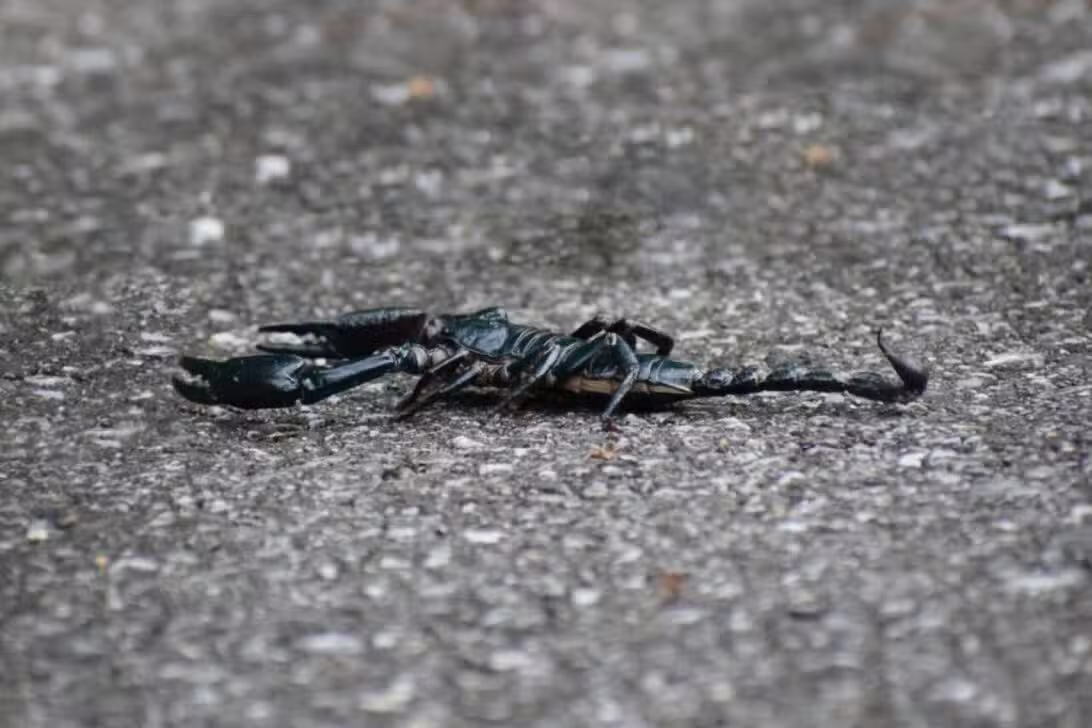
Domestic garden vegetation holds no biological capability to deter scorpions, and species with thick foliage directly facilitate the survival and reproduction of these venomous arachnids in residential areas. Scientific warnings issued by research biologists directly contradict entrenched folk traditions regarding botanical deterrent barriers, demonstrating that bromeliads, unpruned palm fronds, and dense climbing vines establish welcoming havens for dangerous pests right next to living quarters.
Urban infestations of these arachnids depend on four basic environmental criteria: access to physical shelter, ambient humidity, constant shade, and a steady supply of prey. When residential landscaping satisfies these conditions, flowerbeds and borders turn into functional nesting grounds and hunting perches for venomous species. Paulo Goldoni, a technologist working at Instituto Butantan, clarified that widespread assumptions attributing natural repellent qualities to specific plants are entirely unsupported by science.
“There is no scientific proof whatsoever,” stated Paulo Goldoni. The researcher emphasized that scorpions remain an intrinsic component of native woodland ecosystems across South America. “If that were true, these animals would avoid any vegetated environment. But they live normally in forested areas, alongside diverse types of plants,” the technologist explained.
Bromeliads and unpruned palm fronds create moist microclimates for pests
Tank bromeliads display physical configurations that routinely draw dangerous arachnids into suburban yards. These botanical varieties develop curved, cupped foliar rosettes that capture and retain significant volumes of rainwater as well as domestic irrigation runoff, generating a cool microclimate shielded from direct sunlight. This leaf architecture serves as a stable physical sanctuary and ambush platform where predators can capture insects drawn by moisture, while also offering immediate structural cover from larger predators.
Ornamental trees such as the Mexican fan palm, known scientifically as Washingtonia robusta, introduce distinct hazards across domestic landscapes whenever routine arboricultural upkeep is neglected. As the plant matures, its lower fronds desiccate and drape downward along the trunk, assembling an unbroken thatch layer known colloquially as a skirt. Research documented by Professor Timothy K. Broschat at the University of Florida demonstrates that this dense accumulation of dried foliage creates an insulated habitat capable of sheltering rodents, snakes, and scorpions.
Intertwined wall vines and tightly packed shrub clusters bordering exterior masonry structures function as elevated transit routes for pests. This thick mass of leaves prevents sunlight from reaching the ground, preserves soil dampness across seasonal dry spells, and shelters narrow cavities where common household prey like crickets and cockroaches thrive. By multiplying these insect colonies, unmanaged borders sustain the primary food source required by predatory arachnids.
“The greatest risk is serving as a hiding place. Vegetation can be used as shelter and even as a pathway for the animal to reach locations where it would not normally be,” warned Paulo Goldoni regarding the movement of arachnids into house interiors.
Submersion survival abilities and national sting records outline serious health risks
Scientific field investigations conducted across northern habitats documented that scorpions of the species Tityus neglectus routinely adopt the rosettes of Aechmea leptantha, a bromeliad native to the semi-arid Caatinga biome, as permanent retreats. Specimens exhibited the physiological capability to remain submerged underwater inside the plant’s central reservoir for nearly eight minutes to evade capture and exterior threats, highlighting an extensive evolutionary adaptation to botanical water storage.
The proliferation of unmonitored plant refuges in urban zones directly parallels wider health surveillance metrics. Official figures from the Ministry of Health epidemiological panel confirmed 225,695 registered scorpion accidents across the nation during 2025. This recorded volume represented 65 percent of all medical emergencies involving venomous fauna cataloged throughout the public healthcare network during that period.
Keep reading: Castor raivoso de grande porte morde garoto de 13 anos em Maryland, resultando em cirurgia e fechamento de parque aquático
The physiological harm inflicted by these envenomations led to 265 confirmed fatalities nationwide across 2025. Public health bulletins emphasized that over 20 percent of those fatal cases involved children under the age of 10, a demographic segment uniquely susceptible to rapid cardiovascular and neurological collapse when exposed to venom. Across metropolitan communities, the yellow scorpion, biologically classified as Tityus serrulatus, stands as the foremost cause of critical admissions due to its resilience inside storm drains and its capacity for parthenogenetic reproduction, which allows unfertilized females to generate viable offspring without male intervention.
Chronological surveillance alerts track rising domestic sting occurrences
- 2025 — Epidemiological monitoring by the Ministry of Health documents 225,695 clinical sting events and 265 envenomation fatalities across municipal medical networks.
- March 9, 2026 — Specialized botanical and entomological papers outline the scientific invalidity of planting so-called natural repellent barriers around suburban homes.
- October 1, 2026 — Research teams from Instituto Butantan issue updated suburban containment guidelines indicating that bromeliad water storage and dried foliage amplify residential infestation levels.
Yard maintenance strategies eliminate arachnid concealment spots and protect households
Active structural stewardship of outdoor residential plots achieves far greater preventive efficacy than simply swapping one decorative plant for another. Consistently clearing decaying garden debris and leaf mulch eradicates the primary shelter of domestic cockroaches, denying venomous arachnids their staple nutritional supply and driving them away from properties. Maximizing natural aeration and sunlight penetration dries out damp ground crevices, rendering the space uninhabitable for moisture-dependent nocturnal hunters.
Property owners who maintain bromeliad collections should position containers well away from patio doorways, ground-floor windows, exterior boundary structures, and daily walking paths. Rosettes demand periodic sanitization using targeted water jets while handlers wear heavy protective gloves with extended gauntlets to break up accumulating detritus and prevent long-term reservoir stagnation.
Large palm selections demand manual pruning of dead lower fronds throughout the initial development stages of the tree. As individual specimens reach full arboricultural maturity, their trunks enter a self-cleaning biological cycle that naturally sheds withered leaves, substantially reducing the necessity of human canopy intervention over older plantings.
Perimeter defenses around physical buildings must mirror the maintenance carried out across landscaped garden beds. Guidelines issued by Instituto Butantan urge residents to seal external drainage grates with wire screening, mount protective sweeps beneath exterior doors, and caulk foundational masonry fractures. Domestic indoor hygiene also requires that footwear and clothing never remain scattered on floor surfaces, while outdoor garden beds should be positioned with clear physical separation from structural walls to eliminate climbing avenues toward roof cavities.
If an accidental envenomation takes place, clinical guidance dictates washing the puncture zone immediately with mild soap and clean water before proceeding straight to a designated urgent care center. Patients must never bind the affected limb with a tourniquet, apply topical unguents, or cut the skin around the wound, as hospital medical staff must oversee symptomatic assessment and the timely administration of antivenom serum.